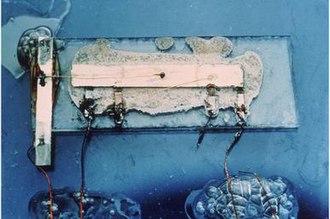
An integrated circuit (IC), or microchip, is a tiny electronic component that combines various circuits and components onto a single piece of semiconductor material, crucial for modern electronics.
Set reading age
View for Kids
Easy to read and understand
View for Students
Clear, detailed explanations
View for Scholars
Deep dives and big ideas
An integrated circuit, or IC for short, is a tiny chip that packs lots of electronic parts together! 🌟These chips can fit right on your finger! They are found in many devices like phones, computers, and even toys. ICs make these devices smaller, faster, and more efficient. The first integrated circuit was made in 1958. They are like magic wands that help electronics work while saving space! You might also hear ICs called microchips. They are super important for our modern technology and help us do amazing things every day! 🚀
Integrated circuits work by using tiny electronic parts like transistors, resistors, and capacitors. 🛠️ Transistors act like tiny switches, controlling electricity flow. When you turn on your device, electricity moves through these parts, allowing the chip to process information. 💡For example, when you press a button on your toy, an IC receives the signal and tells the toy what to do! This happens super fast—like lightning! ⚡All these little components are connected to each other in a precise way, helping everything work smoothly together.
There are different kinds of integrated circuits, and each has its special job! 😊The two main types are analog and digital ICs. Analog ICs deal with continuous signals, like sound and light. They help things like radios and TVs work. 🎶Digital ICs use 0s and 1s to process data, just like computers and smartphones! 📱There are also mixed-signal ICs that combine the two! Examples include microcontrollers that help devices think and operate. ICs can also be classified as linear, logic, and memory chips. Each type has a unique function!
The story of integrated circuits began in the late 1950s. 🕵️♂️ Robert Noyce and Jack Kilby are two scientists who played a big role in creating the first ICs! 🎉In 1958, Noyce invented a way to put many tiny circuits on one piece of silicon, a type of rock. Only a year earlier, Kilby made a simple IC that could do basic tasks. Since then, these chips have evolved, becoming smaller and more powerful! Today, they are made by many companies all around the world, helping change how we live! 🌍
Integrated circuits have many advantages! 🌟First, they save space by packing many components into a tiny chip, making devices smaller and lighter. This makes it easier to carry gadgets like phones! 📱Second, ICs use less energy than older technology, helping save electricity and making devices last longer! 🔋They also work faster, allowing you to make phone calls or play games quickly! 🎮Plus, they are easier to produce, which can lower costs. This means more people can enjoy new technology and inventions! Isn’t that awesome? 🚀
Integrated circuits are everywhere! 🌍You can find them in everyday items, such as calculators, microwaves, and video game consoles. 🎮They are in mobile phones, allowing you to call friends or play games. 📞In cars, ICs help control important functions like the engine and safety systems. 🚗They are also essential for medical devices like heart monitors. Overall, ICs make our lives easier and more fun in so many ways! From toys to space satellites, these chips help make the world go round! 🌈
Before integrated circuits, electronics used discrete components, like individual transistors and resistors. 📏Imagine building a Lego tower but using separate bricks instead of blocks! This made devices bulky and complicated. While discrete components are still important for certain jobs, ICs are preferred for most modern devices because they are compact and efficient. 💡For example, an old radio might have several parts, while an IC does the work of many in the same tiny space! ICs have mostly replaced discrete parts, helping technology advance to what we have today! 🌟
The future of integrated circuits is exciting! 🚀Scientists are working on making them even smaller and faster. One trend is using new materials like graphene, which is super thin and allows ICs to work even better! They are also exploring using ICs in wearable technology, like smartwatches and fitness trackers, to help us stay healthy. 🏃♂️ Another exciting idea is connecting ICs to artificial intelligence, helping machines learn and think! 🧠As technology continues to grow, we can expect amazing innovations to come from integrated circuits! 🌈
Designing integrated circuits isn’t easy! 😅Engineers face several challenges. One challenge is making sure all the tiny parts work together perfectly, which gets harder as they try to fit more components on smaller chips. 🔧Another issue is heat! When ICs work too hard, they can get hot, which can cause malfunctions. 🔥Engineers must find ways to keep them cool. Finally, making sure ICs are reliable and safe for people to use is crucial. It takes a lot of hard work, creativity, and problem-solving to create these chips! 🧠
Integrated circuits have changed our world in incredible ways! 🌍They allow us to use smartphones, computers, and an array of electronics we love. 🎉Without ICs, we wouldn’t have the internet, which connects people from all over the globe! 🌐They also help with advancements in space exploration, medicine, and transportation, making our lives easier and safer. 🚀ICs are like the heartbeat of modern technology! Every time you use a device, you can thank integrated circuits for making it possible! Isn’t technology amazing? 🥳
Making integrated circuits is a fascinating process! 🏭It starts with a slice of silicon called a wafer. First, engineers add special chemicals to create small patterns on the wafer. This is done using a technique called photolithography. 🌞Next, they etch these patterns to form the tiny parts inside the IC. After that, the wafers are cut into small pieces called dice. Each die is then packaged into protective shells with pins to connect to other devices. Finally, they are tested to ensure they work correctly. It’s like crafting tiny works of art! 🎨


DIY is a creative community where kids draw, build, explore ideas, and share.
No credit card required