Humboldt Penguin Facts For Kids
Humboldt penguins are medium-sized birds recognized by their distinctive markings and native to the coasts of Chile and Peru.
Select reading age

Humboldt Penguin Facts For Kids
Videos & Quizzesincluded
About this topic
The Humboldt Penguin (Spheniscus humboldti) is a cheerful bird that waddles and swims! 🐧Native to the chilly coasts of Peru and Chile in South America, they love rocky beaches. These black-and-white birds are iconic for their friendly looks. With unique markings and a cheerful waddling style, Humboldt Penguins can grow to about 65 cm (25.6 inches) tall and weigh between 4 to 5 kg (8.8 to 11 lbs). They spend time both on land and in the water, where they are excellent swimmers, using their wings like flippers! 🌊
Explore with ChatDinoKey Points
Humboldt Penguins are very social creatures!
Did you know that Humboldt Penguins are named after the Humboldt Current?
The Humboldt Penguin is considered vulnerable.
Humboldt Penguins face a number of challenges in their lives.
Humboldt Penguins live along the coasts of Peru and Chile, often found on rocky shorelines and islands.
Humboldt Penguins have a distinct look!
Humboldt Penguins are very social and like to breed in large colonies!
Humboldt Penguins are carnivorous and love to munch on seafood!
Photos of Humboldt Penguin
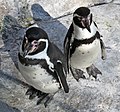
Humboldt Penguin — photo 1

Nazca Penguin effigy vessel, 350 CE–500 CE, said to represent a Humboldt Penguin by the Art Institute of Chicago

Humboldt penguin in Eskişehir Zoo

Humboldt Penguin — photo 4

Humboldt Penguin — photo 5

Humboldt Penguin Cotswold Wildlife Park
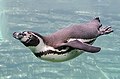
Humboldt Penguin swimming under water

Humboldt Penguin — photo 8

Humboldt Penguin — photo 9
🤝 Social Behavior
Humboldt Penguins are very social creatures! 🤝They often hang out in big groups, known as colonies. They communicate with each other through vocalizations, like braying sounds—some say they sound like donkeys! 🐴During breeding, they perform courtship displays to attract mates. Additionally, these penguins groom each other, helping to strengthen their bonds. Humboldt Penguins are also known to form friendships and care for their young together, showing the importance of community! 🐾
Go deeper🌊 Interesting Facts
Did you know that Humboldt Penguins are named after the Humboldt Current? 🌊This current brings cold water up from the ocean floor and helps support the fish they eat! Another fun fact is that these penguins can actually swim at speeds of up to 20 miles per hour (32 km/h)! 🏃♂️ They have a special ability to hold their breath for about 2 minutes while diving underwater. Lastly, Humboldt Penguins are great parents, working as a team to raise their chicks and teach them how to swim! 🏊♀️
Go deeper🛑 Conservation Status
The Humboldt Penguin is considered vulnerable. 🛑Their numbers are decreasing due to threats like habitat destruction, pollution, and overfishing. Organizations are working hard to protect them and their homes. In some areas, marine parks have been established to help keep the ocean safe and clean. 🐠With teamwork from people, we can ensure these happy penguins thrive in their beautiful coastal habitat! 🌍
Go deeper😟 Threats And Challenges
Humboldt Penguins face a number of challenges in their lives. 😟Overfishing and pollution are major threats because they affect their food sources and living environments. Climate change is also a problem, as warmer oceans can stop fish availability. Additionally, oil spills can harm their feathers, making it hard for them to stay warm and swim. Conservation efforts are crucial to protect their habitats and ensure a healthy environment for them to live in! 🚫🌊
Go deeper🏝️ Habitat And Distribution
Humboldt Penguins live along the coasts of Peru and Chile, often found on rocky shorelines and islands. 🏝️ They enjoy the cool, nutrient-rich waters of the Humboldt Current, a cold ocean current that runs along this coast. These penguins prefer areas with lots of cliffs and rocks where they can build their nests. Some popular spots are the Ballestas Islands in Peru and the Chiloé Island in Chile. They are well-adapted to their environment, which helps them survive in their coastal home. 🏖️
Go deeper🖤 Physical Characteristics
Humboldt Penguins have a distinct look! They have a black back with white bellies and create a tuxedo-like appearance. 🖤🤍 Each penguin has unique markings, including a stripe that runs across its chest. Their heads are also black with white patches, giving them a charming look! Adult penguins are larger than chicks. Chicks hatch covered in gray down feathers, which they lose as they grow. These birds are built for the water, with strong wings that help them swim swiftly! 🏊
Go deeper🏡 Breeding And Reproduction
Humboldt Penguins are very social and like to breed in large colonies! 🏡Breeding usually occurs in spring, around September in the Southern Hemisphere. They create nests in caves, under bushes, or between rocks. Female penguins lay 1 to 3 eggs, which both parents take turns incubating. 🥚After about 40 days, the fluffy chicks hatch, and both parents feed them fish until they can swim and catch food on their own. The young stay with their parents for a while before becoming independent! 🐥
Go deeper🦐 Diet And Feeding Behavior
Humboldt Penguins are carnivorous and love to munch on seafood! 🦐🐟 Their diet mainly includes fish, squid, and crustaceans. They dive underwater, sometimes reaching depths of about 50 meters (164 feet), to catch their dinner. Using their sharp beaks, they snatch up their prey skillfully. They usually hunt in groups, making it easier to find food. These penguins like to eat during the day, especially in the early morning hours! 🌅
Go deeper