All Articles

Hubble–lemaître Law

Hubble–lemaître Law Facts For Kids

The Hubble–Lemaître law states that galaxies move away from Earth at speeds that increase with their distance, showing that the universe is expanding.
🎨 Reading age for 6-8
Background blob
Hubble–lemaître Law
Facts for Kids!

Do more with AI

Introduction

The Hubble–Lemaître law, often called Hubble's law, tells us something exciting about the universe! 🌌It states that galaxies, which are huge groups of stars and planets, are moving away from Earth! The farther away a galaxy is, the faster it's racing away. Imagine if you threw a balloon filled with air, and the air made it float higher and higher—just like galaxies zoom off into space! This amazing idea helps scientists understand how big and ever-growing our universe really is. 🌠Its name comes from two great thinkers, Edwin Hubble and Georges Lemaître, who helped us see the universe in a new light!

Images of Hubble–lemaître Law

Photos of Hubble–lemaître Law
Three steps to the Hubble constant[21]Image by NASA, ESA, A. Feild (STScI), and A. Riess (STScI/JHU), licensed under Creative Commons Attribution 4.0

Three steps to the Hubble constant[21]

Fit of redshift velocities to Hubble's law.[28] Various estimates for the Hubble constant exist.Image by Brews ohare, licensed under Creative Commons Attribution-Share Alike 3.0

Fit of redshift velocities to Hubble's law.[28] Various estimates for the Hubble constant exist.

A variety of possible recessional velocity vs. redshift functions including the simple linear relation v = cz; a variety of possible shapes from theories related to general relativity; and a curve that does not permit speeds faster than light in accordance with special relativity. All curves are linear at low redshifts.[34]Image by Brews ohare, licensed under Creative Commons Attribution-Share Alike 3.0

A variety of possible recessional velocity vs. redshift functions including the simple linear relation v = cz; a variety of possible shapes from theories related to general relativity; and a curve that does not permit speeds faster than light in accordance with special relativity. All curves are linear at low redshifts.[34]

The age and ultimate fate of the universe can be determined by measuring the Hubble constant today and extrapolating with the observed value of the deceleration parameter, uniquely characterized by values of density parameters (ΩM for matter and ΩΛ for dark energy).A closed universe with ΩM > 1 and ΩΛ = 0 comes to an end in a Big Crunch and is considerably younger than its Hubble age.An open universe with ΩM ≤ 1 and ΩΛ = 0 expands forever and has an age that is closer to its Hubble age. For the accelerating universe with nonzero ΩΛ that we inhabit, the age of the universe is coincidentally very close to the Hubble age.

The age and ultimate fate of the universe can be determined by measuring the Hubble constant today and extrapolating with the observed value of the deceleration parameter, uniquely characterized by values of density parameters (ΩM for matter and ΩΛ for dark energy).A closed universe with ΩM > 1 and ΩΛ = 0 comes to an end in a Big Crunch and is considerably younger than its Hubble age.An open universe with ΩM ≤ 1 and ΩΛ = 0 expands forever and has an age that is closer to its Hubble age. For the accelerating universe with nonzero ΩΛ that we inhabit, the age of the universe is coincidentally very close to the Hubble age.

The value of the Hubble constant in (km/s)/Mpc, including measurement uncertainty, for recent surveys[52]Image by Primefac, licensed under Creative Commons Attribution-Share Alike 3.0

The value of the Hubble constant in (km/s)/Mpc, including measurement uncertainty, for recent surveys[52]

The landscape of H0 measurements around 2021, with the 2018 results from CMB measurements highlighted in pink and 2020 distance ladder values highlighted in cyan.[63]Image by Eleonora Di Valentino, Olga Mena, Supriya Pan, Luca Visinelli, Weiqiang Yang, Alessandro Melchiorri, David F Mota, Adam G Riess and Joseph Silk, licensed under Creative Commons Attribution-Share Alike 4.0

The landscape of H0 measurements around 2021, with the 2018 results from CMB measurements highlighted in pink and 2020 distance ladder values highlighted in cyan.[63]

Estimated values of the Hubble constant, 2001–2020. Estimates in black represent calibrated distance ladder measurements which tend to cluster around 73 (km/s)/Mpc; red represents early universe CMB/BAO measurements with ΛCDM parameters which show good agreement on a figure near 67 (km/s)/Mpc, while blue are other techniques, whose uncertainties are not yet small enough to decide between the two.Image by Renerpho, licensed under Creative Commons Attribution-Share Alike 4.0

Estimated values of the Hubble constant, 2001–2020. Estimates in black represent calibrated distance ladder measurements which tend to cluster around 73 (km/s)/Mpc; red represents early universe CMB/BAO measurements with ΛCDM parameters which show good agreement on a figure near 67 (km/s)/Mpc, while blue are other techniques, whose uncertainties are not yet small enough to decide between the two.

Cosmic Expansion

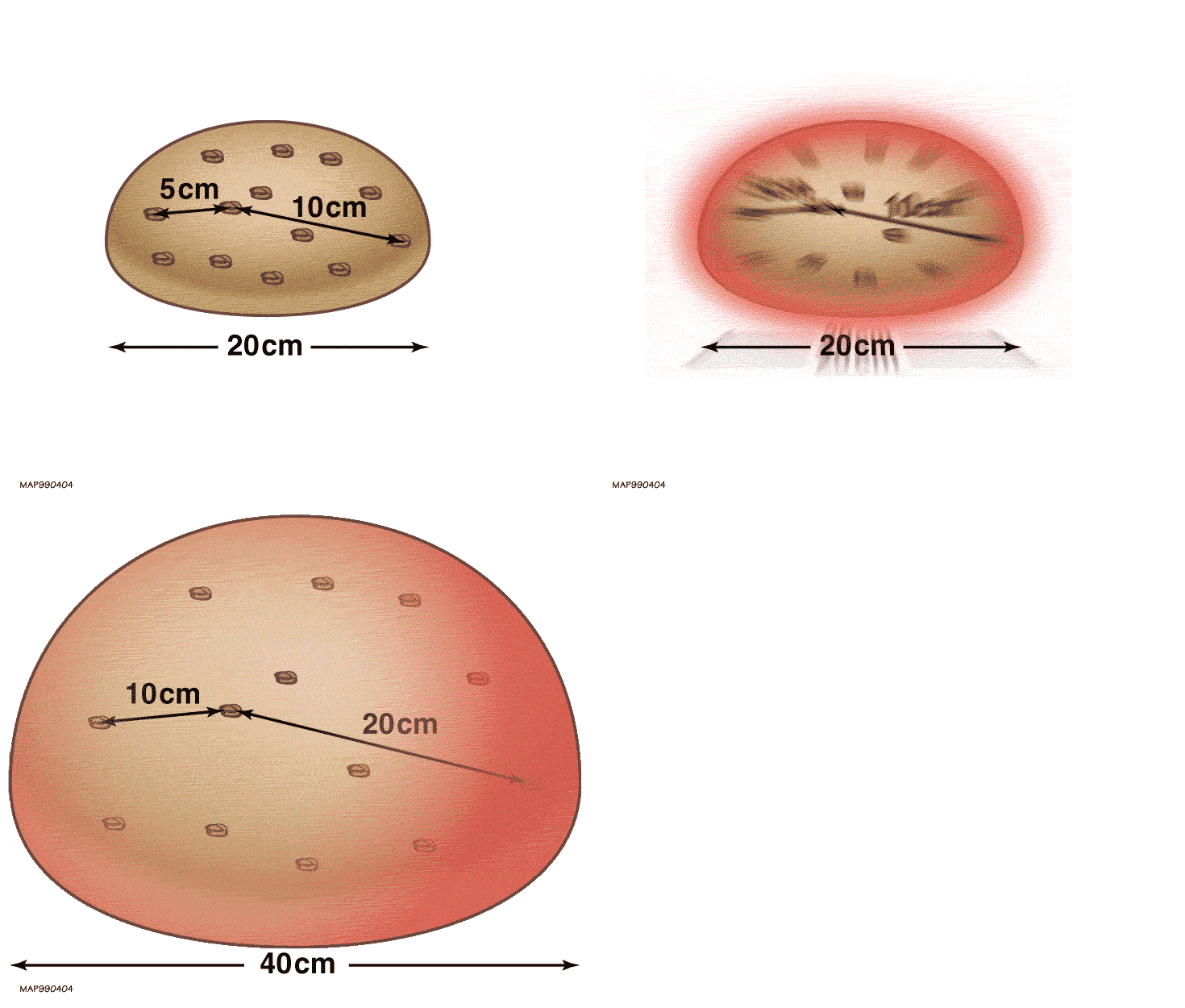
The Hubble–Lemaître law shows that space itself is getting bigger! 🌌Imagine blowing up a balloon; as it expands, the dots on the surface of the balloon move farther apart. Similarly, galaxies are like those dots on our universe’s balloon! This cosmic expansion has been happening since the Big Bang, when the universe was just a tiny, super-hot point. ✨Scientists believe this expansion is still ongoing today! By measuring distances and speeds of galaxies, astronomers have learned that the universe’s growth is speeding up—something that continues to intrigue scientists as they study the laws of our cosmic world.

Historical Context

In the early 20th century, scientists thought the universe was static, meaning it didn’t change. 🕰️ But everything changed when Edwin Hubble peered through a giant telescope in 1929! He discovered that most galaxies were moving away from us, suggesting that the universe is expanding! At the same time, Georges Lemaître, a Belgian priest and scientist, proposed that the universe started from a very tiny point, which he called the "primeval atom." 🥚 His ideas laid the foundation for understanding our universe’s beginning and how it keeps growing, which is called cosmic expansion.

Observational Evidence

Many scientists have gathered evidence to support the Hubble–Lemaître law! 🌠Observations made with powerful telescopes allow astronomers to see galaxies far away. When they looked at the light from these galaxies, they noticed something strange: the light was redshifted! 🔴This means the light waves stretched out, just like a rubber band. This stretching occurs when the galaxy moves away from us, confirming that the universe is growing! The farther the galaxy is, the redder the light appears. This phenomenon helps us understand the universe's expansion, and that's a super cool thing about space!

Key Figures In Cosmology

Two key figures in cosmology are Edwin Hubble and Georges Lemaître. 🌟Edwin Hubble (1889-1953) was an American astronomer who studied distant galaxies using powerful telescopes. His work showed that galaxies are moving away from us, which led to the Hubble law! Georges Lemaître (1894-1966), a Belgian scientist, was both a physicist and a Catholic priest. He imagined that the universe started as a tiny, hot point and expanded over time. Having different backgrounds, these two men made incredible discoveries that helped us understand cosmic expansion and the history of the universe!

Mathematical Formulation

The Hubble–Lemaître law can be described using a simple formula: v = H₀ × d. ✏️ Here, v stands for the speed of a galaxy, d is its distance from Earth, and H₀ is the Hubble constant! The constant is a number that helps us calculate how fast galaxies are moving away. Scientists think it is about 70 kilometers per second per megaparsec. 🚀This means that for every million parsecs (which is 3.26 million light-years!), a galaxy moves away from us at an extra 70 kilometers per second. This formula is like a magic trick to help us understand how big and expanding our universe really is!

Future Research Directions

Future research in cosmology will keep exploring the mysteries of the universe! 🔍Scientists are eager to learn more about dark energy and dark matter—two things we can’t see but seem to influence the cosmos! They also want to analyze more distant galaxies and use new telescopes to observe details of the universe’s expansion. 🛰️ Furthermore, scientists will continue to improve calculations about the Hubble constant. They hope to answer questions about the universe's fate. Will it keep expanding forever, or will it eventually slow down? 🌌The adventure of discovering the universe's secrets is just beginning!

Impact On Modern Cosmology

The Hubble–Lemaître law has greatly impacted modern cosmology! 📚Thanks to the discoveries of Hubble and Lemaître, astronomers now understand how the universe works and its incredible history. 🌌This law helps scientists study things like dark energy, which is thought to make the universe expand even faster! Hubble's discoveries led to many new questions and ideas, encouraging scientists to explore and learn more about our universe! Their work allows us to understand phenomena such as cosmic microwave background radiation and the formation of galaxies. It's like a treasure map leading us deeper into the cosmic mystery!

Relation To Big Bang Theory

The Hubble–Lemaître law is closely related to the Big Bang theory! 🌟The Big Bang theory is the idea that the universe began as a single, super-hot point. As the universe started expanding, galaxies began to move away from each other, just like the Hubble–Lemaître law says. The faster they move, the farther apart they are! 🌌This discovery provided strong support for the Big Bang theory and helped scientists understand that the universe had a beginning. Knowing this helps them figure out how galaxies have changed and grown over billions of years, shaping the cosmos we see today!

Challenges And Misconceptions

Even though the Hubble–Lemaître law is really cool, it also has some challenges and misconceptions! 🚧One common idea is that our galaxy, the Milky Way, is the center of the universe. But guess what? There is no center! 🌌All galaxies are moving away from each other equally. Another challenge is understanding dark energy, which is a mysterious force causing expansion to speed up! Scientists are still studying it! But don’t worry! 🌟These complexities inspire scientists to keep researching and discovering more about our universe every day and to explain it all to curious thinkers like you!

Hubble–lemaître Law Quiz

Q1
Question 1 of 10

Learn more about Hubble–lemaître Law

Ready to create?

Drop Files here
Make

To create a safe space for kid creators worldwide!

Create

Vibe Coding

Kids GPT

All Tools

Kibu

Resources

Worksheets

SafeTube

Blog

FAQ

Account

Pricing

Log-in

Sign-up

Data Deletion

Company

About

Community Guidelines

Privacy Policy

Terms of Service

2025, URSOR LIMITED. All rights reserved. DIY is in no way affiliated with Minecraft™, Mojang, Microsoft, Roblox™ or YouTube. LEGO® is a trademark of the LEGO® Group which does not sponsor, endorse or authorize this website or event. Made with love in San Francisco.