All Articles

Hendrik Lorentz

Hendrik Lorentz Facts For Kids

Hendrik Antoon Lorentz was a Dutch theoretical physicist famous for his work on electromagnetism and the Zeeman effect, sharing the Nobel Prize in Physics in 1902 with Pieter Zeeman.

🎨 Reading age for 6-8
Background blob
Hendrik Lorentz
Facts for Kids!

Do more with AI

Introduction

Hendrik Antoon Lorentz was a famous Dutch physicist born on July 18, 1853, in the city of Arnhem, Netherlands. 🎉He was really good at understanding how the universe works, especially light and motion! Lorentz played a big role in shaping modern physics. He’s best known for the Lorentz transformations that help explain how objects move at super-fast speeds! 🚀In 1902, he won the Nobel Prize in Physics with his friend Pieter Zeeman for their work on something called the Zeeman effect. This effect explains how light changes when magnets are around! 🌈

Images of Hendrik Lorentz

Painting of Hendrik Lorentz by Menso Kamerlingh Onnes, 1916

Painting of Hendrik Lorentz by Menso Kamerlingh Onnes, 1916

Portrait by Jan Veth

Portrait by Jan Veth

Lorentz' theory of electrons. Formulas for the Lorentz force (I) and the Maxwell equations for the divergence of the electrical field E (II) and the magnetic field B (III), La théorie electromagnétique de Maxwell et son application aux corps mouvants, 1892, p. 451. V is the velocity of light.
Lorentz' theory of electrons. Formulas for the Lorentz force (I) and the Maxwell equations for the divergence of the electrical field E (II) and the magnetic field B (III), La théorie electromagnétique de Maxwell et son application aux corps mouvants, 1892, p. 451. V is the velocity of light.

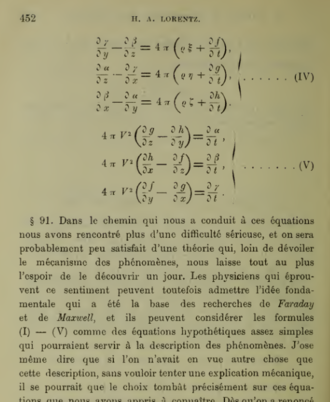
Lorentz' theory of electrons. Formulas for the curl of the magnetic field (IV) and the electrical field E (V), La théorie electromagnétique de Maxwell et son application aux corps mouvants, 1892, p. 452

Lorentz' theory of electrons. Formulas for the curl of the magnetic field (IV) and the electrical field E (V), La théorie electromagnétique de Maxwell et son application aux corps mouvants, 1892, p. 452

Albert Einstein and Hendrik Lorentz, photographed by Ehrenfest in front of his home in Leiden in 1921
Albert Einstein and Hendrik Lorentz, photographed by Ehrenfest in front of his home in Leiden in 1921

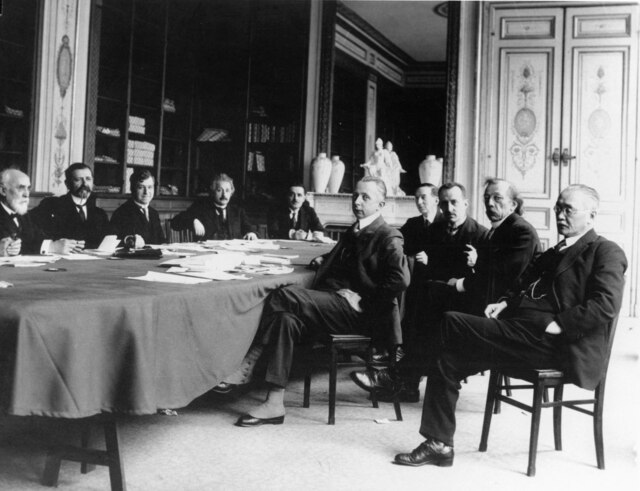
Lorentz (left) at the International Committee on Intellectual Cooperation of the League of Nations, here with Albert EinsteinImage by Unknown author Unknown author, licensed under Creative Commons Attribution-Share Alike 4.0

Lorentz (left) at the International Committee on Intellectual Cooperation of the League of Nations, here with Albert Einstein

His published university lectures in theoretical physics. Part 1. Stralingstheorie (1910-1911, Radiation theory) in Dutch, edited by his student A. D. Fokker, 1919.

His published university lectures in theoretical physics. Part 1. Stralingstheorie (1910-1911, Radiation theory) in Dutch, edited by his student A. D. Fokker, 1919.

Funeral procession for Lorentz in Haarlem

Funeral procession for Lorentz in Haarlem

Lorentz-monument Park Sonsbeek in Arnhem, the NetherlandsImage by Roger Veringmeier, licensed under Creative Commons Attribution-Share Alike 4.0

Lorentz-monument Park Sonsbeek in Arnhem, the Netherlands

Painting of Hendrik Lorentz by Menso Kamerlingh Onnes, 1916

Painting of Hendrik Lorentz by Menso Kamerlingh Onnes, 1916

Portrait by Jan Veth

Portrait by Jan Veth

Lorentz' theory of electrons. Formulas for the Lorentz force (I) and the Maxwell equations for the divergence of the electrical field E (II) and the magnetic field B (III), La théorie electromagnétique de Maxwell et son application aux corps mouvants, 1892, p. 451. V is the velocity of light.

Lorentz' theory of electrons. Formulas for the Lorentz force (I) and the Maxwell equations for the divergence of the electrical field E (II) and the magnetic field B (III), La théorie electromagnétique de Maxwell et son application aux corps mouvants, 1892, p. 451. V is the velocity of light.

Lorentz' theory of electrons. Formulas for the curl of the magnetic field (IV) and the electrical field E (V), La théorie electromagnétique de Maxwell et son application aux corps mouvants, 1892, p. 452

Lorentz' theory of electrons. Formulas for the curl of the magnetic field (IV) and the electrical field E (V), La théorie electromagnétique de Maxwell et son application aux corps mouvants, 1892, p. 452

Albert Einstein and Hendrik Lorentz, photographed by Ehrenfest in front of his home in Leiden in 1921

Albert Einstein and Hendrik Lorentz, photographed by Ehrenfest in front of his home in Leiden in 1921

Lorentz (left) at the International Committee on Intellectual Cooperation of the League of Nations, here with Albert EinsteinImage by Unknown author Unknown author, licensed under Creative Commons Attribution-Share Alike 4.0

Lorentz (left) at the International Committee on Intellectual Cooperation of the League of Nations, here with Albert Einstein

His published university lectures in theoretical physics. Part 1. Stralingstheorie (1910-1911, Radiation theory) in Dutch, edited by his student A. D. Fokker, 1919.

His published university lectures in theoretical physics. Part 1. Stralingstheorie (1910-1911, Radiation theory) in Dutch, edited by his student A. D. Fokker, 1919.

Funeral procession for Lorentz in Haarlem

Funeral procession for Lorentz in Haarlem

Lorentz-monument Park Sonsbeek in Arnhem, the NetherlandsImage by Roger Veringmeier, licensed under Creative Commons Attribution-Share Alike 4.0

Lorentz-monument Park Sonsbeek in Arnhem, the Netherlands

Lorentz Force

The Lorentz force is named after Hendrik Lorentz! 🥳It describes the force experienced by a charged particle moving through electric and magnetic fields. Imagine you have a tiny charged ball! ⚽When it moves in a magnetic field, the Lorentz force makes it change direction, just like when a soccer ball curves when kicked! The formula for the Lorentz force is: F = q(E + v × B), where F is the force, q is the charge, E is the electric field, v is the velocity, and B is the magnetic field. ⚙️

Awards And Honors

Hendrik Lorentz received many awards for his incredible work in physics! 🏆One of his most significant achievements was winning the Nobel Prize in Physics in 1902, which he shared with Pieter Zeeman for their research on the Zeeman effect. ⭐He was also a member of several prestigious scientific societies and received honorary degrees from universities worldwide. His influential research won him respect and admiration from scientists for generations to come! 👏

Later Life And Legacy

Later in life, Hendrik Lorentz continued his work in physics and teaching. He became a professor at the University of Leiden in the Netherlands. 🏫He loved sharing his knowledge with students and inspiring young scientists! Lorentz passed away on February 4, 1928, but his discoveries live on. 🌌Many scientists still study his work and use it in modern physics. His contributions helped shape our understanding of light, motion, and the universe! A true legend in science! 🌟

Lorentz Transformations

The Lorentz transformations are special equations created by Hendrik Lorentz! ✨They help scientists understand how time and space change when objects travel near the speed of light. Light is super fast, moving at about 186,282 miles per second (299,792 kilometers per second)! When something approaches this speed, time can slow down for it compared to someone watching it. This is called "time dilation." ⏰ So, when you think of fast objects, remember these transformations! They are essential to the theory of relativity! 📏

Early Life And Education

Hendrik, or "Henk" as he was called, loved studying from a very young age! 📚As a child in Arnhem, he enjoyed reading books about mathematics and science. He went to a special school called the University of Utrecht, where he learned a lot about physics and math. 🎓After he finished his studies, he began to teach at different universities, sharing his love for science with students. In 1875, he got his degree in physics and went on to become one of the greatest scientists of his time! 🌟

Influence On Modern Physics

The ideas of Hendrik Lorentz greatly influenced modern physics! 🌍His theories about light and motion helped pave the way for Einstein's theory of relativity, which changed the way we think about space and time. ⏳Lorentz's work is still used in technology today, such as satellites and GPS, helping us understand how our universe works! His legacy as a brilliant physicist continues to inspire new generations of scientists eager to explore deep questions about the cosmos! 🚀

Electrodynamics And The Ether

Lorentz studied something called electrodynamics, which is all about electricity and magnetism! ⚡The science of how electric charges interact is really important in physics! He also proposed the idea of "ether," an invisible substance that he thought filled all space and carried light. ☁️ Even though scientists later discovered that light doesn't need ether, Lorentz's ideas helped spark many theories that contributed to our understanding of how light moves through space. His work with electrodynamics influenced many scientists, including Albert Einstein! 💡

Career And Major Contributions

Hendrik Lorentz had an amazing career! He worked at several universities, including the University of Amsterdam. 🤓His most famous work involved understanding light, electricity, and magnetism. One of his biggest contributions is the Lorentz transformation, which helps explain how time and space change when objects move really fast! ⏳He also studied a phenomenon called the Zeeman effect, which shows how light can split into different colors in a magnetic field. Lorentz's discoveries helped pave the way for many theories in physics! 🧪

Collaboration With Albert Einstein

Hendrik Lorentz and Albert Einstein both made amazing discoveries about how the universe works! 🤝Lorentz's work on light and motion laid the foundation for Einstein's famous theory of relativity. Einstein admired Lorentz's ideas, especially the Lorentz transformations. They both helped scientists understand how the laws of physics work for different observers, even if they are moving at different speeds. 📏Their collaboration showed how teamwork in science can lead to incredible discoveries! 📜

Hendrik Lorentz Quiz

Q1
Question 1 of 10

Learn more about Hendrik Lorentz

Ready to create?

Drop Files here
Make

To create a safe space for kid creators worldwide!

Create

Vibe Coding

Kids GPT

All Tools

Kibu

Resources

Worksheets

SafeTube

Blog

FAQ

Account

Pricing

Log-in

Sign-up

Data Deletion

Company

About

Community Guidelines

Privacy Policy

Terms of Service

2025, URSOR LIMITED. All rights reserved. DIY is in no way affiliated with Minecraft™, Mojang, Microsoft, Roblox™ or YouTube. LEGO® is a trademark of the LEGO® Group which does not sponsor, endorse or authorize this website or event. Made with love in San Francisco.