Graphene Facts For Kids
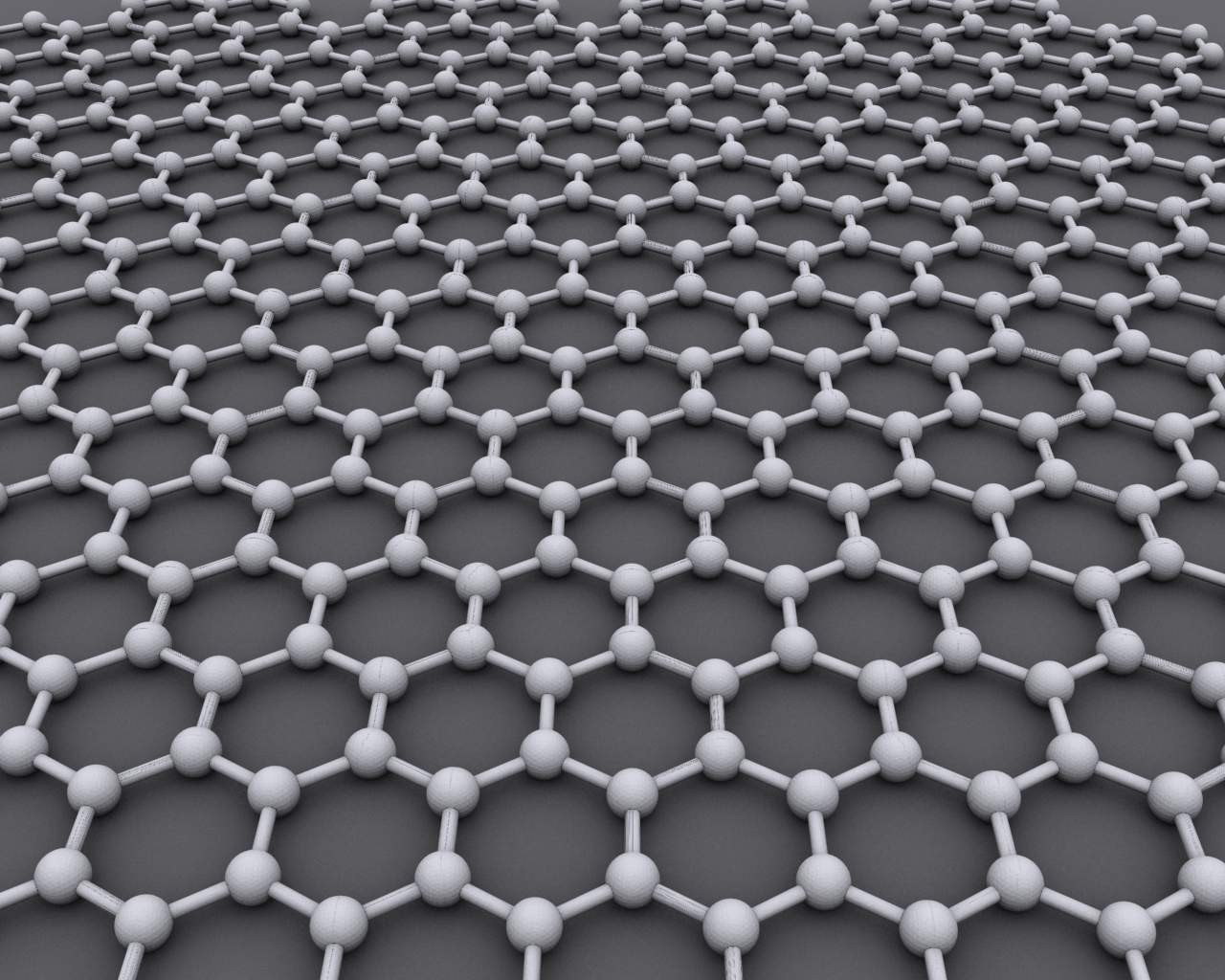
Graphene is a remarkable material composed of a single layer of carbon atoms, known for its exceptional strength, electrical conductivity, and versatility in various applications.
About this topic
Key Points
Photos of Graphene
![Photograph of a suspended graphene membrane in transmitted light. This one-atom-thick material can be seen with the naked eye because it absorbs approximately 2.3% of light.[5][6]](https://upload.wikimedia.org/wikipedia/commons/1/19/Graphene_visible.jpg)
Photograph of a suspended graphene membrane in transmitted light. This one-atom-thick material can be seen with the naked eye because it absorbs approximately 2.3% of light.[5][6]

A lump of graphite, a graphene transistor, and a tape dispenser signed by Andre Geim. Donated to the Nobel Museum in Stockholm by Geim and Konstantin Novoselov in 2010.

Andre Geim and Konstantin Novoselov at the Nobel Laureate press conference, Royal Swedish Academy of Sciences, 2010.

Carbon orbitals 2s, 2px, 2py form the hybrid orbital sp2 with three major lobes at 120°. The remaining orbital, pz, extends out of the graphene's plane.

Sigma and pi bonds in graphene. Sigma bonds result from an overlap of sp2 hybrid orbitals, whereas pi bonds emerge from tunneling between the protruding pz orbitals.

Scanning probe microscopy image of graphene

Electronic band structure of graphene. Valence and conduction bands meet at the six vertices of the hexagonal Brillouin zone and form linearly dispersing Dirac cones.
![When the gate voltage in a field effect graphene device is changed from positive to negative, conduction switches from electrons to holes. The charge carrier concentration is proportional to the applied voltage. Graphene is neutral at zero gate voltage and resistivity is at its maximum because of the dearth of charge carriers. The rapid fall of resistivity when carriers are injected shows their high mobility, here of the order of 5000 cm2/Vs. n-Si/SiO2 substrate, T=1K.[2]](https://upload.wikimedia.org/wikipedia/commons/thumb/4/4f/Graphene_-_Geim_-_ambipolar_FET.svg/250px-Graphene_-_Geim_-_ambipolar_FET.svg.png)
When the gate voltage in a field effect graphene device is changed from positive to negative, conduction switches from electrons to holes. The charge carrier concentration is proportional to the applied voltage. Graphene is neutral at zero gate voltage and resistivity is at its maximum because of the dearth of charge carriers. The rapid fall of resistivity when carriers are injected shows their high mobility, here of the order of 5000 cm2/Vs. n-Si/SiO2 substrate, T=1K.[2]
![Landau levels in graphene appear at energies proportional to √N, in contrast to the standard sequence that goes as N + 1/2.[2]](https://upload.wikimedia.org/wikipedia/commons/thumb/6/6a/Graphene_-_Geim_-_Landau_levels.svg/250px-Graphene_-_Geim_-_Landau_levels.svg.png)
Landau levels in graphene appear at energies proportional to √N, in contrast to the standard sequence that goes as N + 1/2.[2]