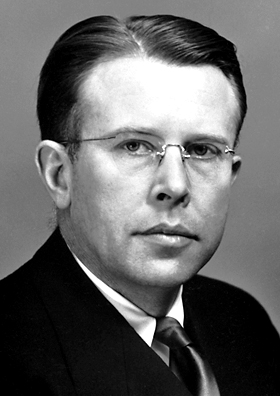
Ernest Lawrence was a pioneering American physicist best known for inventing the cyclotron, significantly advancing the field of nuclear physics and contributing to the development of atomic energy.

Set reading age
View for Kids
Easy to read and understand
View for Students
Clear, detailed explanations
View for Scholars
Deep dives and big ideas
Ernest O. Lawrence was a famous scientist born on August 8, 1901, in Canton, South Dakota 🌽. He is best known for inventing the cyclotron, a special machine that helps scientists understand tiny particles like atoms! He worked in many important places, including the University of California, Berkeley. Lawrence's contributions to physics made a big difference in both science and medicine, especially in the field of nuclear science. He became a huge inspiration for future scientists, showing that curiosity and hard work can lead to amazing discoveries! ✨
The cyclotron is a cool machine that Ernest Lawrence invented to help scientists study atomic particles! 🎡It uses a strong magnetic field to speed up charged particles in a circular path. Imagine riding a merry-go-round but much faster! When particles collide, they can create new elements or even help scientists find out how atoms work. The first cyclotron built by Lawrence was in the 1930s at the University of California, Berkeley! 🌈Because of Lawrence’s innovation, cyclotrons are used in many labs and hospitals today to help with research and treatments.
Ernest Lawrence received many honors and awards throughout his career! Besides the Nobel Prize, he was awarded the National Medal of Science in 1964 for his contributions to science and technology 🎖️. He also got the title of "Distinguished Professor" at the University of California, Berkeley. Lawrence's many achievements show how important his work was and how he influenced the scientific community to strive for excellence, helping to inspire future scientists!
There are some fun stories about Ernest Lawrence! One time, during a lecture, he showed off his cyclotron and got so excited about his work that he accidentally made a big noise with the equipment! 🎉The audience laughed and saw his passion for science. Lawrence also loved fixing things and could often be found tinkering with various gadgets. His enthusiasm for exploration was infectious, inspiring everyone to ask questions, be curious, and never stop learning! Lawrence truly believed that science could change the world! 🌈
In 1939, Ernest Lawrence received the Nobel Prize in Physics for his amazing work on the cyclotron! 🏆The Nobel Prize is one of the highest honors a scientist can receive. Lawrence was recognized for how the cyclotron helped discover new elements and improve scientific research! This made him a big hero in the world of science, showing that hard work pays off. He was not only proud of his invention but also thrilled that it helped others understand and explore the world of atoms!
After World War II, Ernest Lawrence continued his scientific work and became the director of the Lawrence Radiation Laboratory at Berkeley. He focused on using nuclear science for peaceful purposes, such as medicine, energy, and research 🏛️. Lawrence trained many young scientists and inspired them to follow their dreams. His legacy lives on, reminding us that science can change lives for the better. He passed away on August 27, 1958, but many scientists still remember him and his fantastic work today! 🌟
Lawrence made incredible contributions to physics, which is the study of matter and energy 🔬. One of his biggest achievements was inventing the cyclotron in 1930. This device speeds up particles and can make them collide at high speeds. This helped scientists discover new elements and understand the structure of atoms better! ⚛️ His work also included studying radioactive isotopes, which are important in medicine for cancer treatments. Lawrence’s passion for solving problems helped shape modern physics as we know it today!
Ernest Lawrence loved learning when he was a kid! He attended the University of South Dakota, and then he moved to the University of Minnesota for his graduate studies 📚. There, he earned his Ph.D. in physics in 1925. Lawrence was very curious and always wanted to know how things worked. He even built his own little science lab at home! 🏠His early love for science and learning helped him become a great scientist later in life. With a strong foundation in education, he went on to change the world! 🌍
Ernest Lawrence's inventions and discoveries greatly impacted modern science! 🔥The cyclotron paved the way for other particle accelerators used in research today, helping scientists discover new particles and learn about the universe. His work also led to advancements in medicine, providing important tools for treating diseases like cancer. Because of his contributions to nuclear science, many students and scientists are inspired to explore the mysteries of atoms and particles, making the world a more exciting place for discovery! 🚀
During World War II, Ernest Lawrence played an important role in developing atomic energy and weapons ⚔️. He helped create the Manhattan Project, which aimed to build the first atomic bomb! His cyclotron was vital for separating uranium isotopes, which are used in nuclear energy. Lawrence's work during this time showed how science could be used for both good and bad purposes. This made him think deeply about the responsibility of scientists and how their discoveries could affect the world. 🕊️
🔬 Ernest Lawrence invented the cyclotron, a particle accelerator that revolutionized nuclear physics.
🎓 He received the Nobel Prize in Physics in 1939 for his contributions to the development of atomic particles.
🌍 Lawrence founded the Radiation Laboratory at the University of California, Berkeley, which became a hub for nuclear research.
📅 He was born on August 8, 1901, in Canton, South Dakota.
🏅 Lawrence's work laid the groundwork for advancements in medicine, particularly in cancer treatment with radiation.
🔋 He earned his Bachelor's degree from the University of South Dakota in 1922.
👨🔬 Lawrence also played a significant role in the development of the atomic bomb during World War II.
📡 He was the first to demonstrate the principles of isotopic separation using the cyclotron.
🔧 In addition to his scientific achievements, he served as the president of the American Physical Society.
✈️ Lawrence’s cyclotron design was utilized in various fields, including nuclear medicine and research.


DIY is a creative community where kids draw, build, explore ideas, and share.
No credit card required