All Articles

Electric Field

Electric Field Facts For Kids

An electric field is a physical field surrounding electric charges that exerts a force on other electric charges within the field.

🎨 Reading age for 6-8
Background blob
Electric Field
Electric Field
Facts for Kids!
Image by Geek3, licensed under Creative Commons Attribution-Share Alike 3.0

Do more with AI

Introduction

Have you ever felt a little spark when you touch a doorknob? ⚡That's electricity! An electric field is like an invisible force that surrounds electric charges. Imagine a superhero's force field that protects them! Electric fields can push or pull things without touching them, just like how magnets attract metal objects. Scientists discovered electric fields in the 1780s, mainly by studying the work of a scientist named Charles-Augustin de Coulomb, who helped us understand how these fields work. 🌈Electric fields are everywhere in our daily lives, allowing things like lights, phones, and computers to work properly!

Images of Electric Field

Electric field of a positive point electric charge suspended over an infinite sheet of conducting material. The field is depicted by electric field lines, lines which follow the direction of the electric field in space. The induced charge distribution in the sheet is not shown.Image by Geek3, licensed under Creative Commons Attribution-Share Alike 3.0

Electric field of a positive point electric charge suspended over an infinite sheet of conducting material. The field is depicted by electric field lines, lines which follow the direction of the electric field in space. The induced charge distribution in the sheet is not shown.

Evidence of an electric field: styrofoam peanuts clinging to a cat's fur due to static electricity. The triboelectric effect causes an electrostatic charge to build up on the fur due to the cat's motions. The electric field of the charge causes polarization of the molecules of the styrofoam due to electrostatic induction, resulting in a slight attraction of the light plastic pieces to the charged fur. This effect is also the cause of static cling in clothes.Image by Original image: Sean McGrath from Saint John, NB, Canada Derived image: Black Rainbow 999, licensed under Creative Commons Attribution 2.0

Evidence of an electric field: styrofoam peanuts clinging to a cat's fur due to static electricity. The triboelectric effect causes an electrostatic charge to build up on the fur due to the cat's motions. The electric field of the charge causes polarization of the molecules of the styrofoam due to electrostatic induction, resulting in a slight attraction of the light plastic pieces to the charged fur. This effect is also the cause of static cling in clothes.
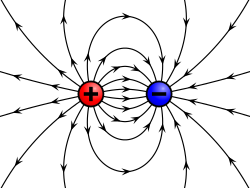
Illustration of the electric field surrounding a positive (red) and a negative (blue) chargeImage by Geek3, licensed under Creative Commons Attribution-Share Alike 3.0

Illustration of the electric field surrounding a positive (red) and a negative (blue) charge

Illustration of the electric field between two parallel conductive plates of finite size (known as a parallel plate capacitor). In the middle of the plates, far from any edges, the electric field is very nearly uniform.Image by Geek3, licensed under Creative Commons Attribution-Share Alike 4.0

Illustration of the electric field between two parallel conductive plates of finite size (known as a parallel plate capacitor). In the middle of the plates, far from any edges, the electric field is very nearly uniform.

The electric field (lines with arrows) of a charge (+) induces surface charges (red and blue areas) on metal objects due to electrostatic induction.

The electric field (lines with arrows) of a charge (+) induces surface charges (red and blue areas) on metal objects due to electrostatic induction.

An illustrative example showing bremsstrahlung radiation: Field lines and modulus of the electric field generated by a (negative) charge first moving at a constant speed and then stopping quickly to show the electromagnetic wave generated and propagation of disturbances in electromagnetic field.

An illustrative example showing bremsstrahlung radiation: Field lines and modulus of the electric field generated by a (negative) charge first moving at a constant speed and then stopping quickly to show the electromagnetic wave generated and propagation of disturbances in electromagnetic field.

Electric field of a positive point electric charge suspended over an infinite sheet of conducting material. The field is depicted by electric field lines, lines which follow the direction of the electric field in space. The induced charge distribution in the sheet is not shown.Image by Geek3, licensed under Creative Commons Attribution-Share Alike 3.0

Electric field of a positive point electric charge suspended over an infinite sheet of conducting material. The field is depicted by electric field lines, lines which follow the direction of the electric field in space. The induced charge distribution in the sheet is not shown.

Evidence of an electric field: styrofoam peanuts clinging to a cat's fur due to static electricity. The triboelectric effect causes an electrostatic charge to build up on the fur due to the cat's motions. The electric field of the charge causes polarization of the molecules of the styrofoam due to electrostatic induction, resulting in a slight attraction of the light plastic pieces to the charged fur. This effect is also the cause of static cling in clothes.Image by Original image: Sean McGrath from Saint John, NB, Canada Derived image: Black Rainbow 999, licensed under Creative Commons Attribution 2.0

Evidence of an electric field: styrofoam peanuts clinging to a cat's fur due to static electricity. The triboelectric effect causes an electrostatic charge to build up on the fur due to the cat's motions. The electric field of the charge causes polarization of the molecules of the styrofoam due to electrostatic induction, resulting in a slight attraction of the light plastic pieces to the charged fur. This effect is also the cause of static cling in clothes.

Illustration of the electric field surrounding a positive (red) and a negative (blue) chargeImage by Geek3, licensed under Creative Commons Attribution-Share Alike 3.0

Illustration of the electric field surrounding a positive (red) and a negative (blue) charge

Illustration of the electric field between two parallel conductive plates of finite size (known as a parallel plate capacitor). In the middle of the plates, far from any edges, the electric field is very nearly uniform.Image by Geek3, licensed under Creative Commons Attribution-Share Alike 4.0

Illustration of the electric field between two parallel conductive plates of finite size (known as a parallel plate capacitor). In the middle of the plates, far from any edges, the electric field is very nearly uniform.

The electric field (lines with arrows) of a charge (+) induces surface charges (red and blue areas) on metal objects due to electrostatic induction.

The electric field (lines with arrows) of a charge (+) induces surface charges (red and blue areas) on metal objects due to electrostatic induction.

An illustrative example showing bremsstrahlung radiation: Field lines and modulus of the electric field generated by a (negative) charge first moving at a constant speed and then stopping quickly to show the electromagnetic wave generated and propagation of disturbances in electromagnetic field.

An illustrative example showing bremsstrahlung radiation: Field lines and modulus of the electric field generated by a (negative) charge first moving at a constant speed and then stopping quickly to show the electromagnetic wave generated and propagation of disturbances in electromagnetic field.

Electric Field Lines

Electric field lines are imaginary lines that help us visualize electric fields. 🔌They show the direction and strength of the electric field around a charged object. If you imagine the electric field as a balloon, the lines would be like strings coming out of the balloon. The closer the lines are, the stronger the electric field is! If a line goes from a positive charge to a negative charge, it shows that the positive charge is pulling on the negative one. 🌈By looking at the lines, scientists can predict how the electric field will behave and how it interacts with other charges.

Safety Considerations

While electric fields are fascinating, we must also be careful! ⚠️ High electric fields can cause electric shocks, which can be dangerous. Always remember to never touch exposed wires or electrical outlets. 🏠If you see someone using a tool near water or wet surfaces, it's best to stay away. Also, it's important to use devices like chargers and batteries properly, following the instructions. And if there's a storm with lightning, stay indoors! 🌧️ By understanding how electric fields work and following safety rules, we can enjoy their benefits while staying safe!

Measurement Techniques

To measure electric fields, scientists use special tools called voltmeters and electrostatic field meters. 🌟A voltmeter helps measure the voltage in an electric circuit. This can help us calculate how strong the electric field is! An electrostatic field meter measures the strength of electric fields directly. Imagine it like having a magic wand that tells you how strong the electrical forces are around you! 🧙‍♂️ These devices help scientists and engineers understand electric fields better, making it easier to design cool electronics and electric devices.

Sources Of Electric Fields

Electric fields are created by charged objects. ⚡Examples of charged objects include batteries, lightning, and even your own body! When a battery is connected to a circuit, it creates an electric field that allows it to power lights 🎇 and toys. Lightning bolts happen when electric fields in clouds build up and then suddenly release energy, causing a bright flash in the sky! 🌩️ Your body can also create electric fields when you walk on certain surfaces, like carpets. Just like when you rub a balloon on your hair, you're creating an electric charge that generates an electric field!

Mathematical Representation

Scientists use math to describe electric fields, just like how we use numbers in school. 📚The electric field (E) is usually measured in volts per meter (V/m). You can calculate it using this formula: E = F/q. Here, E is the electric field, F is the force acting on a charge, and q is the size of the charge. For example, if you use a tiny charge and know the force acting on it, you can quickly find the strength of the electric field! Math helps us understand the power of electric fields in a precise way, making it easier for scientists to solve problems. 🔍

Definition Of Electric Field

An electric field is a special area around a charged object where it can affect other charged objects. 🎈When we say "charged," it means something that has extra tiny particles called electrons, which can be positive or negative. The electric field tells us how strong the charge is and which direction it can push or pull other charges. You can think of it like a bubble around the charged object filled with invisible energy! In simpler terms, if you have a balloon rubbed on your hair, it becomes charged and can make other hair strands move without touching them. Isn't that cool? 🌪️

Applications Of Electric Fields

Electric fields have many fun and useful applications in our everyday lives! 🎉For instance, they help in powering devices like phones 📱, computers 💻, and even electric cars! Electric fields are also used in medical equipment like X-ray machines and MRI scanners 🏥, helping doctors see inside our bodies. Scientists also use electric fields in a process called electrostatics to create static electricity for fun experiments, like making balloons stick to walls or your hair stand up! So, electric fields are not just a science topic; they're part of the amazing technology we use every day!

Electric Fields Vs. Magnetic Fields

While electric fields are about charged objects, magnetic fields are created by magnets! 🧲A magnetic field can attract or repel magnetic materials, just like how electric fields can push or pull charged objects. The two fields are connected! For example, moving an electric charge can create a magnetic field, and moving a magnetic field can create an electric charge. This is how generators work! 🌪️ Electric fields are usually around charges, while magnetic fields are around magnets or moving charges. So, they are like two sides of the same amazing physics coin! 💫

Electric Field Quiz

Q1
Question 1 of 10

Learn more about Electric Field

Ready to create?

Make

To create a safe space for kid creators worldwide!

Create

Vibe Coding

Kids GPT

All Tools

Kibu

Resources

Worksheets

SafeTube

Blog

FAQ

Account

Pricing

Log-in

Sign-up

Data Deletion

Company

About

Community Guidelines

Privacy Policy

Terms of Service

2025, URSOR LIMITED. All rights reserved. DIY is in no way affiliated with Minecraft™, Mojang, Microsoft, Roblox™ or YouTube. LEGO® is a trademark of the LEGO® Group which does not sponsor, endorse or authorize this website or event. Made with love in San Francisco.