All Articles

Crohn's Disease

Crohn's Disease Facts For Kids

Crohn's disease is a chronic inflammatory bowel disease causing recurrent intestinal inflammation, leading to symptoms like diarrhea and abdominal pain.

🎨 Reading age for 6-8
Background blob
Crohn's Disease
Facts for Kids!
Image by Denis Desaulniers et Bernard Têtu, licensed under Creative Commons Attribution-Share Alike 4.0

Do more with AI

Introduction

Crohn's Disease is a tricky tummy problem that makes some people feel sick and have tummy aches. It can make them go to the bathroom a lot. 🏥This disease can happen anywhere in the digestive system, which starts at the mouth and ends at the bottom! Crohn's usually starts when people are young, often between ages 15 and 35. Scientists think it's one of the many types of Inflammatory Bowel Diseases (IBD). 🚸It's important to know that Crohn's Disease is not contagious, so you can't catch it from someone else!

Images of Crohn's Disease

An aphthous ulcer on the mucous membrane of the mouth in Crohn's diseaseImage by Photographer: User:TheBlunderbuss, licensed under Creative Commons Attribution-Share Alike 3.0

An aphthous ulcer on the mucous membrane of the mouth in Crohn's disease

A single lesion of erythema nodosumImage by James Heilman, MD, licensed under Creative Commons Attribution-Share Alike 3.0

A single lesion of erythema nodosum

Histopathology of a non-necrotizing granuloma of colonic mucosa in a patient with Crohn's disease, H&E stain. It is seen as an aggregate of histiocytes in the center of the image, having ample eosinophilic cytoplasm.

Histopathology of a non-necrotizing granuloma of colonic mucosa in a patient with Crohn's disease, H&E stain. It is seen as an aggregate of histiocytes in the center of the image, having ample eosinophilic cytoplasm.

Endoscopic image of colon cancer identified in the sigmoid colon on screening colonoscopy for Crohn's disease

Endoscopic image of colon cancer identified in the sigmoid colon on screening colonoscopy for Crohn's disease

NOD2 protein model with schematic diagram. Two N-terminal CARD domains (red) connected via helical linker (blue) with central NBD domain (green). At C-terminus LRR domain (cyan) is located. Additionally, some mutations which are associated with certain disease patterns in Crohn's disease are marked in red wire representation.[108]Image by Hsp90, LPKozlowski, Samir, licensed under Creative Commons Attribution-Share Alike 3.0

NOD2 protein model with schematic diagram. Two N-terminal CARD domains (red) connected via helical linker (blue) with central NBD domain (green). At C-terminus LRR domain (cyan) is located. Additionally, some mutations which are associated with certain disease patterns in Crohn's disease are marked in red wire representation.[108]
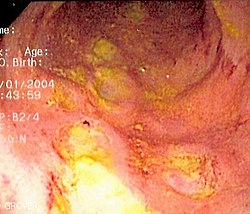
Photos of Crohn's DiseaseImage by Samir at English Wikipedia, licensed under Creative Commons Attribution-Share Alike 3.0
Photos of Crohn's DiseaseImage by The original uploader was Samir at English Wikipedia ., licensed under Creative Commons Attribution-Share Alike 3.0
Terminal ileum resected for Crohn's disease.Image by PPSE15, licensed under Creative Commons Attribution-Share Alike 4.0

Terminal ileum resected for Crohn's disease.

Distribution of gastrointestinal Crohn's diseaseImage by Samir , vectorized by Fvasconcellos, licensed under Creative Commons Attribution-Share Alike 3.0

Distribution of gastrointestinal Crohn's disease

An aphthous ulcer on the mucous membrane of the mouth in Crohn's diseaseImage by Photographer: User:TheBlunderbuss, licensed under Creative Commons Attribution-Share Alike 3.0

An aphthous ulcer on the mucous membrane of the mouth in Crohn's disease

A single lesion of erythema nodosumImage by James Heilman, MD, licensed under Creative Commons Attribution-Share Alike 3.0

A single lesion of erythema nodosum

Histopathology of a non-necrotizing granuloma of colonic mucosa in a patient with Crohn's disease, H&E stain. It is seen as an aggregate of histiocytes in the center of the image, having ample eosinophilic cytoplasm.

Histopathology of a non-necrotizing granuloma of colonic mucosa in a patient with Crohn's disease, H&E stain. It is seen as an aggregate of histiocytes in the center of the image, having ample eosinophilic cytoplasm.

Endoscopic image of colon cancer identified in the sigmoid colon on screening colonoscopy for Crohn's disease

Endoscopic image of colon cancer identified in the sigmoid colon on screening colonoscopy for Crohn's disease

NOD2 protein model with schematic diagram. Two N-terminal CARD domains (red) connected via helical linker (blue) with central NBD domain (green). At C-terminus LRR domain (cyan) is located. Additionally, some mutations which are associated with certain disease patterns in Crohn's disease are marked in red wire representation.[108]Image by Hsp90, LPKozlowski, Samir, licensed under Creative Commons Attribution-Share Alike 3.0

NOD2 protein model with schematic diagram. Two N-terminal CARD domains (red) connected via helical linker (blue) with central NBD domain (green). At C-terminus LRR domain (cyan) is located. Additionally, some mutations which are associated with certain disease patterns in Crohn's disease are marked in red wire representation.[108]

Photos of Crohn's DiseaseImage by Samir at English Wikipedia, licensed under Creative Commons Attribution-Share Alike 3.0
Photos of Crohn's DiseaseImage by The original uploader was Samir at English Wikipedia ., licensed under Creative Commons Attribution-Share Alike 3.0
Terminal ileum resected for Crohn's disease.Image by PPSE15, licensed under Creative Commons Attribution-Share Alike 4.0

Terminal ileum resected for Crohn's disease.

Distribution of gastrointestinal Crohn's diseaseImage by Samir , vectorized by Fvasconcellos, licensed under Creative Commons Attribution-Share Alike 3.0

Distribution of gastrointestinal Crohn's disease

Treatment Options

There are different ways to help people with Crohn's Disease feel better! 🩺Doctors often prescribe medicine to calm inflammation and reduce symptoms. Some people may need nutritional supplements if they can’t eat well. 🍽️ In more severe cases, surgery may be needed to remove part of the intestines. Rest and taking good care of the body are also important! Everyone is different, so treatments can vary for each person. 👩‍⚕️

Support And Resources

There are many places to find help and support for people with Crohn's Disease. 🌍Organizations like the Crohn's & Colitis Foundation offer information, resources, and ways to connect with other people who understand. Schools can also have support groups to help kids feel comfortable sharing their feelings. Having a team of support makes a big difference! Don’t forget to check out websites, books, and doctors for more information! 📚

Symptoms And Diagnosis

People with Crohn's Disease might feel stomach pain, get diarrhea, or feel really tired. 💧Some may have visible bumps on their skin or mouth sores, like little ulcers. If someone has these symptoms, doctors can help by doing a special test called a colonoscopy. This involves looking inside the intestines with a tiny camera. 😷It helps them find out if someone has Crohn's Disease. It’s crucial to visit a doctor if you feel unwell for a long time!

Causes And Risk Factors

The exact cause of Crohn's Disease is still a bit of a mystery! 🕵️‍♂️ Scientists think it might be a mix of genetics (what we get from our parents), our environment, and the immune system, which is our body's defense team. 📋For example, if someone in your family has it, you might have a higher chance of getting it. Additionally, smoking and unhealthy diets may also increase the risk of developing Crohn's. 🚭It's always best to eat healthy and stay active!

Types Of Crohn's Disease

Crohn's Disease has different types! The most common ones include:
1. Ileitis: Affects the last part of the small intestine. 🍽️
2. Colitis: Affects the colon (large intestine) and may cause diarrhea. 💩
3. Ileocolitis: A mix-up where both the ileum and colon are affected. 🚶‍♂️
4. Gastroduodenal Crohn's: This can hit the stomach and the first part of the small intestine. 🌮It's important for doctors to identify which type someone has to help them feel better!

Frequently Asked Questions

1. Can Crohn's Disease go away on its own?
No, it's a long-term condition, but it can be managed well!
2. Is there a cure for Crohn's Disease?
Not yet, but research is ongoing to find one!
3. Can kids with Crohn's play sports?
Yes, many kids can still play sports—just remember to listen to your body!
4. Does Crohn's Disease hurt?
It can cause pain, but doctors can help with medicine and treatments!
5. Can diet really help?
Yes! A good diet can make a big difference! 🍽️

Living With Crohn's Disease

Having Crohn's may feel different, but it doesn’t mean life is over! 🌈Many kids with Crohn's learn to manage their symptoms and enjoy life! It’s important to listen to their bodies, take breaks, and tell someone if they don’t feel well. Friends, family, and even teachers can be very supportive! 💖Sharing their experiences with others can help kids feel less alone. Remember, Crohn's can be managed, and fun times can still happen!

Lifestyle And Dietary Changes

Eating healthy foods can help manage Crohn's Disease! 🥦It’s good to have a balanced diet of fruits, veggies, and proteins. Drinking plenty of water is super important too! 💧Some foods might make symptoms worse, like spicy or fatty foods, so it's best to avoid them. Keeping a food diary can help people understand what foods are best for them. 🌟Regular exercise, like walking or biking, also helps people feel strong and happy!

Research And Future Directions

Scientists are always working hard to learn more about Crohn's Disease! 🔍They study how to make better medicines and find new ways to diagnose it. Researchers are also looking at how genes play a role in this disease. 🧬There's hope that with continued research, they will find new treatments or even a cure! Keeping up with studies helps people with Crohn's live healthier lives. 🧑‍🔬

Complications Of Crohn's Disease

Sometimes, Crohn's Disease can lead to more health problems. 😨People might have a higher chance of getting infections or other diseases because of ongoing inflammation. They may also have blockages in their intestines, which can be very painful! 🍃It’s important for kids with Crohn's to talk to a doctor about any changes they feel to avoid these complications. Staying on top of symptoms can help prevent additional health issues. 📈

Crohn's Disease Quiz

Q1
Question 1 of 10

Learn more about Crohn's Disease

Ready to create?

Make

To create a safe space for kid creators worldwide!

Create

Vibe Coding

Kids GPT

All Tools

Kibu

Resources

Worksheets

SafeTube

Blog

FAQ

Account

Pricing

Log-in

Sign-up

Data Deletion

Company

About

Community Guidelines

Privacy Policy

Terms of Service

2025, URSOR LIMITED. All rights reserved. DIY is in no way affiliated with Minecraft™, Mojang, Microsoft, Roblox™ or YouTube. LEGO® is a trademark of the LEGO® Group which does not sponsor, endorse or authorize this website or event. Made with love in San Francisco.