All Articles

Augustus

Augustus Facts For Kids

Augustus, the first Roman emperor, played a crucial role in the transformation of Rome and established an era of peace known as the Pax Romana.

🎨 Reading age for 6-8
Background blob
Augustus
Augustus
Facts for Kids!
Image by Justin Benttinen, licensed under Creative Commons Attribution-Share Alike 4.0

Do more with AI

Introduction

Augustus was a powerful leader who became the first Emperor of Rome! 🌟He was born on September 23, 63 BC, in Rome. His real name was Gaius Octavius Thurinus, but he was later called Augustus, which means "the revered one" in Latin. He played a huge role in changing the Roman Republic into the Roman Empire, a vast area that included places like modern-day Italy, France, and Spain. Augustus is celebrated for bringing peace to Rome after many years of war, a time called the "Pax Romana." 🕊️ His rule lasted until 14 AD, making him an important figure in history!

Images of Augustus

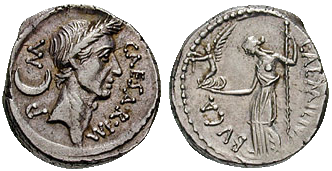
Denarius from 44 BC, showing Julius Caesar on the obverse and the goddess Venus on the reverse of the coin. Caption: CAESAR IMP. M. / L. AEMILIVS BVCA

Denarius from 44 BC, showing Julius Caesar on the obverse and the goddess Venus on the reverse of the coin. Caption: CAESAR IMP. M. / L. AEMILIVS BVCA

The Death of Caesar by Vincenzo Camuccini. On 15 March 44 BC, Octavian's adoptive father Julius Caesar was assassinated by a conspiracy led by Marcus Junius Brutus and Gaius Cassius Longinus. Galleria Nazionale d'Arte Moderna, Rome.

The Death of Caesar by Vincenzo Camuccini. On 15 March 44 BC, Octavian's adoptive father Julius Caesar was assassinated by a conspiracy led by Marcus Junius Brutus and Gaius Cassius Longinus. Galleria Nazionale d'Arte Moderna, Rome.

A bust of Augustus as a younger Octavian, dated c. 30 BC. Capitoline Museums, RomeImage by Gautier Poupeau from Paris, France, licensed under Creative Commons Attribution 2.0

A bust of Augustus as a younger Octavian, dated c. 30 BC. Capitoline Museums, Rome

Aureus bearing the portraits of Mark Antony (left) and Octavian (right), issued in 41 BC to celebrate the establishment of the Second Triumvirate. Both sides bear the inscription .mw-parser-output span.smallcaps{font-variant:small-caps}.mw-parser-output span.smallcaps-smaller{font-size:85%}III vir rpc, meaning 'One of Three Men for the regulation of the Republic'. Caption: m ant imp aug [w] IIIvir rpc m barbat q p [x] / caesar imp pont IIIvir rpc.[100][101]

Aureus bearing the portraits of Mark Antony (left) and Octavian (right), issued in 41 BC to celebrate the establishment of the Second Triumvirate. Both sides bear the inscription .mw-parser-output span.smallcaps{font-variant:small-caps}.mw-parser-output span.smallcaps-smaller{font-size:85%}III vir rpc, meaning 'One of Three Men for the regulation of the Republic'. Caption: m ant imp aug [w] IIIvir rpc m barbat q p [x] / caesar imp pont IIIvir rpc.[100][101]

A denarius minted c. 18 BC. Obverse: CAESAR AVGVSTVS; reverse: comet of eight rays with tail upward; DIVVS IVLIV[S], "divine Julius".

A denarius minted c. 18 BC. Obverse: CAESAR AVGVSTVS; reverse: comet of eight rays with tail upward; DIVVS IVLIV[S], "divine Julius".

Fresco paintings inside the House of Augustus, his residence during his reign as emperorImage by Cassius Ahenobarbus, licensed under Creative Commons Attribution-Share Alike 3.0

Fresco paintings inside the House of Augustus, his residence during his reign as emperor

A denarius of Sextus Pompeius, minted for his victory over Octavian's fleet. Obverse: the place where he defeated Octavian, Pharus of Messina decorated with a statue of Neptune; before that galley adorned with aquila, sceptre & trident; MAG. PIVS IMP. ITER. Reverse, the monster Scylla, her torso of dogs and fish tails, wielding a rudder as a club. Caption: PRAEF[ECTUS] CLAS[SIS] ET ORAE MARIT[IMAE] EX S. C.Image by CNG, licensed under Creative Commons Attribution-Share Alike 3.0

A denarius of Sextus Pompeius, minted for his victory over Octavian's fleet. Obverse: the place where he defeated Octavian, Pharus of Messina decorated with a statue of Neptune; before that galley adorned with aquila, sceptre & trident; MAG. PIVS IMP. ITER. Reverse, the monster Scylla, her torso of dogs and fish tails, wielding a rudder as a club. Caption: PRAEF[ECTUS] CLAS[SIS] ET ORAE MARIT[IMAE] EX S. C.

Antony and Cleopatra, by Lawrence Alma-Tadema, painted 1885

Antony and Cleopatra, by Lawrence Alma-Tadema, painted 1885

The Battle of Actium, by Laureys a Castro, painted 1672 National Maritime Museum, London

The Battle of Actium, by Laureys a Castro, painted 1672 National Maritime Museum, London

Denarius from 44 BC, showing Julius Caesar on the obverse and the goddess Venus on the reverse of the coin. Caption: CAESAR IMP. M. / L. AEMILIVS BVCA

Denarius from 44 BC, showing Julius Caesar on the obverse and the goddess Venus on the reverse of the coin. Caption: CAESAR IMP. M. / L. AEMILIVS BVCA

The Death of Caesar by Vincenzo Camuccini. On 15 March 44 BC, Octavian's adoptive father Julius Caesar was assassinated by a conspiracy led by Marcus Junius Brutus and Gaius Cassius Longinus. Galleria Nazionale d'Arte Moderna, Rome.

The Death of Caesar by Vincenzo Camuccini. On 15 March 44 BC, Octavian's adoptive father Julius Caesar was assassinated by a conspiracy led by Marcus Junius Brutus and Gaius Cassius Longinus. Galleria Nazionale d'Arte Moderna, Rome.

A bust of Augustus as a younger Octavian, dated c. 30 BC. Capitoline Museums, RomeImage by Gautier Poupeau from Paris, France, licensed under Creative Commons Attribution 2.0

A bust of Augustus as a younger Octavian, dated c. 30 BC. Capitoline Museums, Rome

Aureus bearing the portraits of Mark Antony (left) and Octavian (right), issued in 41 BC to celebrate the establishment of the Second Triumvirate. Both sides bear the inscription .mw-parser-output span.smallcaps{font-variant:small-caps}.mw-parser-output span.smallcaps-smaller{font-size:85%}III vir rpc, meaning 'One of Three Men for the regulation of the Republic'. Caption: m ant imp aug [w] IIIvir rpc m barbat q p [x] / caesar imp pont IIIvir rpc.[100][101]

Aureus bearing the portraits of Mark Antony (left) and Octavian (right), issued in 41 BC to celebrate the establishment of the Second Triumvirate. Both sides bear the inscription .mw-parser-output span.smallcaps{font-variant:small-caps}.mw-parser-output span.smallcaps-smaller{font-size:85%}III vir rpc, meaning 'One of Three Men for the regulation of the Republic'. Caption: m ant imp aug [w] IIIvir rpc m barbat q p [x] / caesar imp pont IIIvir rpc.[100][101]

A denarius minted c. 18 BC. Obverse: CAESAR AVGVSTVS; reverse: comet of eight rays with tail upward; DIVVS IVLIV[S], "divine Julius".Image by Carlomorino, licensed under Creative Commons Attribution-Share Alike 3.0

A denarius minted c. 18 BC. Obverse: CAESAR AVGVSTVS; reverse: comet of eight rays with tail upward; DIVVS IVLIV[S], "divine Julius".

Fresco paintings inside the House of Augustus, his residence during his reign as emperorImage by Cassius Ahenobarbus, licensed under Creative Commons Attribution-Share Alike 3.0

Fresco paintings inside the House of Augustus, his residence during his reign as emperor

A denarius of Sextus Pompeius, minted for his victory over Octavian's fleet. Obverse: the place where he defeated Octavian, Pharus of Messina decorated with a statue of Neptune; before that galley adorned with aquila, sceptre & trident; MAG. PIVS IMP. ITER. Reverse, the monster Scylla, her torso of dogs and fish tails, wielding a rudder as a club. Caption: PRAEF[ECTUS] CLAS[SIS] ET ORAE MARIT[IMAE] EX S. C.Image by CNG, licensed under Creative Commons Attribution-Share Alike 3.0

A denarius of Sextus Pompeius, minted for his victory over Octavian's fleet. Obverse: the place where he defeated Octavian, Pharus of Messina decorated with a statue of Neptune; before that galley adorned with aquila, sceptre & trident; MAG. PIVS IMP. ITER. Reverse, the monster Scylla, her torso of dogs and fish tails, wielding a rudder as a club. Caption: PRAEF[ECTUS] CLAS[SIS] ET ORAE MARIT[IMAE] EX S. C.

Antony and Cleopatra, by Lawrence Alma-Tadema, painted 1885

Antony and Cleopatra, by Lawrence Alma-Tadema, painted 1885

The Battle of Actium, by Laureys a Castro, painted 1672 National Maritime Museum, London

The Battle of Actium, by Laureys a Castro, painted 1672 National Maritime Museum, London

Legacy

The legacy of Augustus continues to impact our world! 🌍His leadership style set the standard for future emperors and rulers. He showed how important it is to create stability and ensure the well-being of citizens. The time of peace he created, known as the Pax Romana, lasted for over 200 years and allowed trade, culture, and ideas to spread. Augustus’s name became a symbol of greatness, and even today, we learn about his incredible life and accomplishments. His contributions to politics, military strategies, and culture helped shape the Roman Empire and world history forever! 📚

Early Life

Augustus came from a wealthy family in Rome! His father was a senator, and he was raised in a time when Rome was a Republic. 🏛️ When he was just four years old, his father died. Augustus grew up under the care of his great-uncle, Julius Caesar, who would later adopt him. Young Augustus was intelligent and showed great leadership skills. During his childhood, he noticed that Rome was often unsafe and full of fighting. This influenced him to create a safer and better Rome when he grew older. Augustus learned to be brave and smart, traits that would help him later on! 🌠

Rise To Power

After Julius Caesar was killed in 44 BC, Augustus (then called Octavian) wanted to honor him and seek revenge! ⚔️ With his friends Marc Antony and Lepidus, he formed the "Second Triumvirate" to take control of Rome. They battled against the people who killed Caesar. After winning the famous battle of Actium in 31 BC against Antony and Cleopatra, he became the sole leader of Rome. In 27 BC, Octavian was given the title "Augustus" by the Senate, marking the start of his reign as the first Emperor of Rome. The city and the empire began to prosper under his power! 🏆

Reign As Emperor

Augustus ruled Rome for more than 40 years, making many positive changes. He worked hard to build roads, improve trade, and create a postal system 📫, which helped people communicate across the empire! Augustus was also concerned about the people’s happiness, so he built public buildings, temples, and even theaters. His reign was a time of great peace and stability, known as the Pax Romana. He wanted to ensure that everyone felt secure and included in Roman life. Augustus showed that a leader could bring people together to create a better, stronger society! 🌈

Historical Impact

Augustus changed history by transforming Rome from a republic into a thriving empire! 🏛️ His rule marked the beginning of the Roman Empire, which lasted for nearly 500 years. His ideas about governance, military strength, and cultural growth influenced many countries after him. Many leaders looked up to Augustus, and even today, we see his policies reflected in modern governments. The peace and stability he established allowed trade and communication to grow across continents. Augustus’s impact on history shows how one leader can change the course of a civilization! 🌠

Political Reforms

As Emperor, Augustus made many important laws that helped improve Roman life! He organized the government into well-structured groups called provinces 📜, making it easier to rule the vast Empire. Augustus also improved the tax system to ensure fair collection, which meant more money for public projects. He introduced laws that encouraged marriage and family life, aiming to strengthen Roman society. Augustus even made sure that government officials were qualified and honest. These political reforms laid the foundation for a stronger Rome, showing that good leadership can change a nation! 🇷🇴

Military Achievements

Augustus was a brilliant military leader too! 🛡️ He led many successful campaigns to defend the Roman Empire and expand its territories. He built a professional army that was well-trained and loyal. Augustus established important borders, known as "limes," to protect Rome from invaders. He fought against tribes in places like Germania, and his military strategies helped keep the Empire safe. Under his leadership, the army became a powerful force that brought respect and security to Rome. Augustus knew that strength and safety were necessary to maintain peace in the Empire! ⚔️

Cultural Contributions

Augustus believed that art and culture should flourish in Rome! 🎨He encouraged poets like Virgil and Horace, who wrote beautiful stories and poems that are still loved today. He built grand structures like the Forum of Augustus, a public space that showcased Roman architecture. Augustus also emphasized the importance of religion by restoring temples and promoting traditional Roman gods. His love for culture inspired citizens and elevated Roman society. Augustus proved that leadership is not just about power, but also about promoting creativity and the arts! 🌟

Augustus Quiz

Q1
Question 1 of 10

Learn more about Augustus

Ready to create?

Drop Files here
Make

To create a safe space for kid creators worldwide!

Create

Vibe Coding

Kids GPT

All Tools

Kibu

Resources

Worksheets

SafeTube

Blog

FAQ

Account

Pricing

Log-in

Sign-up

Data Deletion

Company

About

Community Guidelines

Privacy Policy

Terms of Service

2025, URSOR LIMITED. All rights reserved. DIY is in no way affiliated with Minecraft™, Mojang, Microsoft, Roblox™ or YouTube. LEGO® is a trademark of the LEGO® Group which does not sponsor, endorse or authorize this website or event. Made with love in San Francisco.