Antikythera Mechanism Facts For Kids
The Antikythera Mechanism is an ancient Greek hand-powered orrery that was used to predict astronomical positions and eclipses.

About this topic
Key Points
Photos of Antikythera Mechanism

Antikythera Mechanism — photo 1

Derek J. de Solla Price (1922–1983) with a model of the Antikythera mechanism

Computer-generated front panel of the Freeth model

Front panel of a 2007 re-creation
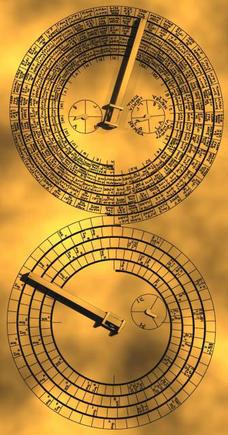
Computer-generated back panel

ΣΚΓ, indicating the Saros cycle of 223 months
![A hypothetical schematic representation of the gearing of the Antikythera Mechanism, including the 2012 published interpretation of existing gearing, gearing added to complete known functions, and proposed gearing to accomplish additional functions, namely true sun pointer and pointers for the five then-known planets, as proposed by Freeth and Jones, 2012.[7] Based also upon similar drawing in the Freeth 2006 Supplement[17] and Wright 2005, Epicycles Part 2.[80] Proposed (as opposed to known from the artefact) gearing crosshatched.](https://upload.wikimedia.org/wikipedia/commons/thumb/5/59/AntikytheraMechanismSchematic-Freeth12.png/960px-AntikytheraMechanismSchematic-Freeth12.png)
A hypothetical schematic representation of the gearing of the Antikythera Mechanism, including the 2012 published interpretation of existing gearing, gearing added to complete known functions, and proposed gearing to accomplish additional functions, namely true sun pointer and pointers for the five then-known planets, as proposed by Freeth and Jones, 2012.[7] Based also upon similar drawing in the Freeth 2006 Supplement[17] and Wright 2005, Epicycles Part 2.[80] Proposed (as opposed to known from the artefact) gearing crosshatched.


Gearing layout proposed by Michael T. Wright for planetary indication on the Antikythera mechanism . Wright proposed an arrangement of individual pointers on the front face with their spindles coaxial to each other. The inferior planet mechanism and solar anomaly mechanism are very similar to that adopted by Freeth and Jones in their later model. The inferior planet systems use b1 as an epicyclic platform. The superior planets all follow the same basic design idea and for clarity only the mechanism for Jupiter is shown here. Each system is located on a frame attached to the body of the mechanism as a whole and each system has its own 224 toothed epicyclic carrier, driven from b1 by coaxial gears (as seen to the left of the mechanism in grey) at the same angular velocity (essentially b1/z * z/b1 = 1). Above this gear is a platform on which more gears ride. The spindle is attached to a gear which is fixed (by square pin) to the frame of the mechanism. Thus the system is essentially a compound epicyclic system. All in all each system has up to 8 gears. When the system's 224 toothed gear turns it turns another gear which follows on by turning two more gears, one which turns the pin carrier which is on the edge of the upper plate this pin carrier drives the slot follower which in turn induces anomaly in the rotation of the spindle. The other gear is a smaller one on the same axis which turns the fixed gear on the upper plate, this then forces motion around the fixed spindle gear. This motion serves to subtract an angular velocity from the mean sun gear's angular velocity. (This part is not encyclopaedic) Unfortunately tooth counts for Wright's mechanism are not publicly available or published as of this date so exact ratios cannot be calculated, but from images and estimated counts they match up fairly well with what is to be expected from each planet and anomaly. The idea of planetary indication on the Antikythera mechanism is relatively hotly debated because no hard evidence has ever been found to prove once and for all if such a display existed and if it did how it was engineered. This image is just a general arrangement of the gearing layout, in a similar style to the image on commons of the known mechanism. This image omits all of the known mechanism apart from a1 and b1 to show where in relation the proposed gears fit. Also omitted are the mechanisms for Mars and Saturn because of clarity. If more detailed information about the proposed system and how it would be constructed and used please read M.T. Wright's articles: The Greek Planetarium: a new reconstruction of the Antikythera Mechanism The Antikythera Mechanism: a Review of the Evidence, and the Case for Reconstruction as a Planetarium. Presentation Given for NHRF Athens, 6th March 2007

Gearing layout proposed by Evans et al for planetary indication on the Antikythera mechanism. This team propose individual dials placed around the main face of the mechanism, with simple gearing and markings on the respective dial faces showing such information as: rising, setting, reversing and so forth of said planet. Gear trains are: Mars: 224/71 * 19/128 = 0.4683 Jupiter: 224/86 * 45/128 = 0.9157 Saturn: 224/53 * 24/105 = 0.966 Mercury: 224/57 * 77/96 = 3.152 Venus: 224/29 * 25/63 * 20/98 = 0.6255 The idea of planetary indication on the Antikythera mechanism is relatively hotly debated because no hard evidence has ever been found to prove once and for all if such a display existed and if it did how it was engineered. This image is just a general arrangement of the gearing layout, in a similar style to the image on commons of the known mechanism. This image omits all of the known mechanism apart from a1 and b1 to show where in relation the proposed gears fit. If more detailed information about the proposed dials and how one would read them is required then please read Evans, Carmen and Thorndike's article entitled "SOLAR ANOMALY AND PLANETARY DISPLAYS IN THE ANTIKYTHERA MECHANISM"