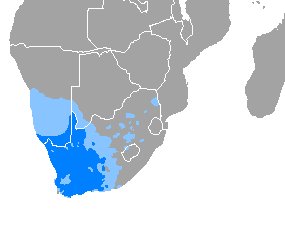
Afrikaans is a West Germanic language that developed from Dutch and is primarily spoken in South Africa and Namibia.
Set reading age
View for Kids
Easy to read and understand
View for Students
Clear, detailed explanations
View for Scholars
Deep dives and big ideas
Afrikaans is a fun and interesting language spoken mainly in South Africa and Namibia. 🇿🇦 It evolved from Dutch and is one of the 11 official languages of South Africa! The word "Afrikaans" means "Africans" in Dutch, reflecting its roots. People who speak Afrikaans communicate with each other in schools, homes, and even in music! 🎶Many words are similar to English, like "boek" (book) and "huis" (house). Today, about 7 million people speak Afrikaans. Whether sharing stories or singing songs, Afrikaans is a vital part of South Africa's rich culture! 🌍
Schools in South Africa teach Afrikaans as one of the main languages! 🏫Many students learn in Afrikaans from a young age, helping them express themselves better. Classrooms use Afrikaans for subjects like math, science, and art. Learning the language also helps kids connect with their roots and enjoy local stories. 📖To encourage children to read more, teachers often recommend fun stories and books in Afrikaans! Educational videos and online resources make learning Afrikaans exciting, using games and songs! 🎵This makes it easy and enjoyable for kids to practice speaking and reading.
Afrikaans is known for its simple and easy grammar. 😄For example, there are no complex verb conjugations like in French or Spanish! Most regular verbs end in "-e," making them easy to remember. Sentences often follow a straightforward structure, like "Subject-Verb-Object," as in "I love ice cream!" (Ek hou van roomys!). 🍦Many Afrikaans words are similar to Dutch and English, so learning Afrikaans can even help with these languages! Did you know it uses some fun slang words, too? "Lekker" means good or nice! 😋
Afrikaans has a rich world of literature, from poetry to novels! 📚One famous writer is André P. Brink, known for his powerful stories about life in South Africa. Children can enjoy delightful children's books like "Die Vark se Snot" by Janie Oosthuysen, filled with humor and adventure! 🐷Literature in Afrikaans often highlights important themes, like friendship, nature, and history. Authors use storytelling as a way to connect readers with their culture and experiences. 📖This literary treasure serves to inspire young minds and encourages creativity through reading!
The story of Afrikaans began in the 17th century when Dutch settlers arrived in South Africa. 🚢They interacted with people from other cultures, such as the Khoisan, African tribes, and slaves from Asia. Over time, their language blended together, and Afrikaans started to form. By the early 1900s, Afrikaans was recognized as a separate language rather than just a Dutch dialect. 🥳In 1925, Afrikaans became an official language in South Africa, which was a big deal! Today, Afrikaans helps connect people and tells the history of diverse cultures in the region. 📖
Afrikaans is more than just a language; it holds cultural importance in South Africa! 🎉It's spoken by people from various backgrounds, celebrating their unique traditions through music, food, and art. One popular music genre is "Afrikaans rock," which brings people together at festivals. 🌈Stories and poems written in Afrikaans share the experiences of local communities. This language helps preserve cultural identity and allows people to express their feelings, traditions, and dreams. 🌟Afrikaans also plays a role in promoting unity among South Africans!
Afrikaans is not the same everywhere! 😃There are different variants and dialects based on regions or communities. Some well-known dialects are Cape Afrikaans, spoken mainly in the Western Cape, and Orange River Afrikaans in the Northern Cape. Another fun variant is the "Kaaps" dialect, often spoken in Cape Town, which has its unique slang words! 🗣️ These variations show how Afrikaans is influenced by local cultures and languages. As kids learn about these differences, they can appreciate the colorful diversity in language within South Africa!
Today, Afrikaans continues to thrive in South Africa! 🌍While it faces competition from other languages, many people are proud to speak Afrikaans. Schools and communities promote the language through events, like Afrikaans poetry competitions and music festivals! 🎤Efforts are being made to keep the language alive among young people, ensuring it remains vibrant for future generations. 🌱As friends share stories and experiences in Afrikaans, it helps build understanding and unity in a diverse nation! The future of Afrikaans looks bright and colorful! 😄
There are lots of exciting ways to learn Afrikaans! 📚Kids can visit local libraries for books and stories in Afrikaans. One fun website is Duolingo, which offers games and lessons for beginners! 🎮YouTube has many channels with catchy songs and children’s shows in Afrikaans, making it easy to practice listening. Movies and cartoons can also introduce new vocabulary while being entertaining! 🎬Another great idea is to chat with friends or family who speak Afrikaans; it’s one of the best ways to practice! 🚀Let’s learn Afrikaans and have fun at the same time!