Your Favorite Speech
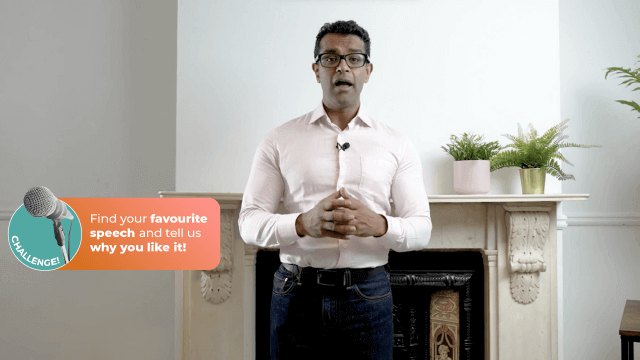
Write and practice your favorite short speech, design simple cue cards or props, then deliver and record it to improve confidence and speaking skills.
About this activity
Write and practice your favorite short speech, design simple cue cards or props, then deliver and record it to improve confidence and speaking skills.
What you need
Step by step
- 1
Step 1
Choose a topic you love to talk about like a hobby a favorite book a pet or something funny.
- 2
Step 2
Decide how long your speech will be for example 30–60 seconds or 1–2 minutes.
- 3
Step 3
Write one clear opening sentence that tells your audience what your speech is about.
- 4
Step 4
Write the first short main point that explains why you picked this topic.
- 5
Step 5
Write the second short main point that gives another reason or example.
- 6
Step 6
Write a short closing sentence that wraps up and thanks your listeners.
- 7
Step 7
Read your whole speech out loud slowly to check for words you want to change.
- 8
Step 8
Take three index cards or fold three small pieces of paper to make cue cards.
- 9
Step 9
On each card write one main point in big clear letters so you can see them while speaking.
- 10
Step 10
Add a tiny drawing or a keyword on each card to help you remember the point.
- 11
Step 11
Pick one small prop or costume piece from home that matches your topic and place it where you will perform.
- 12
Step 12
Practice delivering your speech aloud three times using the cue cards and the prop.
- 13
Step 13
Record your speech one time ask an adult for help if you need it.
- 14
Step 14
Watch your recording once and notice one thing you did well.
- 15
Step 15
Share your finished speech on DIY.org
Fun facts
How do I run the 'Your Favorite Speech' activity with my child?
To run 'Your Favorite Speech', help your child pick a short, familiar topic like a favorite toy or animal. Guide them to write a 30–90 second speech: a one-sentence intro, two brief points, and a closing line. Make simple cue cards with a word or picture per card and add one small prop. Practice aloud with breathing and posture warmups, then record the delivery. Watch together, praise strengths, and choose one small improvement for next time.
What materials do I need for the 'Your Favorite Speech' activity?
Gather paper and pencils for drafting, index cards or small pieces of paper for cue cards, and markers or stickers for visuals. Optional props like a favorite toy, picture, or simple costume can boost confidence. Use a smartphone or tablet to record and a timer to keep speeches short. Choose a quiet, comfortable space. Keep tech supervised and focus on simple tools so the speaking practice stays central.
What ages is the 'Your Favorite Speech' activity suitable for?
This activity fits children roughly ages 4–13 with adjustments. Ages 4–6 benefit from adult-led, imitation-style speeches of 10–30 seconds. Ages 7–9 can write and rehearse 30–60 second speeches using simple cue cards. Ages 10–13 can plan 60–90 second talks, add props, and self-review recordings. Tailor length, vocabulary, and parental support to each child’s attention span and comfort level.
What are the benefits and safety tips for 'Your Favorite Speech'?
Benefits include boosted confidence, clearer vocabulary, improved organization, memory, and nonverbal skills like eye contact. It encourages storytelling and critical thinking. For safety, never post a child’s video online without parental consent; store recordings privately and review before sharing. Keep feedback positive and specific. If a child is nervous, shorten the speech, use familiar props, and emphasize fun over perfection to build comfort.
Watch & Learn
Need help?
What can we use if we don't have index cards, a small prop, or a camera to record the speech?
Fold three pieces of printer paper or cut thin cardboard from a cereal box for the cue cards, use a toy, printed picture, or kitchen item as the 'small prop or costume piece,' and record the speech with a phone, tablet, or an adult's camera as part of the 'record your speech one time' step.
What should we do if the child keeps forgetting lines or gets too nervous when recording?
If lines are forgotten or nerves appear during the 'practice delivering your speech aloud three times' and recording steps, slow the pace, rely on the big clear letters and tiny drawings on each cue card, rehearse the speech more than three times, and ask an adult to help with the recording.
How can this activity be adapted for younger kids or older kids?
For younger children, choose a 30–60 second length, help write the single opening sentence and use big drawings on each of the three cue cards, while older kids can aim for 1–2 minutes, add an extra main point or a fourth card, practice more than three times, and polish the recording before sharing on DIY.org.
How can we make the speech more creative or longer-term as a project?
To enhance the activity, create a matching poster or simple slides to place behind you when you 'pick one small prop or costume piece,' add a costume or sound effects, practice additional runs, watch the recording to note one thing you did well and one improvement, and then share the finished speech on DIY.org.