Take the Frog Hopping Pose Challenge
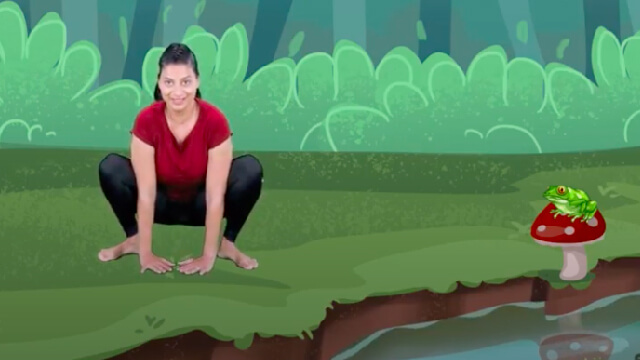
Practice the frog-hopping yoga pose: bend knees, balance hands, hop like a frog safely, count hops, and improve strength and flexibility.
About this activity
Practice the frog-hopping yoga pose: bend knees, balance hands, hop like a frog safely, count hops, and improve strength and flexibility.
What you need
Step by step
- 1
Step 1
Put on comfortable clothes that let you move easily.
- 2
Step 2
Lay a soft mat or towel on the floor so you have a comfy landing.
- 3
Step 3
Warm up by marching in place or doing 10 gentle jumps for 30 seconds.
- 4
Step 4
Stand with your feet wider than your hips and turn your toes slightly outward.
- 5
Step 5
Bend your knees and lower into a deep squat so your thighs are near parallel to the floor.
- 6
Step 6
Place your hands on the floor in front of you shoulder-width apart.
- 7
Step 7
Press into your hands and feet to find a steady, balanced frog position.
- 8
Step 8
Say out loud how many hops you will do so you are ready to count (for example say "1 2 3 4 5").
- 9
Step 9
Hop forward like a frog five times with soft landings using your hands and feet to catch yourself.
- 10
Step 10
Rest and sip water for 30 seconds to recover.
- 11
Step 11
Repeat the five-hop set two more times so you complete three sets total.
- 12
Step 12
Sit and do a gentle hip and ankle stretch for 30 seconds on each side to improve flexibility.
- 13
Step 13
Share a photo or short description of your frog-hopping practice on DIY.org
Fun facts
How do you do the Frog Hopping Pose Challenge with my child?
Start with a short warm-up (ankle circles, gentle squats). Demonstrate the frog pose: feet wider than hips, toes turned out, knees bent into a deep squat, hands placed on the floor in front. Shift weight into hands and hop forward a few inches, landing softly back into the squat. Count each small hop aloud, take breaks between sets, encourage steady breathing. Keep hops low and controlled to reduce risk of falls.
What materials do I need for the Frog Hopping Pose Challenge?
You don't need special equipment—just comfortable clothing and a non-slip surface like a yoga mat or carpet. Optional items: a soft mat for extra cushioning, a small towel, water bottle, and a timer or counting beads to track hops. Have a clear, open space away from furniture. Adult supervision is recommended, plus a small reward (stickers) to motivate younger children.
What ages is the frog-hopping pose challenge suitable for?
This activity suits children roughly three to ten years old, adjusted for coordination and strength. Toddlers (around three to four) need close hands-on supervision and simplified tiny hops. Preschool and early-school-age kids (four to seven) can practice short sets with breaks. Older children (eight to ten) can increase repetitions and try longer hops. Always consider the child's balance, joint health, and attention span before advancing.
What safety tips should I know before trying the frog-hopping pose challenge?
Safety-first tips: practice on a soft, non-slip surface and clear the area of furniture. Keep hops low, landing softly with knees bent to absorb impact. Supervise closely for children under six and stop if there is pain. Modify by holding a parent's hands for balance or doing frog squats without hopping. Cool down with gentle stretches. If your child has joint, balance, or heart issues, consult a pediatrician before starting.
Watch & Learn
Need help?
What can we use if we don't have a soft mat or towel for the comfy landing?
If you don't have a soft mat or towel, use a folded blanket, yoga mat, stacked bath towels, or a carpeted area to provide a comfy landing for the frog hops.
I'm losing my balance when I press into my hands and feet or during the five forward hops—how can we fix that?
If you lose balance while following the 'press into your hands and feet' step or during the five forward hops, make each hop smaller and slower, move your hands slightly closer to your feet, and practice holding the deep squat a few seconds before hopping.
How can this challenge be adapted for a 3-year-old versus a 12-year-old?
For a 3-year-old do one set of three tiny hops with a parent spotting and extra padding from the mat/towel, and for a 12-year-old increase to more sets or hops or add a timed round to the three-set routine.
How can we make the frog-hopping challenge more fun or more challenging?
To enhance the activity, play upbeat music, count hops out loud as the instructions say, increase each set from five to seven hops or time each set for speed, and share a photo or short description of progress on DIY.org.