Share secret messages with a scytale
Make a scytale cipher using a cardboard tube and paper strip, encode and decode secret messages, and explore simple ancient encryption.
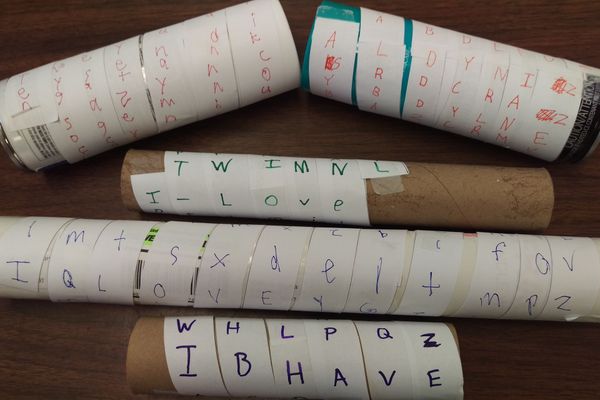
About this activity
Make a scytale cipher using a cardboard tube and paper strip, encode and decode secret messages, and explore simple ancient encryption.
What you need
Step by step
- 1
Step 1
Gather all the materials from the list and bring them to a clear table or floor space.
- 2
Step 2
Lay the cardboard tube on the paper and use the pencil to trace along the length of the tube to mark how long your strip should be.
- 3
Step 3
Use the ruler to draw two straight parallel lines about 2 to 3 centimeters apart along the traced area to mark the strip width.
- 4
Step 4
Cut out the paper strip along the lines using scissors.
- 5
Step 5
Wrap the paper strip snugly around the tube so the ends meet and tape or glue the ends to hold it in place.
- 6
Step 6
With the strip wrapped on the tube use the marker to write your secret message in one straight line along the length of the tube so letters sit across the wrapped turns.
- 7
Step 7
Carefully slide the paper off the tube and lay the strip flat to see the scrambled secret message.
- 8
Step 8
To decode the message wrap the scrambled strip back around the same size tube so the ends match and read the letters along the line to reveal the original message.
- 9
Step 9
Write a new secret message and give the scrambled strip to a friend or family member to decode.
- 10
Step 10
Try using a different size tube or a wider strip and observe how the encoded message looks different.
- 11
Step 11
Decorate or color your strip to make your scytale look ancient or mysterious.
- 12
Step 12
Share your finished scytale and secret messages on DIY.org
Fun facts
How do you make and use a scytale cipher?
To make and use a scytale cipher, wrap a long narrow strip of paper tightly around a cardboard tube so edges line up. Keeping it wrapped, write your secret message across the paper horizontally, placing one letter per wrap segment. Unwrap the strip to scramble the letters. Give the strip to someone who has the same-size tube; when they rewrap it correctly the original message reads across the tube.
What materials do I need for a scytale cipher activity?
You’ll need a cardboard tube (paper towel or mailing tube), a long strip of paper (cut from printer paper or poster board), a pencil or marker, scissors to cut the strip, and tape to hold the paper on the tube while writing. Optional items: ruler for even spacing, stickers or colored pens for decoration, and a second tube of the same diameter for decoding practice.
What ages is the scytale cipher suitable for?
This activity suits children about 6 years and up who can write and follow wrapping patterns; younger children (4–5) can join with adult help for cutting and wrapping. It builds fine motor skills and early reasoning. Supervise scissors and small parts. Adapt complexity by using single-word messages for beginners or longer sentences and spacing patterns for older kids and tweens.
What are the benefits of making a scytale cipher?
Making a scytale teaches basic encryption, pattern recognition, and sequencing while linking to ancient history. It strengthens fine motor control, early coding concepts, teamwork, and problem-solving as kids encode and decode messages. It’s low-cost, encourages curiosity about secret communication, and can be expanded into games, secret-mail exchanges, or cross-curricular lessons in history and math.
Watch & Learn
Need help?
What can we use if we don't have a cardboard tube?
If you don't have a cardboard tube, roll a piece of thin cardboard or use a similarly sized marker, glue stick, or paper towel tube and tape it so the paper strip can be wrapped snugly.
My decoded message looks scrambled—what went wrong?
If the decoded message is scrambled, make sure you wrapped the paper strip snugly with the ends matched and wrote the secret in one straight line while the strip was on the tube as the instructions say.
How can I adapt this activity for different age groups?
For younger kids, an adult can pre-trace and pre-cut the 2–3 cm paper strip and help tape it to the tube, while older kids can measure with the ruler themselves and try different-size tubes or wider strips to increase the challenge.
How can we make the scytale more creative or harder to decode?
As the instructions suggest, decorate or color your strip and also try different-size tubes or wider strips and even add a letter-number substitution to create a personalized, layered secret message.