Recreate Monstera Leaf on Paper
Draw and paint a Monstera leaf on paper using pencil, paint, and a simple stencil to explore leaf shape, holes, symmetry, and texture.
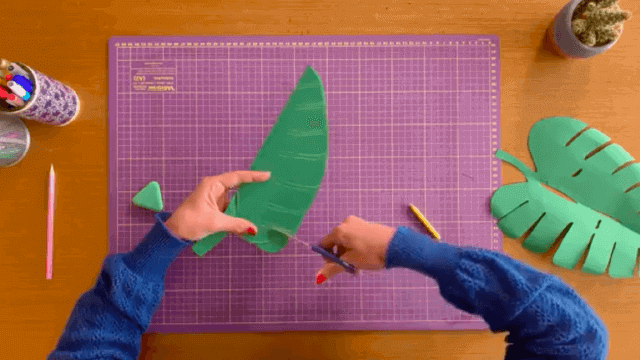
About this activity
Draw and paint a Monstera leaf on paper using pencil, paint, and a simple stencil to explore leaf shape, holes, symmetry, and texture.
What you need
Step by step
- 1
Step 1
Gather all your materials and set them on a clean flat table.
- 2
Step 2
Fold your scrap cardboard in half along the long edge to prepare a folded stencil.
- 3
Step 3
Draw half of a Monstera leaf along the folded edge including big splits and a few round or oval holes.
- 4
Step 4
Cut out the leaf shape from the folded cardboard to make a symmetrical stencil using scissors with adult help.
- 5
Step 5
Place the finished stencil flat on your paper where you want the leaf to be.
- 6
Step 6
Trace the stencil outline and the inner hole shapes with your pencil.
- 7
Step 7
Draw a center vein from the base to the tip and add paired side veins to show symmetry.
- 8
Step 8
Choose two or three green paints and mix a light base green on your palette.
- 9
Step 9
Paint the whole leaf area inside your pencil outline with the base green color.
- 10
Step 10
Use a smaller brush and a darker green to paint the center vein and side veins for depth and texture.
- 11
Step 11
Dab a sponge or use a dry brush with a lighter green to add soft highlights and leaf texture.
- 12
Step 12
Let your painting dry completely before touching it.
- 13
Step 13
Erase any visible pencil lines gently once the paint is dry.
- 14
Step 14
Sign your name on the picture to show your artist credit.
- 15
Step 15
Share your finished Monstera leaf on DIY.org
Fun facts
How do I recreate a Monstera leaf on paper?
Start by studying a real Monstera photo to notice split edges and holes. Place a simple stencil or lightly sketch the leaf outline with pencil, marking where the holes and lobes will sit to keep symmetry. Refine your pencil lines, then paint a base green wash. Add darker greens for veins and shadows and lighter greens for highlights and texture. Let dry, erase stray pencil marks, then add fine details with a thin brush or marker.
What materials do I need to draw and paint a Monstera leaf?
Gather pencil and eraser, sturdy paper (watercolor or mixed-media), a simple stencil (cardboard or printable), paints (watercolor, tempera, or acrylic), a few brushes (flat and round), a palette or plate, cup of water, and paper towel. Optional: fine-tip marker for detailing and a pencil sharpener. Choose non-toxic, washable paints for younger children and a protective table covering to keep things tidy.
What ages is the Monstera leaf activity suitable for?
This activity adapts well: ages 3–5 enjoy tracing a stencil and painting with supervision, focusing on color and big shapes. Ages 6–8 can sketch freehand, add holes and simple shading. Ages 9+ can explore symmetry, texture, and more detailed painting techniques. Always supervise cutting stencils and select materials appropriate for the child’s motor skills and attention span.
What are the benefits of drawing and painting a Monstera leaf?
Recreating a Monstera leaf builds observation skills, fine motor control, and spatial awareness (holes, lobes, symmetry). Painting teaches color mixing, layering, and texture techniques while promoting creativity and focus. The activity links art to nature, encouraging curiosity about plants. It’s calming and boosts confidence when the child sees a finished result they created, and it’s easy to adapt for skill-building or relaxation.
Watch & Learn
Need help?
What can we use if we don't have scrap cardboard or a sponge?
If you don't have scrap cardboard for the folded stencil, cut a cereal box or thick poster board folded along the long edge to make the stencil, and if you lack a sponge dab highlights with a crumpled paper towel or cotton ball after painting.
My stencil keeps moving when I trace and paint, and the paint sometimes bleeds—what should we do?
Tape the finished folded stencil flat to your paper with masking tape before tracing and painting to stop shifting, use thin paint layers and let your painting dry completely between steps to avoid bleeding and smudges.
How can this activity be adapted for younger children or older kids?
For younger children have an adult cut a larger, simpler leaf stencil and let them color with green markers or crayons, while older kids can mix two or three greens, use the small brush for veins and a sponge for highlights to add texture and detail.
How can we extend or personalize the Monstera leaf project?
Extend the project by painting a background, creating a repeating pattern of multiple traced leaves, adding metallic or textured highlights with the small brush or sponge, and finishing by signing your name and sharing on DIY.org.