Recreate Coconut Tree Leaf on Paper
Draw and recreate a coconut tree leaf on paper using tracing, folding, cutting fringes, and coloring to practice symmetry, observation, and fine motor skills.
About this activity
Draw and recreate a coconut tree leaf on paper using tracing, folding, cutting fringes, and coloring to practice symmetry, observation, and fine motor skills.
What you need
Step by step
- 1
Step 1
Gather all your materials and put them on a flat workspace.
- 2
Step 2
Place the picture or real coconut leaf beside your paper so you can look at it while you work.
- 3
Step 3
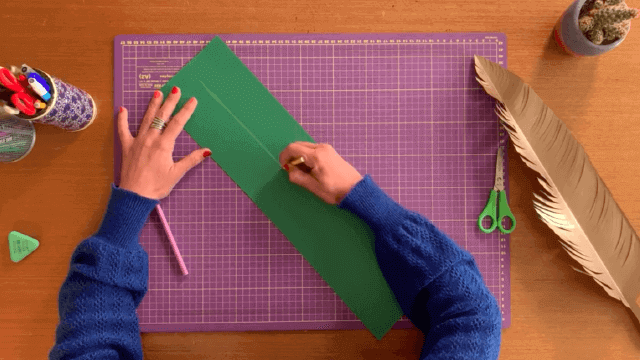
Fold the paper lengthwise so the long edges meet and press the fold to make a clear center line.
- 4
Step 4
Hold the folded paper over the picture against a window or bright light and trace half of the leaf outline along the fold with your pencil.
- 5
Step 5
Darken the pencil outline if it is faint so you can see it clearly for cutting.
- 6
Step 6
Cut carefully along the outer pencil outline through both layers of the folded paper.
- 7
Step 7
From the outer edge of the cut shape, cut small vertical fringes toward the folded edge and stop about 1 cm from the fold so the center stays connected.
- 8
Step 8
Unfold the paper gently to reveal the full symmetrical coconut leaf.
- 9
Step 9
Trim any uneven fringe tips to make the leaflets look even.
- 10
Step 10
Cut a thin strip of paper and tape it to the base of the leaf to make a stem.
- 11
Step 11
Color the leaf with different shades of green using your coloring materials.
- 12
Step 12
Add veins and fine details using a darker color while looking at your reference picture.
- 13
Step 13
Share your finished coconut tree leaf on DIY.org.
Fun facts
How do you recreate a coconut tree leaf on paper?
Start by folding a sheet of paper in half to create a symmetry line. Place a real coconut leaf or half-leaf template along the fold and trace the outline of the central spine and one side of the leaf. Cut along the traced outer line, then make evenly spaced cuts inward from the outer edge to create fringes without cutting through the spine. Unfold to reveal a symmetrical coconut leaf, then refine edges and add veins before coloring.
What materials do I need to recreate a coconut tree leaf on paper?
You’ll need paper (construction paper or light cardstock), a pencil and eraser, child-safe scissors, a ruler or template, and a real coconut leaf or printed half-leaf for tracing. For decorating, use crayons, colored pencils, markers, or watercolor paints. Optional items: tape or clips to hold the template, a craft mat, and an adult helper for cutting if children are young or using sharper scissors.
What ages is this activity suitable for?
This activity suits children about 4–10 years old. Ages 4–6 may need adult help with folding, tracing and cutting controlled fringes; scissors practice at this stage builds fine motor skills. Ages 7–10 can work more independently and add details like veins or shading. For younger toddlers (2–3), simplify by coloring a printed leaf outline rather than cutting. Always supervise when scissors are in use.
What are the benefits of making a coconut tree leaf on paper?
Recreating a coconut leaf builds symmetry awareness, observational skills and fine motor control through tracing, folding, and cutting fringes. It strengthens hand-eye coordination, scissor control and bilateral hand use (holding and cutting), which support pre-writing skills. The activity also encourages focus, patience and creativity when coloring and adding veins. It’s great for nature connection and can be extended into lessons about plants and tropical ecosystems.
Watch & Learn
Need help?
If I don't have a bright window to trace the leaf over, what materials can I substitute so I can still trace half the leaf as instructed?
If you don't have a bright window, hold the folded paper and reference picture over a desk lamp, use a smartphone flashlight behind the picture, or place tracing paper over the reference and trace without folding.
My scissors keep slipping when I cut through both layers of the folded paper and my fringe pieces tear—how can I fix that?
Press the fold firmly to make a crisp center line, use sharp scissors to cut slowly through both layers while keeping the paper flat, and stop each fringe cut about 1 cm from the fold as instructed to avoid tearing toward the center.
How can I adapt this activity for different ages so it's safe and still fun?
For toddlers, have an adult fold and trace the leaf and draw wider fringe lines so they can cut with safety scissors and color, while older children can perform all steps independently, add finer fringe cuts, and draw veins with darker colors.
What are easy ways to enhance or personalize the finished coconut leaf beyond the basic coloring and stem?
After trimming the fringes and adding a taped stem, personalize by layering several leaves around a rolled brown-paper trunk to make a 3D palm, blend multiple green shades for realistic shading, and add veins with a dark marker before sharing on DIY.org.