Read and write music notation
Learn to read and write basic music notation by identifying notes and rhythms, then compose and notate a short melody on staff paper.
About this activity
Learn to read and write basic music notation by identifying notes and rhythms, then compose and notate a short melody on staff paper.
What you need
Step by step
- 1
Step 1
Gather your materials and sit at a clear workspace with your staff paper and pencil.
- 2
Step 2
Draw one five‑line staff on your paper and add a treble clef at the left end.
- 3
Step 3
Write the line note names E G B D F on the five lines from bottom to top.
- 4
Step 4
Write the space note names F A C E in the four spaces from bottom to top.
- 5
Step 5
Draw a whole note (an open circle) on the staff on any line or space.
- 6
Step 6
Draw a half note (open circle with a stem) on the staff on a different line or space.
- 7
Step 7
Draw a quarter note (filled circle with a stem) on the staff.
- 8
Step 8
Draw an eighth note (filled circle with a stem and one flag) on the staff.
- 9
Step 9
Set your metronome or timer to 60 beats per minute so each click is one beat.
- 10
Step 10
For each note type you drew, clap and count its beats to the metronome so you can hear the rhythm.
- 11
Step 11
Write a short 4‑measure melody on the staff using notes and rhythms you learned where each measure has four beats.
- 12
Step 12
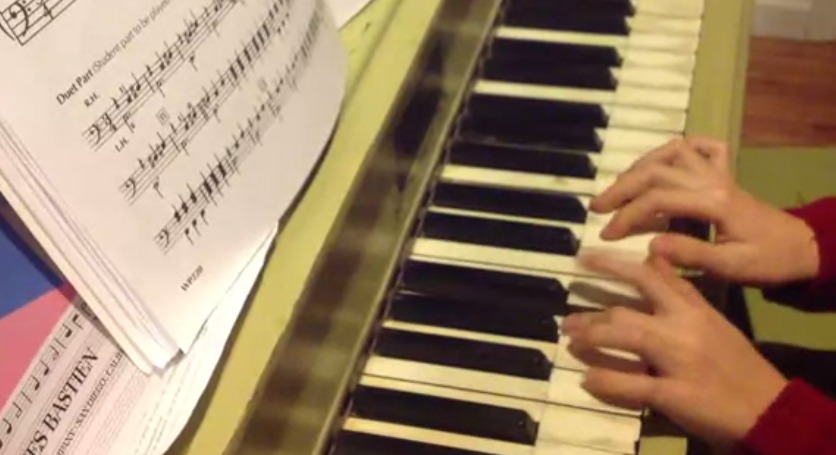
Play your written melody on the keyboard while reading the staff to hear how it sounds.
- 13
Step 13
Erase and redraw any notes that sound or look wrong until the melody is the way you like it.
- 14
Step 14
Share a photo or scan of your finished notated melody on DIY.org.
Fun facts
How do I teach my child to read and write basic music notation and compose a short melody?
Start by introducing the staff, treble clef, and note names (A–G). Teach simple rhythms (whole, half, quarter, eighth notes and rests) by clapping and counting aloud. Have the child identify notes on staff paper, then practice writing single notes and simple rhythmic patterns. Once comfortable, ask them to create a 4–8 measure melody, sing or play it on an instrument, and notate it on staff paper. Encourage revision and praise effort to build confidence.
What materials do I need to help my child learn music notation and compose melodies?
You’ll need staff paper (printed or a notebook), pencils with erasers, and a ruler for neat staves. Add a simple instrument (keyboard, xylophone, recorder, or ukulele), a metronome or timing app, and rhythm flashcards. Optional items include note-name cards, stickers for rewards, and a phone or tablet with a basic notation or piano app for playback. Keep materials durable and age-appropriate for easier practice and exploration.
What ages is reading and writing basic music notation suitable for?
This activity suits children roughly ages 5–12, depending on readiness. Ages 5–7 benefit from rhythmic games, singing, and identifying a few notes on a simplified staff. Ages 7–9 can learn more note values, note placement, and begin simple notation. Ages 9–12 can compose short melodies and refine notation skills. Always adapt pace to the child’s attention span and offer hands-on support for younger learners.
What are the benefits, safety tips, and variations for teaching music notation to kids?
Benefits include improved memory, pattern recognition, fine motor skills, language links, and creativity. Safety tips: keep instrument volume moderate to protect hearing, supervise small parts, and use age-appropriate instruments. Variations: turn composing into a game, use stickers or colored notes for beginners, try digital notation apps for playback, or compose collaboratively as a family. Short, regular sessions work better than long ones to maintain focus and enjoyment.
Watch & Learn
Need help?
What can we use if we don't have staff paper, a metronome, or a keyboard?
If you don't have staff paper, draw five evenly spaced lines with your pencil or print a free staff template, and replace a metronome and keyboard with a free metronome app (set to 60 BPM) and a virtual keyboard app or simple xylophone.
My clapping and playing don't match the beats or the notes look wrong — what should I try next?
If clapping doesn't match the metronome or the melody sounds wrong on the keyboard, slow the tempo to about 40 BPM, count out loud for each note value as you clap (whole=4, half=2, quarter=1, eighth=½), then erase and redraw any notes that are misplaced before replaying.
How can I adapt this activity for different ages or skill levels?
For younger children, simplify 'Write a short 4‑measure melody' to two measures using only quarter and half notes and use colored stickers on the staff paper, while older kids can add key signatures, rests, eighth-note rhythms, and increase the metronome tempo when playing on the keyboard.
How can we extend or personalize the basic 4‑measure melody activity?
Enhance your 4‑measure melody by color-coding whole, half, quarter, and eighth notes on the staff paper, adding dynamics or a second keyboard part to make a duet, recording the performance, and then upload the photo or audio with the notated score to DIY.org.