Prepare a slide
Prepare a microscope slide by collecting a leaf or onion sample, mounting it under a coverslip, staining with adult help, and observing cells.



Step-by-step guide to prepare a microscope slide of leaf or onion cells
Google Slides for Kids: How to Make Awesome Presentations
Step 1
Gather all the materials listed and put them on a clean table so everything is ready.
Step 2
Wash your hands with soap and dry them so your slide stays clean.
Step 3
Pick whether you will use an onion or a thin leaf for your sample.
Step 4
With adult help cut or peel a very thin transparent layer from the onion or take a tiny thin piece of the leaf.
Step 5
Place the thin sample flat in the middle of a clean microscope slide.
Step 6
Use the dropper to place one small drop of water onto the sample on the slide.
Step 7
Gently use tweezers or a toothpick to spread the sample flat so it is thin and sits in the water.
Step 8
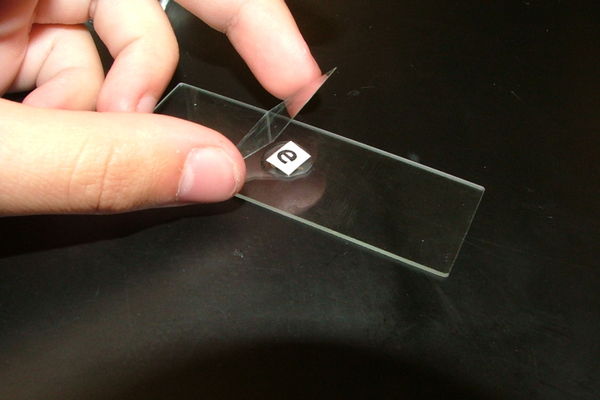
Hold a coverslip by its edge and slowly lower one side down at an angle onto the slide to avoid air bubbles.
Step 9
Ask an adult to put one tiny drop of the stain at the edge of the coverslip so the stain is drawn under the glass.
Step 10
Wait about 30 seconds for the stain to spread and then carefully blot any extra stain from the slide edge with a paper towel.
Step 11
Put the slide on the microscope stage and secure it with the stage clips.
Step 12
Start observing at low power and use the coarse focus knob to bring the sample into view.
Step 13
Switch to a higher power and use the fine focus knob to sharpen the details and look for cell walls and nuclei.
Step 14
Clean up your workspace and tools with adult help and then share your finished slide and what you saw on DIY.org.
Help!?
What can we use if we don't have a coverslip or a commercial stain?
If you don't have a coverslip, an adult can cut a thin square of clear plastic from clean packaging or a transparency to use in step 7, and for stain in step 9 you can use one tiny drop of blue food coloring or a dilute iodine solution as a safe contrast alternative.
Why is my sample showing air bubbles or the stain won't move under the coverslip, and how do I fix it?
If air bubbles appear or the stain doesn't draw in (steps 7–9), gently lift one edge of the coverslip with tweezers and add a tiny extra drop of water or stain at the edge, then lower the coverslip slowly at an angle so the liquid fills the space and the sample lies flat.
How can I adapt this slide-making activity for different ages?
For younger children, have an adult do the cutting/peeling in step 4 and guide them through placing the sample, adding the drop of water (step 5), and lowering the coverslip (step 7), while older kids can prepare multiple samples (step 3), try different stains, compare onion versus leaf cells, and use higher power and fine focus (steps 11–12) to record observations.
How can we extend or personalize the finished slide before sharing it on DIY.org?
Make several slides using both onion and leaf samples (steps 3–6) with different stains, label each slide, photograph your best view through the microscope at low and high power (steps 11–12), and upload the images and notes about cell walls and nuclei when you share on DIY.org (step 13).
Watch videos on how to prepare a microscope slide of leaf or onion cells
PowerPoint Basics ( For kids / students) | Introduction to PowerPoint for beginners #powerpoint
4 Videos

PowerPoint Basics ( For kids / students) | Introduction to PowerPoint for beginners #powerpoint

Tips for Kids by Kids: How to Make your Google Slides Dynamic

How to Create Interactive Drag-and-Drop Slides in Canva | Engaging Presentations for Teachers

How to Make CUTE Google Slide Presentations
Facts about microscopy and plant cells
🔬 School microscopes usually let you see things at about 40× to 400× magnification — perfect for plant cells!
🧅 The onion (Allium cepa) epidermis is a classic first slide because its single-layer cells are clear and easy to observe.
🍃 Leaf cells often contain chloroplasts, the green structures that help plants turn sunlight into food.
🧪 A tiny drop of iodine or methylene blue (with adult help) makes cell parts pop by staining starch or nuclei.
🧱 Plant cells have sturdy cell walls, so under the microscope they often look like little boxes or bricks.
How do I prepare a microscope slide to see cells from a leaf or onion?
What materials do I need to make a leaf or onion microscope slide?
What ages is preparing microscope slides suitable for?
What safety tips should I follow when making and observing slides?
