Practice a straddle roll
Practice a straddle roll by warming up, learning arm and leg positioning, rolling safely on soft mat, and repeating drills with spotter supervision.
About this activity
Practice a straddle roll by warming up, learning arm and leg positioning, rolling safely on soft mat, and repeating drills with spotter supervision.
What you need
Step by step
- 1
Step 1
Put on comfortable clothes and remove any jewelry or sharp accessories.
- 2
Step 2
Lay the soft mat flat in an open space with plenty of room around it.
- 3
Step 3
Warm up for 5 minutes by jogging lightly in place to raise your heart rate.
- 4
Step 4
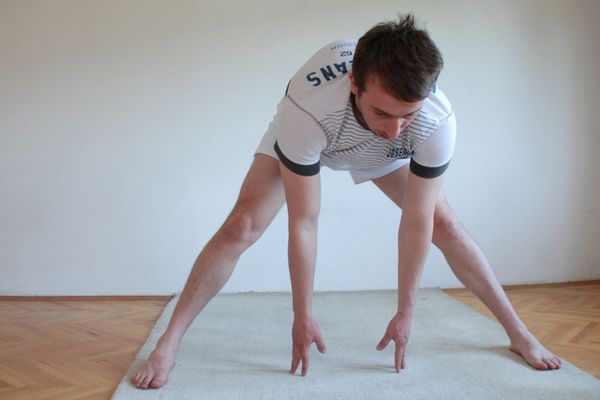
Do 10 standing straddle leg swings on each side to loosen your hips.
- 5
Step 5
Sit on the mat with your legs wide in a straddle and reach both arms forward until you feel a gentle stretch.
- 6
Step 6
Practice tucking your chin to your chest and rolling your shoulders forward while sitting to feel the roll path.
- 7
Step 7
Ask your spotter to stand in front of you and show the hand placement near your hips for support while you watch.
- 8
Step 8
With your spotter's hands at your hips, lie back and gently roll over your upper back while keeping legs wide and arms reaching forward.
- 9
Step 9
Repeat the assisted roll five times focusing on tucking your chin and keeping legs wide throughout the roll.
- 10
Step 10
Attempt a slow unassisted straddle roll while your spotter stands ready to guide or catch your hips.
- 11
Step 11
Rest for one minute and drink some water between attempts.
- 12
Step 12
Repeat the unassisted roll and rest sequence three more times to build confidence and smoothness.
- 13
Step 13
Share a photo or short description of your finished straddle roll on DIY.org to show your progress.
Fun facts
How do I teach my child to practice a straddle roll safely and correctly?
Start with a 5–10 minute warm-up (jogging, leg swings, gentle forward rolls). Begin seated in a wide straddle with hands on the floor between the legs. Tuck the chin to the chest, press hands into the mat, push the hips forward and roll diagonally across the back toward the shoulders, keeping legs wide. Finish seated in a straddle. Repeat slowly, increasing speed only when form is steady. Use a spotter for early attempts.
What materials do I need to practice a straddle roll at home or in class?
You’ll need a thick, soft gym mat or padded surface, comfortable clothing that allows movement, and a clear floor area. An adult spotter is essential for safety. Optional helpful items include a wedge or small incline for progressions, cones or tape to mark start lines, and grip socks. Keep first-aid supplies nearby and remove jewelry or loose items before practicing.
What ages are suitable for learning a straddle roll?
Straddle rolls suit preschool and elementary-aged children with basic balance and neck control—typically ages 4–10. Younger children (about 3–4) can try assisted versions with extra padding and a spotter. Older children and teens can work on speed and technique. Always judge readiness by individual coordination, and keep close adult supervision until the skill is performed safely and consistently.
What safety tips should parents follow when teaching a straddle roll?
Practice on a thick, non-slip mat and clear the area of obstacles. Always have a trained adult spot early attempts, supporting hips and shoulders as needed. Teach a chin-tuck to protect the neck and progress gradually from assisted to independent rolls. Limit repetitions when the child is tired to prevent sloppy technique. Avoid hard surfaces or unsupervised practice, and consult a pediatrician or coach if there are neck or back concerns.
Watch & Learn
Need help?
What can we use if we don't have a soft mat or can't find a spotter?
If you don't have a soft mat, fold two to three thick blankets or use a thick yoga mat on carpet, and if a trained spotter isn't available have a responsible adult stand in front as your spotter to follow the instructions for hand placement near your hips.
I'm struggling to tuck my chin and roll over my upper back during the assisted roll—what should I try?
Practice 'tucking your chin to your chest and rolling your shoulders forward while sitting to feel the roll path,' have your spotter keep hands at your hips during the 'assisted roll five times,' and start with small rocking motions before lying back fully.
How can I adapt the steps for younger children or make it more challenging for older kids?
For younger children reduce the warm-up to 2–3 minutes, cut the '10 standing straddle leg swings' to 5 per side and keep every attempt assisted, while older kids can keep the full warm-up and swings, progress from the 'assisted roll five times' to attempting the unassisted roll and repeating the 'unassisted roll and rest sequence three more times' for refinement.
How can we extend or personalize the activity once the basic straddle roll is working?
To extend and personalize the activity, video your attempts to analyze and improve smoothness, set a goal to increase the number of clean unassisted rolls between rests, and 'Share a photo or short description of your finished straddle roll on DIY.org' as a documented outcome.