Make tic-tac-toe with plastic caps
Make a reusable tic tac toe game using cardboard and colorful plastic bottle caps, design the grid, decorate pieces, and play strategic rounds.
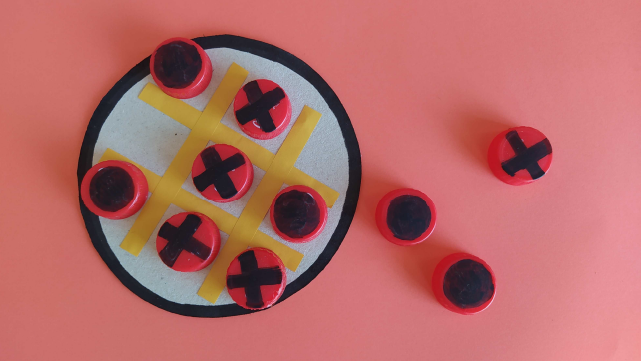
About this activity
Make a reusable tic tac toe game using cardboard and colorful plastic bottle caps, design the grid, decorate pieces, and play strategic rounds.
What you need
Step by step
- 1
Step 1
Gather all your materials and bring them to a clear flat workspace.
- 2
Step 2
Use the ruler and pencil to draw a square about 20 cm across and divide it into a 3 by 3 grid with equal squares.
- 3
Step 3
Cut out the square board carefully along the pencil line with scissors.
- 4
Step 4
Decorate the board with colouring materials and stickers to make it bright and fun.
- 5
Step 5
Choose 10 plastic caps and split them into two sets of five for the two players.
- 6
Step 6
Decorate one set of caps with X marks and the other set with O marks using markers or stickers.
- 7
Step 7
Put a small piece of double-sided tape or a tiny dab of glue under each cap so they stay in place during play.
- 8
Step 8
Place the board on a flat surface and have each player pick one set of decorated caps.
- 9
Step 9
Take turns placing one cap per turn on the grid trying to get three in a row horizontally vertically or diagonally.
- 10
Step 10
Play several rounds switching who goes first and try different strategies to win more games.
- 11
Step 11
Share your finished reusable tic-tac-toe game on DIY.org
Fun facts
How do I make a reusable tic-tac-toe game with cardboard and plastic bottle caps?
To make a reusable tic-tac-toe game, cut a sturdy cardboard square about 10–12 inches and draw a 3×3 grid with a ruler and marker. Decorate the board with paint, stickers, or contact paper. Collect 10–12 clean plastic bottle caps and decorate five as X and five as O using paint, permanent markers, or glued paper labels. Add small self-adhesive felt dots or magnets to the caps and board so pieces stay put, and store them in a zip bag or small box.
What materials do I need to make a reusable tic-tac-toe game using plastic caps?
Gather one piece of sturdy cardboard (10–12 inches), a ruler, pencil, black marker, scissors or craft knife (adult use only), and glue or a hot glue gun. You’ll need 10–12 clean plastic bottle caps, paints or permanent markers, stickers or colored paper for decorating, self-adhesive felt dots or small magnets to secure pieces, clear contact paper or varnish to protect the board, and a small bag or box for storage. Optional: Velcro dots or elastic bands for carrying.
What ages is this cardboard and bottle cap tic-tac-toe suitable for?
This craft and game is suitable for children aged about 4 and up with supervision. Bottle caps are a choking hazard so keep them away from children under three. Preschoolers (4–5) can enjoy decorating caps and placing pieces with guidance; school-age kids (6–10) benefit from practicing strategy and taking turns. Adults should handle cutting, hot glue, or sharp tools and supervise painting until pieces are dry.
What are the benefits of making a tic-tac-toe game with recycled bottle caps?
Making a tic-tac-toe game from recycled caps encourages creativity, fine motor control, and early strategic thinking. Decorating pieces builds focus and color recognition, while playing fosters social skills like turn-taking and good sportsmanship. It teaches sustainability by reusing materials, is low-cost and portable, and can be adapted for learning activities such as counting scores, pattern-making, or turning games into simple math challenges.
Watch & Learn
Need help?
What can I use instead of double-sided tape or plastic caps if they're hard to find?
If you don't have double-sided tape use reusable sticky putty or small pieces of poster putty under each cap (step 6), and if you can't get plastic bottle caps use coins, pom-poms, or cut cardboard circles for the 10 game pieces.
My grid lines aren't even or the board is floppy — how can I fix that?
Use a ruler or the edge of a book as a straightedge when drawing the 20 cm square and 3×3 divisions (step 2), and glue the paper onto a piece of cardboard before cutting (step 3) to create a sturdier, flat board.
How can I adapt this activity for different ages?
For younger children make larger squares and use pre-decorated stickers for X and O to avoid fine motor steps (steps 2–6), while older kids can precisely measure the 20 cm square, cut the board from thin wood, or run a mini tournament to practice strategy (steps 2, 3, 9).
How can we personalize or improve the reusable tic-tac-toe game?
Decorate and protect the board with waterproof paint or laminate after step 4, swap the tape for small round Velcro dots under each cap for stronger hold (step 6), and post your finished set on DIY.org (step 10) to show your design.