Make Art with Fractals
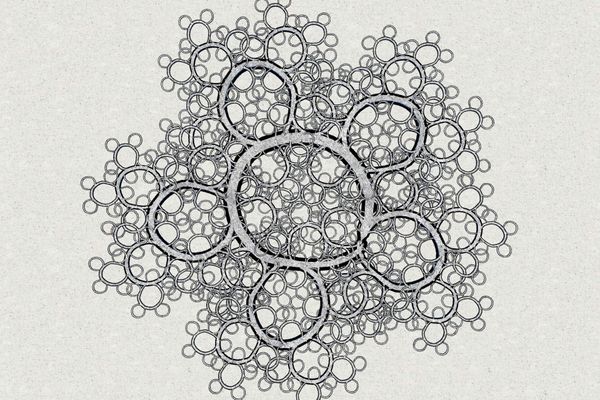
Create fractal artwork by drawing and repeating simple shapes like triangles or trees on paper, experimenting with scale, color, and pattern.
About this tutorial
Create fractal artwork by drawing and repeating simple shapes like triangles or trees on paper, experimenting with scale, color, and pattern.
What you need
Instructions
- 1
Step 1
Choose which simple shape you will repeat for your fractal art like a triangle or a little tree.
- 2
Step 2
Lightly draw one large version of your chosen shape near the middle or edge of the paper.
- 3
Step 3
Draw a smaller copy of that shape on one part of the large shape using about half the size.
- 4
Step 4
Add another small copy of the shape on a different part of the large shape using the same smaller size.
- 5
Step 5
Draw even smaller copies on the smaller shapes you just made, keeping each new copy about half the size of the shape it sits on.
- 6
Step 6
Keep adding smaller and smaller copies in the same way until the page looks full or the shapes are too tiny to draw.
- 7
Step 7
Use your black marker to trace over the pencil lines you want to keep so the shapes stand out.
- 8
Step 8
Pick 2 or 3 colors you will use for the big medium and tiny shapes.
- 9
Step 9
Color the shapes following your color plan so similar-size shapes share the same color.
- 10
Step 10
Add tiny patterns like dots or stripes inside some shapes to make your art more detailed.
- 11
Step 11
Write your name and the date on your artwork in a corner.
- 12
Step 12
Share a photo of your finished fractal artwork on DIY.org.
Fun facts
How do you make fractal artwork with repeated shapes?
Start by picking a simple shape—triangle, tree, or rectangle—then draw a large version on paper. Inside or beside it, draw smaller copies of the same shape, repeating the process to create branches or layers. Reduce the size each time and vary the angle or position for interest. Use light pencil first, then outline with markers. Finish by adding color, patterns, or texture. Encourage experimentation with scale, spacing, and symmetry for different fractal effects.
What materials do I need to create fractal art with children?
You’ll need plain drawing paper or a sketchbook, pencils and erasers, and a ruler for straight shapes. Provide fine liners or markers for outlines, colored pencils, crayons or watercolor paints for fills, and optional stencils or stamps to repeat shapes quickly. A compass or protractor helps older kids explore precise scaling. Keep scrap paper and wipes handy for paint, and a clipboard if working away from a table.
What ages are suitable for making fractal artwork?
Simple repetition suits preschoolers (4–6) with adult help for drawing basic shapes and patterns. Elementary children (7–11) can handle size changes, spacing, and layering independently, gaining math connections. Tweens and teens (12+) can explore precise scaling, symmetry, and more complex fractal rules or digital tools. Adapt complexity to fine motor skills and attention span, and offer templates or stencils for younger artists.
What are the benefits of making fractal art with kids?
Fractal art boosts pattern recognition, spatial reasoning, and early geometry skills while encouraging creativity and focus. The repetition and scaling help children understand proportions and sequencing. It supports fine motor development through careful drawing and coloring, and can be calming or meditative. Sharing work builds confidence; discussing patterns links art to nature and math, making learning visual and playful.
Watch & Learn
Need help?
What can we use instead of the black marker or special paper if we can't find them?
If you don't have a black marker, use a dark crayon, ballpoint pen, or thin paintbrush with black watercolor to trace over the pencil lines you want to keep, and ordinary printer or construction paper works fine for the drawing steps.
I'm having trouble keeping the smaller copies about half the size and they look messy—how can I fix that?
Lightly fold a scrap of paper to mark 'half-size' or use a ruler to measure each smaller copy and draw faint guide lines so the repeated shapes stay proportional and stop adding copies when the shapes become too tiny to color.
How can I adapt this fractal art activity for younger or older kids?
For younger children, make one large shape and only one or two smaller copies to color with washable markers, while older kids can make more iterations, use a ruler for precise half-size reductions, and add tiny patterns with fine-tip pens.
What are simple ways to extend or personalize the finished fractal artwork?
Enhance and personalize your piece by painting a watercolor wash background before tracing with the black marker, using metallic or gel pens for the tiny patterns inside shapes, and writing your name and date in a decorative corner as the instructions say.