Make an Origami Crocodile
Fold colored paper step by step to create an origami crocodile with movable jaws, learning precise folds, patience, and symmetry while decorating scales safely.
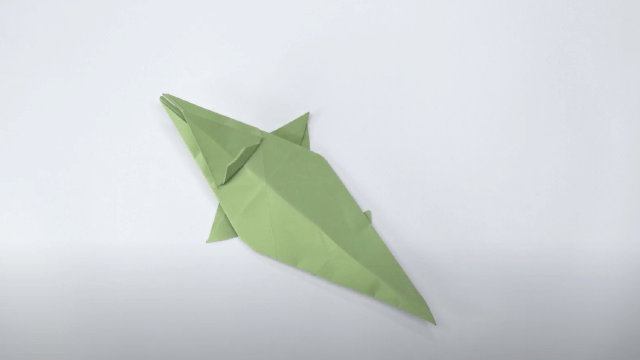
About this activity
Fold colored paper step by step to create an origami crocodile with movable jaws, learning precise folds, patience, and symmetry while decorating scales safely.
What you need
Step by step
- 1
Step 1
Place one colored paper sheet face up on the table.
- 2
Step 2
Fold the sheet in half diagonally to make a triangle and press the crease firmly.
- 3
Step 3
Fold the left corner of the triangle to meet the center crease and press the fold.
- 4
Step 4
Fold the right corner to meet the center crease so you have a kite shape and press the fold.
- 5
Step 5
Fold the top point of the kite down about one third toward the bottom to form the crocodile snout and crease.
- 6
Step 6
Fold a small bottom front flap upward about 1 cm to make a movable lower jaw and crease along that flap.
- 7
Step 7
Fold about 1 cm of the back edge of the head backward to make a small glue tab.
- 8
Step 8
Place the second colored paper sheet face up on your table.
- 9
Step 9
Fold that sheet in half lengthwise and press the crease to make a rectangle.
- 10
Step 10
Make three or four accordion folds along the rectangle to form the crocodile body and tail.
- 11
Step 11
Cut small triangles out of the tip of the accordion tail to shape a pointed tail.
- 12
Step 12
Put a small dab of glue on the folded glue tab at the back of the head.
- 13
Step 13
Press the glued tab onto the front of the accordion body so the head is attached while the lower jaw stays free.
- 14
Step 14
Decorate your crocodile by drawing eyes scales and teeth with your coloring materials and let any glue dry.
- 15
Step 15
Share a photo of your finished origami crocodile with movable jaws on DIY.org.
Fun facts
How do you make an origami crocodile?
Start with a square sheet of colored paper. Fold diagonals and create a waterbomb/base to shape the body. Form the head by folding a triangular flap and make a mouth hinge with a small inside pleat so the jaws open. Fold accordion pleats along the back to suggest scales and shape the tail with reverse folds. Use precise creases and work slowly, decorating with non-toxic markers or stickers. Practice each fold one at a time to keep the jaws movable.
What materials do I need for an origami crocodile with movable jaws?
You'll need several square sheets of colored origami or lightweight craft paper (about 6–8 inches), a bone folder or fingernail for sharp creases, non-toxic markers or crayons for decorating, child-safe scissors for any small cuts (optional), glue or double-sided tape for secure features, and stickers or googly eyes. A flat work surface and a small ruler help with precise folds. Supervision is recommended for scissors and glue.
What ages is folding an origami crocodile suitable for?
Folding an origami crocodile suits children aged about 6 and up, with adjustments. Ages 6–8 can do simplified versions with larger paper and step-by-step adult help for precise folds and movable jaws. Ages 9–12 manage standard instructions independently, building patience and symmetry skills. Teens and adults can try complex details and realistic scales. Always supervise scissors, glue, and small decorations; tailor difficulty to a child's fine-motor ability and attention span.
What are the benefits and safety tips for making an origami crocodile?
Making an origami crocodile strengthens fine motor skills, spatial reasoning, patience, and symmetry awareness while encouraging creativity through decoration. It teaches following sequential steps and careful hand-eye coordination. For safety, use child-safe scissors, non-toxic markers, and supervise glue or small adornments to avoid choking hazards. Encourage breaks to reduce frustration, keep paper edges away from faces, and choose thicker origami paper for beginners to make folds easier. Off
Watch & Learn
Need help?
What can we use if we don't have colored paper sheets?
Use plain printer paper, construction paper, or cut pages from magazines as substitutes for the colored paper sheet, but avoid very thick cardstock because the diagonal and accordion folds (steps 1–4 and 6–9) will be harder to crease.
Why won't the lower jaw move or why does the head come loose?
If the lower jaw sticks or the head comes loose, check that you folded the small bottom front flap upward about 1 cm (step 7) and that you only put a small dab of glue on the folded glue tab at the back of the head (step 11) and pressed only the tab to the front of the accordion body so the jaw remains free.
How can I adapt this activity for younger or older children?
For younger children, pre-fold the diagonal triangle and accordion body and pre-cut the tail triangles so they can assemble and decorate, while older kids can add extra accordion folds for a longer tail, use thicker paper, or draw detailed scales and teeth (steps 2, 6–9, and 13).
How can we enhance or personalize the origami crocodile after following the instructions?
After decorating with markers or crayons (step 13), personalize it by gluing on googly eyes, adding textured paper or painted scales, attaching a craft stick under the accordion body to make a puppet, or adding a small piece of magnetic tape to the jaws to make them snap shut before sharing your photo on DIY.org.