Make a zipline to deliver secret messages
Build a short, low backyard zipline using string, a clothespin, and a small pouch to deliver secret messages and measure delivery speed.
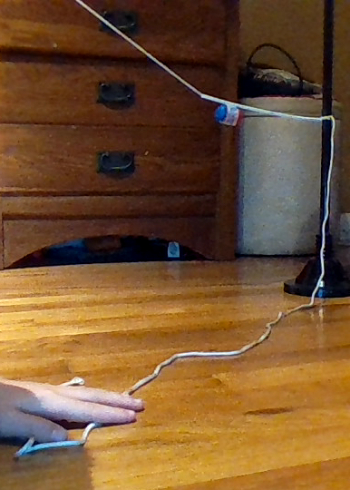
About this activity
Build a short, low backyard zipline using string, a clothespin, and a small pouch to deliver secret messages and measure delivery speed.
What you need
Step by step
- 1
Step 1
Pick two sturdy anchor points 2 to 5 meters apart such as two trees fence posts or a porch post.
- 2
Step 2
Use the measuring tape to measure the straight-line distance between the two anchors and write the number down in meters.
- 3
Step 3
Decide which anchor will be the top (higher) end and mark that spot at about waist height.
- 4
Step 4
Tie one end of the string to the top anchor with a secure knot so it will not slip.
- 5
Step 5
Pull the string toward the lower anchor to create a gentle downhill slope and tie the string to the lower anchor with a tight knot.
- 6
Step 6
Press the middle of the string to check for too much sag and retighten a knot if the line droops a lot.
- 7
Step 7
Open the clothespin and clip it onto the string so the clothespin can slide freely.
- 8
Step 8
Attach the small pouch to the clothespin using the clip or tape so the pouch hangs securely from the pin.
- 9
Step 9
Fold a small secret note and put it inside the pouch then close the pouch.
- 10
Step 10
Ask your helper to be ready to start the stopwatch the instant they see you release the pouch.
- 11
Step 11
Stand at the top anchor and release the pouch so it slides down the zipline.
- 12
Step 12
Ask your helper to stop the stopwatch the moment the pouch reaches the bottom and tell you the time in seconds.
- 13
Step 13
Calculate the delivery speed by dividing the measured distance in meters by the recorded time in seconds and write down the speed in meters per second.
- 14
Step 14
Repeat the ride two more times record each time and compute the average speed by adding the three speeds and dividing by three.
- 15
Step 15
Share a photo and your speed results of your finished secret-message zipline on DIY.org
Fun facts
How do you build a backyard zipline to deliver secret messages?
Choose two low anchor points about 10–20 feet apart (a tree and a fence). Tie a strong string or thin rope with a slight downhill slope, using secure knots and wrapping for grip. Clip a clothespin to the string and attach a small pouch or zipper bag to hold the message. Place the message in the pouch, lift it to the higher end, and release; time from release until it reaches the lower end.
What materials do I need to make a message-delivery zipline?
You’ll need sturdy string or thin rope, a clothespin, a small pouch or zipper bag, scissors, measuring tape, and a stopwatch or phone timer. Optional extras: a carabiner or keyring to attach the pouch, small weights to test load, tape for knot reinforcement, and gloves for adults when tightening knots. Use only lightweight messages and weather-safe materials.
What ages is a backyard zipline activity suitable for?
This activity suits children about 5 and up with adult supervision. Ages 5–7 can help set up and prepare messages while adults handle anchoring and tightening. Ages 8–12 can participate more independently with guidance on knot-tying and timing. Teens can design experiments measuring speed and slope. Always supervise younger children and manage any cutting or climbing tasks.
What safety tips and variations should I consider for the zipline?
Keep the zipline low to the ground and clear of walkways. Use lightweight items only, avoid metal clips near people, and always have an adult secure anchors and test the line. Variations: add simple timing experiments, change slope to compare speeds, create code words for messages, or decorate pouches. Emphasize safety checks before each run and never allow children to ride on the line.
Watch & Learn
Need help?
What can we use if we don't have a measuring tape, clothespin, small pouch, or stopwatch?
Use a long ruler or count footsteps to estimate the measuring tape distance, swap the clothespin for a keyring or binder clip, use a resealable sandwich bag or folded paper envelope for the small pouch, and use a phone timer app instead of a stopwatch when you tie the string to the anchors and release the pouch.
The line sags too much or the pouch gets stuck—what should we try?
If the string droops when you press the middle or the clothespin won't slide, retie the knots tighter at the top and lower anchors, shorten the anchor distance slightly, or raise the top anchor point to reduce sag and let the clothespin slide freely.
How can we adapt this zipline activity for different age groups?
Have an adult set anchors and handle knot-tying and stopwatch timing for preschoolers with a 1–2 meter line, let elementary kids measure the 2–5 meter span and release the pouch with supervision, and challenge older kids to precisely compute and compare average speeds using the measuring tape and stopwatch as instructed.
How can we extend or personalize the secret-message zipline?
Decorate the pouch and clothespin, test different payloads (small toys or coded notes), try adding a small pulley or extra clips to study friction, and share photos plus your average speed results on DIY.org as the instructions recommend.