Make a landsail vehicle
Build a small landsail vehicle using a toy car chassis, lightweight sail, and cardboard; learn wind power, steering, and simple engineering principles outdoors.




Step-by-step guide to make a landsail vehicle
Learning Construction Vehicles For Kids With Blippi | Trucks For Kids
Step 1
Choose a flat open outdoor area with light to moderate wind to test your landsail vehicle
Step 2
Clear any removable body parts from the toy car so you have a bare chassis with free-rolling wheels
Step 3
Cut the straight straw or wooden skewer to a height about 1.5 to 2 times the car height using adult supervision
Step 4
Tape or glue the mast upright to the center of the chassis so it stands firmly and straight
Step 5
Draw a triangle shape on the sail material about the height of the mast and cut it out using adult supervision
Step 6
Cut the drinking straw or thin stick to be a little wider than the car to make the boom
Step 7
Attach the bottom edge of the triangular sail to the boom with tape so the sail holds its shape
Step 8
Fasten the boom to the mast about halfway up using a clothespin or tape so the sail can pivot slightly
Step 9
Cut a small fin from cardboard and tape it under the chassis near the rear to help the car track straight
Step 10
Place the car on flat ground and roll it by hand to check wheel movement and add small paperclip ballast if it tips or rides unevenly
Step 11
Test the vehicle in the wind and adjust the sail angle mast position or fin placement until it moves forward and steers well
Step 12
Share a photo or video of your finished landsail vehicle and what you learned on DIY.org
Help!?
What can I use instead of a straight straw or wooden skewer for the mast if I can't find one?
Use a pencil, chopstick, bamboo skewer, or a thin dowel cut to about 1.5–2× the car height with adult supervision and tape or glue it upright to the chassis as the instructions say.
My landsail car won't move in the wind or keeps veering off course—what should I check and fix?
Check that the wheels spin freely after clearing removable parts, make sure the mast is taped straight and the sail angle and boom pivot (clothespin or tape) are adjusted, and move or reshape the cardboard fin or add paperclip ballast under the rear to improve tracking.
How can I adapt this activity for younger children or older kids?
For younger kids have an adult pre-cut the mast and sail and let them tape the mast, attach the boom and fin, and test in a light wind, while older kids can cut materials themselves, experiment with different sail shapes, boom widths, fin placements, and measure how changes affect speed and steering.
What are simple ways to extend or personalize the landsail vehicle after the basic build?
Decorate the sail material and chassis, try different mast heights and boom materials to compare performance, test several cardboard fin shapes or add adjustable ballast, and record a photo or video of your wind tests to share on DIY.org.
Watch videos on how to make a landsail vehicle
Construction Trucks for Children: Learn Construction Vehicles with Toy Trucks for Kids, Speedie DiDi
4 Videos

Construction Trucks for Children: Learn Construction Vehicles with Toy Trucks for Kids, Speedie DiDi

Land Transport vehicles for kids - Vocabulary
Blippi Explores Construction Trucks For Kids | Blippi Videos | Educational Videos For Toddlers
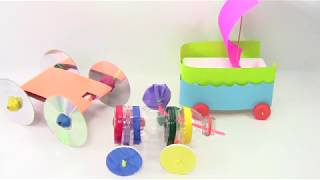
How to Build a Toy Car - Science Project
Facts about wind-powered vehicles
🌬️ Land yachts can travel faster than the wind that pushes them because sails create an "apparent wind" that boosts speed.
♻️ Reusing a toy car chassis teaches kids about upcycling—many DIY land-sail projects start with a simple toy frame.
🪁 A sail works like an airplane wing: its curved shape and angle to the wind make pressure differences that produce thrust.
🔧 Simple steering setups (a pivoting front axle or a string-and-stick linkage) let kids explore real engineering and cause-and-effect.
🏁 On wide flat surfaces like salt flats, experimental wind-powered vehicles have exceeded 200 km/h, showing how powerful wind energy can be.
How do I build a small landsail vehicle with a toy car chassis and cardboard?
What materials and tools do I need to make a landsail vehicle?
What ages is this landsail vehicle activity suitable for?
What are some creative variations and challenges to try with a landsail vehicle?
