Identify wild animal scat
Observe and photograph wild animal scat from a safe distance, record size, shape, and contents, then use field guides to identify likely species.


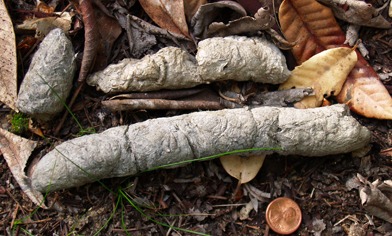
Step-by-step guide to identify wild animal scat
Can You Identify Local Animals By Their Droppings? - The Everyday Why
Step 1
Find an adult who will go outside with you and tell them you want to look for animal scat.
Step 2
Put on your disposable gloves so you do not touch anything directly.
Step 3
Gather your notebook pencil ruler and magnifying glass before you head out.
Step 4
Walk with the adult to a safe outdoor place where you might spot wildlife signs.
Step 5
When you see scat stop and stay at least three meters away from it.
Step 6
Do not touch the scat under any circumstance.
Step 7
From your safe distance take a clear photo of the scat.
Step 8
Take a second photo that includes your ruler or tape measure next to the scat for scale.
Step 9
Use your magnifying glass from the same safe distance to observe visible contents like fur seeds or insect bits.
Step 10
Measure the length and width using your ruler or tape measure and write the numbers in your notebook.
Step 11
Write notes about the scat’s shape color and any visible contents and where you found it.
Step 12
Use your field guide or printed pictures to compare your photos and notes and list two likely species.
Step 13
Carefully remove and throw away your disposable gloves in a trash bin.
Step 14
Use hand sanitizer to clean your hands after removing the gloves.
Step 15
Share your finished scat-identification report with photos and notes on DIY.org.
Help!?
What can we use instead of disposable gloves, a magnifying glass, or a ruler if we don't have them?
If you don't have disposable gloves, magnifying glass, or a ruler, use disposable plastic sandwich bags over your hands (but still don't touch the scat), use your smartphone camera's zoom or a clip‑on macro lens to inspect visible contents from the same safe distance, and place a common object of known size (like a coin or stick) next to the scat before photographing for scale.
What should we do if photos come out blurry or we can't see contents with the magnifying glass?
If photos are blurry or the magnifying glass doesn't show details, steady the camera against the ruler or a stable surface, switch to the phone's macro mode or increase zoom while keeping at least the three‑meter safe distance, and retake a clear photo that includes the ruler or coin for scale before recording length and width in your notebook.
How can I adapt this activity for different ages, like a 4-year-old, an 8-year-old, or a 13-year-old?
For a 4‑year‑old have the adult lead the walk and take the photos while the child makes simple drawings in the notebook, for an 8‑year‑old let them use the magnifying glass and ruler to measure and write short notes about shape and contents, and for a 13‑year‑old require precise measurements, two species comparisons using the field guide, and a full scat‑identification report with photos to post on DIY.org.
How can we extend or personalize the scat-identification activity after finishing the instructions?
Turn your notebook entries, ruler‑scale photos, and species guesses into a personalized field guide by adding map locations or GPS coordinates, a comparison chart of shapes and contents from your notes, and a photo slideshow or detailed DIY.org post that links each finding to the two likely species.
Watch videos on how to identify wild animal scat
What Can Animal Droppings Reveal About Wildlife Health And Behavior?
4 Videos
What Can Animal Droppings Reveal About Wildlife Health And Behavior?
How do I identify bat droppings and rat droppings.

How Can You Identify Animal Droppings (scat)? - The Marksman's Journal
Wildlife Conservation for Kids | What Is Wildlife Conservation? | Twinkl USA
Facts about wildlife tracking for kids
🐾 Animal scat often reveals diet — you can spot bits of bones, fur, seeds, or insect shells inside!
🦌 Shape and size give clues — deer droppings are pellets, while fox or coyote scat is tubular and sometimes tapered.
🐺 Some animals use scat to mark territory — predators like foxes and bobcats leave scent piles as signals.
🌱 Seeds can survive digestion — many plants rely on animals to spread their seeds through droppings.
⚠️ Never touch or taste scat — it can carry parasites and bacteria; always observe and photograph from a safe distance.
How do I identify wild animal scat step-by-step?
What materials do I need to identify wild animal scat?
What ages is identifying animal scat suitable for?
What are the benefits of identifying wild animal scat with children?
