How to Draw a Soccer Ball
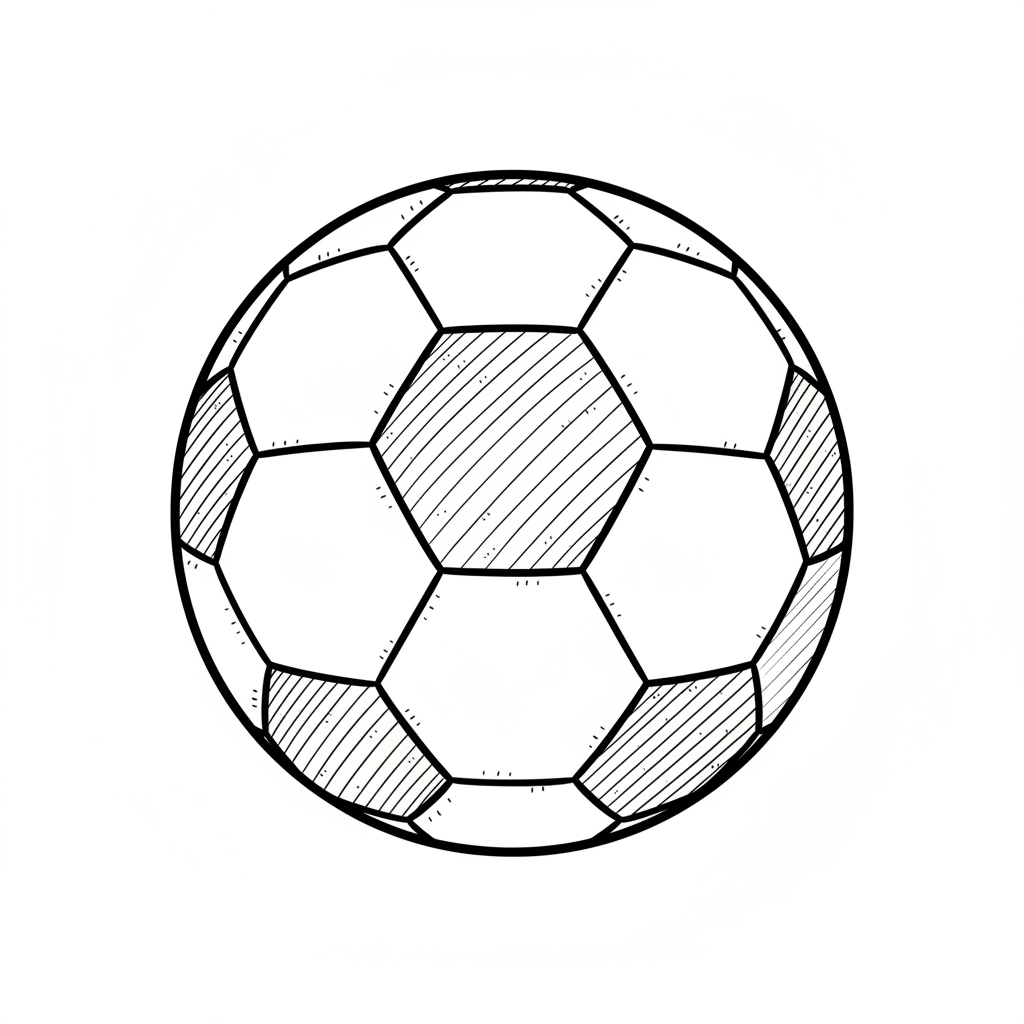
Draw a realistic soccer ball by sketching pentagons and hexagons, shading for depth, and adding highlights. Practice pattern recognition and shading.
About this tutorial
Draw a realistic soccer ball by sketching pentagons and hexagons, shading for depth, and adding highlights. Practice pattern recognition and shading.
What you need
Instructions
- 1
Step 1
Gather your materials and place the paper on a flat table so you are ready to draw.
- 2
Step 2
Trace a neat circle using a round object or compass to make the outline of your soccer ball.
- 3
Step 3
Lightly draw one curved vertical guideline and one curved horizontal guideline across the circle to show the ball's tilt.
- 4
Step 4
Sketch a small pentagon near the center of the circle following the curve of the circle.
- 5
Step 5
Draw five hexagons around that central pentagon so each pentagon edge touches a hexagon edge.
- 6
Step 6
Add pentagons in the gaps between those hexagons to keep the pattern alternating outward.
- 7
Step 7
Fill any remaining spaces inside the circle with hexagons or pentagons to complete the pattern across the ball.
- 8
Step 8
Erase the guideline lines that cross the shapes so the pattern looks clean and neat.
- 9
Step 9
Trace the pentagons with your black marker so they stand out as the black panels of the ball.
- 10
Step 10
Choose a light source and mark a tiny dot outside the circle to remember where the light is coming from.
- 11
Step 11
Shade the ball with curved pencil strokes on the side opposite the light dot to show roundness.
- 12
Step 12
Use a blending stump or tissue to smooth and soften your shading so the sphere looks natural.
- 13
Step 13
Use your eraser or white colored pencil to add a small bright highlight on the side toward the light to make the ball look shiny.
- 14
Step 14
Darken any outlines you want sharpened with pencil or marker to finish the drawing.
- 15
Step 15
Share your finished soccer ball creation on DIY.org.
Get inspired
Fun facts
How do you draw a realistic soccer ball?
Begin by drawing a light circle for the ball. Sketch a central pentagon, then lightly map surrounding hexagons and pentagons so edges meet like a soccer ball’s truncated icosahedron. Keep lines curved to follow the sphere. Ink or darken selected panels (traditionally black), erase guidelines. Establish a light source, add gradual shading across panels with softer pencils and blending for roundness, add sharp highlights and a soft cast shadow to ground the ball.
What materials do I need to draw a soccer ball?
Materials you’ll need: drawing paper or sketchbook, a range of pencils (HB, 2B, 4B), kneaded and vinyl erasers, blending stump or tissue, sharpener, ruler and compass or round object for the circle, fine black marker or ink pen for panel edges, white gel pen or white colored pencil for highlights, and a clear reference photo of a soccer ball. Optional: charcoal for deeper shadows or colored pencils for variation.
What ages is drawing a realistic soccer ball suitable for?
Suitable for children aged about 8 and up. Kids 8–12 can learn the panel pattern and basic shading with guidance; older children and teens can tackle realistic detail and advanced shading techniques. Younger children (5–7) can enjoy simplified versions—drawing a circle and coloring black and white patches—with adult help for the pattern and safe use of sharp pencils. Adjust complexity to skill level and supervision.
What are the benefits of drawing a soccer ball?
Drawing a realistic soccer ball builds pattern recognition, spatial reasoning and observation skills as kids map pentagons and hexagons onto a sphere. Shading practice teaches light, form and value contrasts, improving fine motor control and hand–eye coordination. It also encourages patience, perseverance and confidence when completing a realistic study. Use it as a warm-up for other drawing exercises or a cross-curricular tie-in to geometry and sports for further learning.
Watch & Learn
Need help?
What can we use if we don't have a compass, blending stump, or black marker?
Trace any round object like a cup or lid instead of a compass, smooth shaded areas with a folded tissue if you lack a blending stump, and use a sharp graphite pencil or fine-tip pen to trace the pentagons in place of the black marker.
My pentagons and hexagons don't line up—how can I fix the pattern?
Redraw the light curved vertical and horizontal guidelines, sketch the small central pentagon first, then add the five hexagons touching its edges and erase guideline lines as you adjust so the alternating pattern fits inside the circle.
How can I change the activity for different ages?
For preschoolers, have them color pre-drawn pentagons inside a traced circle; for elementary kids, let them draw the center pentagon and surrounding shapes lightly with pencil; and for older kids, require careful curved shading with a blending stump and a white colored pencil highlight.
What are some ways to personalize or extend the finished soccer ball?
Color non-black panels with your team's colors, add a small logo on a hexagon, experiment with stronger highlights using a white colored pencil or gel pen, and scan or photograph the final drawing to share on DIY.org.