Have you taken part in an acting audition before?
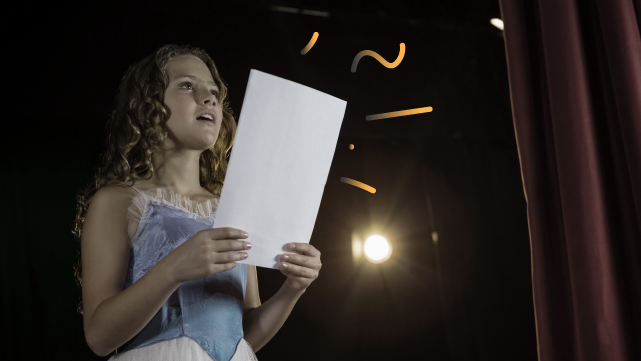
Prepare and perform a short monologue, practice voice and expressions, record your audition, and get feedback to improve performance skills.
About this activity
Prepare and perform a short monologue, practice voice and expressions, record your audition, and get feedback to improve performance skills.
What you need
Step by step
- 1
Step 1
Choose a short monologue to perform that is age appropriate and about 30 to 90 seconds long.
- 2
Step 2
Read the monologue aloud slowly to understand every word and the story behind it.
- 3
Step 3
Use your pen to mark emotions breaths and important beats on the script.
- 4
Step 4
Do a two minute vocal warm up such as humming lip trills and saying a few tongue twisters.
- 5
Step 5
Practice your facial expressions and body movements in the mirror while saying a line.
- 6
Step 6
Rehearse the entire monologue three times focusing on clear words and honest emotion.
- 7
Step 7
Record your first take of the monologue in a quiet space.
- 8
Step 8
Watch or listen to your recording all the way through without stopping.
- 9
Step 9
Write down two things you liked and two things you want to improve from that recording.
- 10
Step 10
Ask a friend family member or adult to watch your recording and give one helpful suggestion.
- 11
Step 11
Rehearse the monologue again applying the single suggestion you received.
- 12
Step 12
Record a second take of the monologue after rehearsing the change.
- 13
Step 13
Compare your first and second takes and choose the one that shows your best performance.
- 14
Step 14
Share your finished audition on DIY.org.
Fun facts
How do I prepare my child for an acting audition monologue?
To prepare and perform a short monologue, first choose a piece that fits the child's age and voice. Read it aloud, mark beats and emotions, and break it into manageable chunks. Do warm-ups for breath, articulation, and facial expressions. Rehearse with movement and timing, then record several takes in a quiet space. Watch the recordings together, note strengths and areas to improve, and repeat with adjustments until the child feels confident.
What materials do I need to record an audition monologue at home?
You'll need: a short monologue text appropriate for the child's age, a smartphone or simple camera to record, a quiet space, a mirror for practicing expressions, a notebook for notes and beats, a timer, optional simple costume or prop, and an adult or coach for supervision and feedback. Basic recording apps and free editing tools can help make playback and review easy.
What ages is practicing an audition monologue suitable for?
Suitable for kids roughly aged 6 and up, with adjustments: ages 6–9 benefit from short, playful monologues and lots of adult support; ages 10–13 can handle more structure, character work, and feedback; teens (14–18) can work on complex choices, emotional range, and audition technique. Always choose age-appropriate material, supervise younger children, and adjust rehearsal length to attention span.
What are the benefits of practicing and recording audition monologues?
Practicing monologues builds confidence, vocal control, and expressive skills. It strengthens concentration, memory, and storytelling ability while improving posture and breath support. Recording and reviewing teaches self-awareness and resilience to constructive feedback. Group or coach feedback encourages communication skills and collaboration. Regular practice helps reduce stage fright and prepares children for auditions, presentations, and social speaking situations.
Watch & Learn
Need help?
What can we use if we don't have a pen or a mirror?
Use a pencil, highlighter, or sticky-note tabs to mark emotions, breaths and important beats on the script, and use your phone's front camera or a shiny spoon/glass as a mirror to practice facial expressions.
My recording is noisy and I keep forgetting lines—what should I do?
Move to a quieter room as suggested for 'record your first take in a quiet space', do the two-minute vocal warm-up and mark breaths with your pen, rehearse the monologue three times focusing on marked beats, then re-record to get a clearer, more confident take.
How do I change the activity for younger or older children?
For younger kids choose a 30-second familiar monologue and have an adult help mark the script and handle recording, while older kids can work on a 60–90 second piece, add detailed pen notes about backstory, and extend the warm-up.
How can we make the audition more creative or stronger before sharing on DIY.org?
Add a simple prop or costume related to the piece, film an alternate angle, apply the one helpful suggestion you received when you rehearse again, then compare takes and upload the best polished performance to DIY.org.