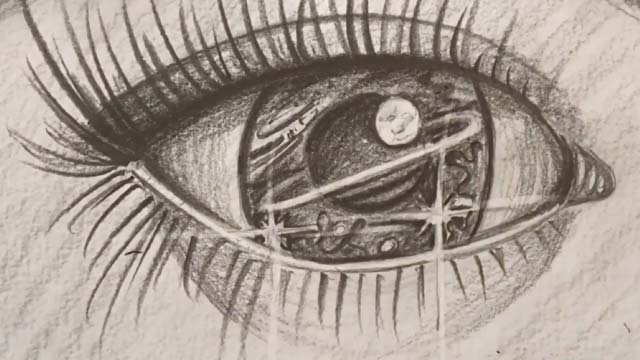
Get creative with the galaxy eye
Paint a galaxy eye on paper using watercolors, sponges, and white paint for stars, practicing color blending, layering, and fine detail brushwork.
About this activity
Paint a galaxy eye on paper using watercolors, sponges, and white paint for stars, practicing color blending, layering, and fine detail brushwork.
What you need
Step by step
- 1
Step 1
Arrange a flat workspace with paper towels a cup of water and your paints within reach.
- 2
Step 2
Lightly sketch an eye shape and a circle for the iris in the center with your pencil.
- 3
Step 3
Wet the inside of the iris gently with clean water using the medium flat brush.
- 4
Step 4
Mix a deep blue on your palette by adding a little water to the blue paint.
- 5
Step 5
Use the sponge to press deep blue onto the outer edge of the iris.
- 6
Step 6
Mix a purple color on your palette by blending paint with a little water.
- 7
Step 7
Use the sponge to press purple toward the middle of the iris so it overlaps the blue.
- 8
Step 8
Mix a teal or turquoise color on your palette.
- 9
Step 9
Use the small round brush to add teal into the inner ring near the pupil for a bright glow.
- 10
Step 10
Let the painted layers dry completely before adding dark or white details.
- 11
Step 11
Paint the pupil and the dark rim of the iris with black paint using the small round brush.
- 12
Step 12
Dip your toothbrush or a small brush into the white paint on the palette.
- 13
Step 13
Flick the toothbrush or tap the brush to splatter tiny white stars across the iris and the surrounding space.
- 14
Step 14
Use the toothpick or a fine brush to add a few larger star dots and tiny starburst lines for detail.
- 15
Step 15
Share your finished galaxy eye painting on DIY.org.
Fun facts
How do I paint a galaxy eye step by step?
Start by lightly sketching an eye shape on watercolor paper. Wet the paper slightly, then sponge on washes of dark blue, purple, and pink, blending while damp to create a nebula effect. Let each layer dry, then add darker edges and a pupil with concentrated paint. Use a small brush for highlights and fine lines. Flick white paint with a toothbrush or tiny brush for stars, and finish with fine white dots for detail. Practice layering and controlled brushwork between steps.
What materials do I need to paint a galaxy eye?
You’ll need watercolor paper (200gsm recommended), watercolor pans or tubes, a palette, water cups, and paper towels. Use a mix of sponges (kitchen or craft), a round detail brush and a flat wash brush, pencil and eraser, plus white gouache or acrylic for stars. A toothbrush or small splatter brush helps make star fields. Optional: masking fluid, metallic watercolors, and a hairdryer to speed drying.
What ages is painting a galaxy eye suitable for?
This activity suits children about 5+ with adult supervision; younger kids can enjoy simple sponge blending while adults handle fine detail and splattering. Ages 8–12 are ideal for learning layering, color mixing, and fine brushwork. Teens will appreciate more advanced techniques like masking and controlled highlights. Adjust complexity, supervision, and tools to match the child’s attention span and motor skills.
What are the benefits and safety tips for painting a galaxy eye?
Painting a galaxy eye boosts color blending, patience, fine motor skills and imaginative thinking. It’s calming and encourages attention to detail. Safety tips: use non-toxic paints, protect clothing and surfaces, supervise splattering for younger kids, and ensure good ventilation for acrylic or gouache. Variations include adding metallic paints, salt texture effects, glitter, or trying the design on canvas or cardstock for different finishes.
Watch & Learn
Need help?
What can I use if I don't have a sponge, medium flat brush, or a toothbrush?
If you don't have a sponge use a crumpled paper towel or makeup sponge to press color for the step 'Use the sponge to press deep blue onto the outer edge of the iris', swap the medium flat brush for a wide craft or house paint brush to 'Wet the inside of the iris gently', and replace the toothbrush splatter by flicking a stiff small paintbrush or tapping white paint with the toothpick to 'Flick the toothbrush or tap the brush to splatter tiny white stars'.
My colors are running or turning muddy—what should I do?
If colors run or become muddy after wetting the iris or overlapping blue and purple, blot excess water with a paper towel, mix paint with less water on your palette, and follow the instruction to 'Let the painted layers dry completely before adding dark or white details'.
How can I modify this activity for different age groups?
For preschoolers pre-sketch the eye and have them dab washable paints with the sponge under supervision, for elementary kids follow every step including the small round brush and toothbrush splatter, and for teens encourage precise color mixing, glazing between layers on the palette, and fine starburst lines with the toothpick for more detail.
How can we extend or personalize the galaxy eye painting?
Enhance the piece by adding metallic or iridescent paint when you 'add teal into the inner ring', using glow-in-the-dark paint or fine glitter when you 'splatter tiny white stars', and then frame or photograph the finished galaxy eye to share on DIY.org.