Do a cartwheel
Learn and practice a cartwheel by warming up, breaking the skill into steps, using a straight line for guidance, and building confidence safely.
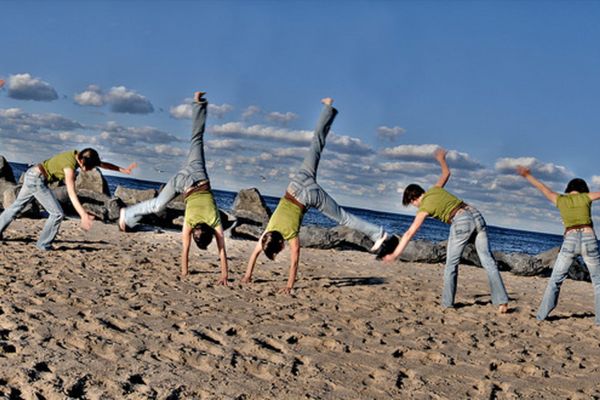
About this activity
Learn and practice a cartwheel by warming up, breaking the skill into steps, using a straight line for guidance, and building confidence safely.
What you need
Step by step
- 1
Step 1
Clear a space about an arm-span wide so you have room to move.
- 2
Step 2
Lay down a soft mat or use the carpet for a safer landing.
- 3
Step 3
Make a straight line on the floor with tape or rope or chalk to guide your cartwheel.
- 4
Step 4
Put on comfortable clothes and shoes or go barefoot so you can move easily.
- 5
Step 5
Jog in place for 60 seconds to warm up your body.
- 6
Step 6
Circle your wrists slowly for 30 seconds to warm and loosen them.
- 7
Step 7
Swing your arms and reach up to stretch your shoulders for 30 seconds.
- 8
Step 8
Stand beside the line with your stronger leg forward and practice one big lunge over the line.
- 9
Step 9
From the lunge position, place your hands on the line one at a time to practice hand placement.
- 10
Step 10
With both hands on the line, kick your back leg up and over once to feel the cartwheel motion.
- 11
Step 11
Ask your adult to spot you and try one assisted cartwheel along the line for safety and confidence.
- 12
Step 12
When you feel ready, try a full unassisted cartwheel along the line and land facing the same way.
- 13
Step 13
Share your finished cartwheel and progress on DIY.org
Fun facts
How do I teach my child to do a cartwheel?
Start with a brisk warm-up (jog, leg swings, wrist circles) to loosen muscles. Break the skill into steps: lunge toward a straight line, place lead hand on the floor, plant second hand, kick legs over one at a time and land facing the start. Practice each step separately, then combine slowly. Use a soft surface, offer spotting for balance, encourage repetition and celebrate small progress to build confidence safely.
What materials do I need to teach a child a cartwheel?
You don’t need fancy gear—just a soft, flat surface like a gymnastics mat or grass, comfortable clothing that allows movement, and a straight line marked with tape, chalk, or a rope for alignment. Optional items: a spotter or coach, light ankle support if needed, and a phone to record progress. Keep water and a small first-aid kit nearby for basic safety.
What ages is learning a cartwheel suitable for?
Cartwheels are typically suitable for children around 4 years and older, once they have basic balance, arm strength, and coordination. Younger children may try assisted cartwheels with close supervision. Tailor expectations to each child’s development—some start around preschool age, while others begin later. Always ensure proper warm-up and adult spotting for younger or less experienced kids.
How can I keep my child safe while practicing cartwheels?
Prioritize safety: warm up well, practice on a cushioned surface, and clear the area of hazards. Teach proper hand placement and alignment along a straight line, use a spotter when learning, and progress step-by-step rather than forcing full attempts. Stop if there’s pain, limit repetitions to avoid fatigue, and supervise closely. Consider lessons with a trained instructor if you’re unsure about technique or spotting.
Watch & Learn
Need help?
What can we use instead of a soft mat or tape if we don't have them?
If you don't have a soft mat, fold a thick blanket or several towels on the carpet for a safer landing, and if you lack tape/rope/chalk to make the straight line, use a jump rope, a strip of painter's or masking tape, or a length of string as the guide.
I'm falling forward or can't get my legs over—which steps should I repeat to fix it?
If you fall forward or can't complete the rotation, repeat 'practice one big lunge over the line,' rehearse 'placing your hands on the line one at a time' and 'kick your back leg up and over once' while having an adult spot you during the assisted cartwheel step.
How should I change the activity for younger kids or older kids?
For younger children shorten the warm-ups like 'jog in place for 60 seconds' and 'circle your wrists for 30 seconds,' focus on knee cartwheel drills and keep the adult spotting during the assisted cartwheel, while older kids can increase the run-up, practice the full unassisted cartwheel along the line, and use a thicker mat for harder landings.
How can we make this cartwheel activity more challenging or personal?
To extend and personalize the activity, decorate the straight line with colored tape, time or count how many successful cartwheels you land in a row, try starting with the non-dominant leg, record your final unassisted cartwheel, and then share your finished cartwheel and progress on DIY.org.