Demonstrate capillary action
Use colored water and celery stalks or paper towels to observe how plants draw water upward, recording observations and timing the capillary action.


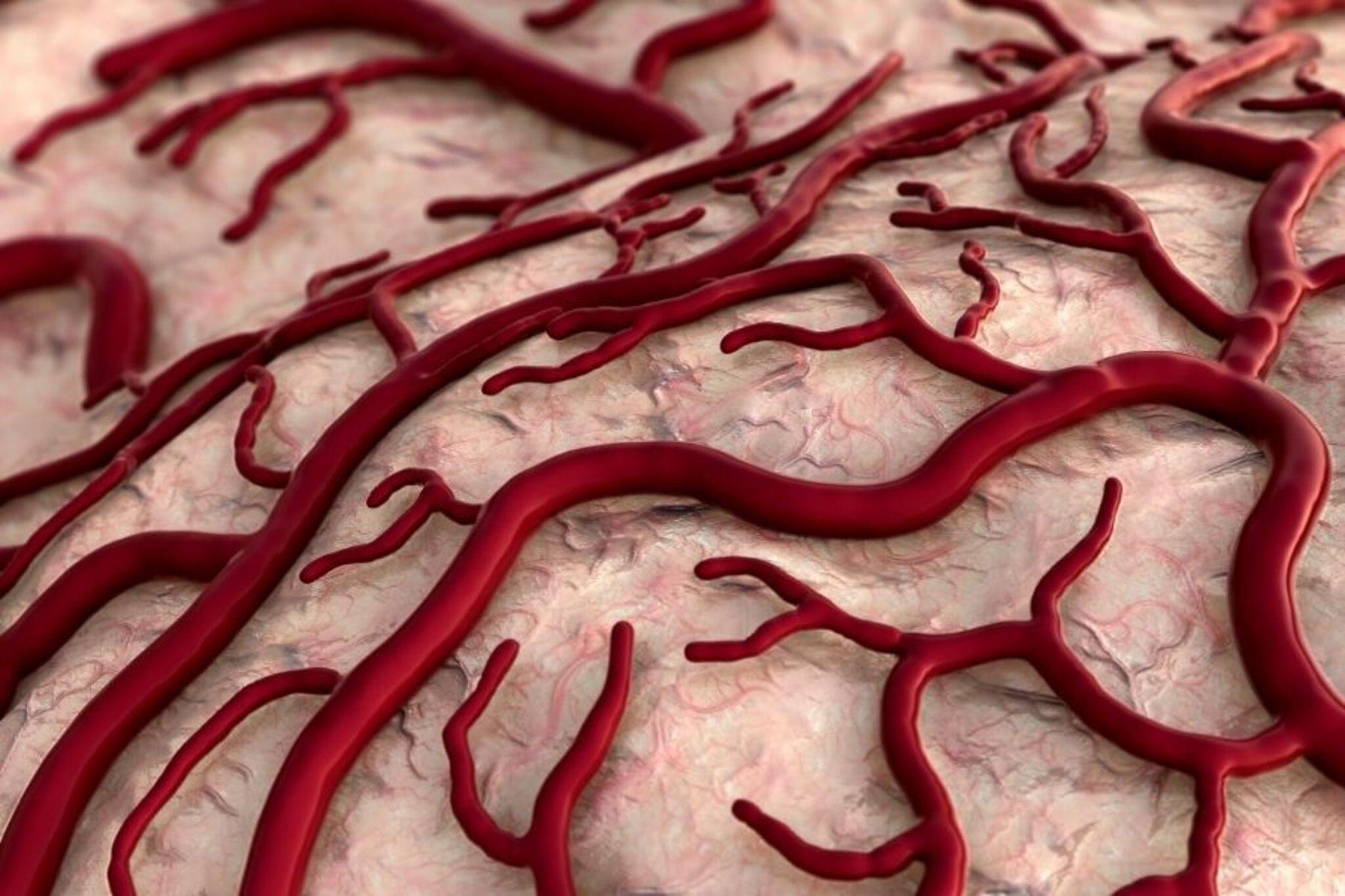

Step-by-step guide to demonstrate capillary action using colored water and celery or paper towels
Capillary Action in Plants | Simple Demonstration with Tissue Paper and Colored Water.
Step 1
Choose whether you will use celery stalks or paper towels for your experiment.
Step 2
Gather two clear jars or cups and set them on a flat table.
Step 3
Fill each jar halfway with water.
Step 4
Add about 8 drops of a different food coloring to each jar so each jar has its own color.
Step 5
Gently swirl each jar until the color spreads evenly through the water.
Step 6
If you chose celery have an adult trim about 1 inch off the bottom of each stalk.
Step 7
If you chose celery place one trimmed stalk into each jar with the cut end submerged in the colored water.
Step 8
If you chose paper towels fold two strips and dip one end of each strip into the different colored jars so the other end hangs out.
Step 9
Start a timer or note the current time in your notebook to mark the beginning of the experiment.
Step 10
Write "0 minutes" in your notebook and make a short note about what the celery or paper towel looks like right now.
Step 11
Every 15 minutes for the next hour look at your experiment and write a brief note about how the color is moving.
Step 12
Use the ruler to measure how high the color traveled on the celery or paper towel and write that measurement in your notebook.
Step 13
Check again after 24 hours and write a final observation about how far and how fast the color moved.
Step 14
Share your finished creation and what you observed on DIY.org.
Help!?
What can we use if food coloring, celery, or clear jars are hard to find?
If food coloring is unavailable use concentrated natural dyes like beet juice or turmeric mixed into the water, substitute white carnations or other firm stems for celery, and use any clear drinking glasses or plastic cups instead of jars so you can still watch the colored water.
My color isn't moving up the celery or paper towel—what should I check?
Check that you followed the step to trim about 1 inch off the celery so the cut end is fresh and fully submerged or that the folded paper towel end is actually sitting in the colored water and not dangling above it so capillary action can work.
How can I modify the experiment for younger or older children?
For younger kids use paper towels, fewer timed observations, and an adult to write the '0 minutes' note, while older kids can use celery, record observations every 15 minutes, measure color height with the ruler, and analyze the rate of movement.
How can we extend or personalize the activity after the 24-hour check?
Extend it by placing one celery stalk or a folded paper towel between two jars with different colors to create blended bands, try mixing color combinations, measure the new heights with the ruler, and share your results and photos on DIY.org as the instructions suggest.
Watch videos on how to demonstrate capillary action using colored water and celery or paper towels
Capillary Action Explained | Kids Science Experiment | How plants Grow
4 Videos
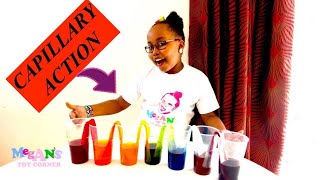
Capillary Action Explained | Kids Science Experiment | How plants Grow

Water transport in plants | Capillary action | Plant Science Experiment
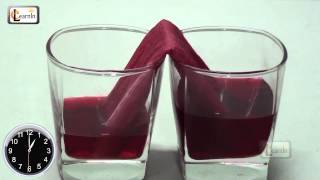
Capillary action in plants experiment with paper towel - Science experiments for kids
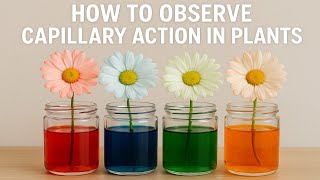
How to See Capillary Action in Plants (Easy Science Experiment!)
Facts about plant biology for kids
🌊 Capillary action lets water climb narrow tubes — the thinner the tube, the higher the water rises (Jurin’s law).
🥬 In a classic celery experiment, colored water shows up in the stalk’s veins in a few hours and in leaves within about a day.
💧 Water molecules stick to each other (cohesion) and to plant walls (adhesion), forming a continuous water column up the xylem.
🌳 A single mature tree can transpire hundreds of liters of water per day — that evaporative pull helps lift water from roots to leaves.
🧻 Paper towels and cotton wick water by capillary action too, which is why they’re great for absorbing spills and transferring dyes.
How do you demonstrate capillary action with colored water and celery stalks or paper towels?
What materials do I need to show capillary action using celery or paper towels?
What ages is the capillary action celery or paper towel experiment suitable for?
What are the benefits, safety tips, and fun variations for the capillary action activity?
