Create 4 rules for an imaginary world
Create four clear rules for an imaginary world: decide who belongs, set safety and resource use limits, list consequences, and draw examples.


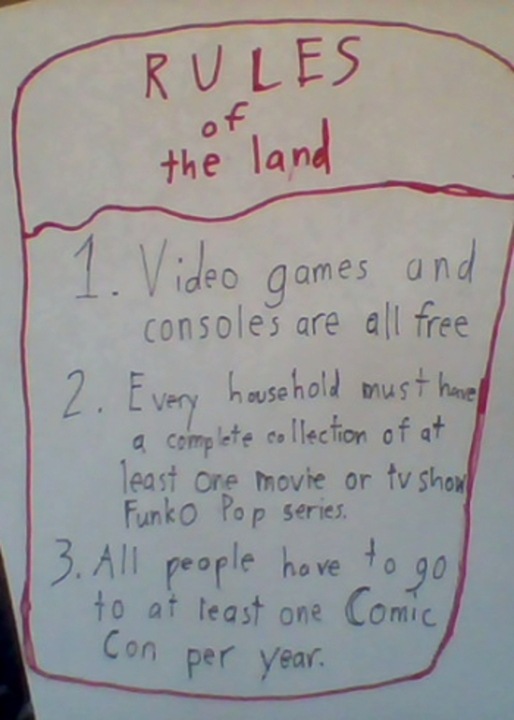

Step-by-step guide to create 4 rules for an imaginary world
How to Write an Imaginative Narrative for Kids Episode 1: What is it?
Step 1
Gather your materials.
Step 2
Give your imaginary world a fun name and write it big at the top of the paper.
Step 3
Make a short list of three to five types of people or creatures who belong in your world.
Step 4
Turn your list into Rule 1 by writing one clear sentence that says who belongs.
Step 5
Write Rule 2 as one clear sentence that sets a safety limit for everyone in the world.
Step 6
Write Rule 3 as one clear sentence that explains how shared resources should be used and limited.
Step 7
Write Rule 4 as one clear sentence that explains what happens when a rule is broken.
Step 8
Under each rule write one short consequence that matches that specific rule.
Step 9
Draw one simple example picture for each rule to show the rule being followed or broken.
Step 10
Add color and labels to your drawings so the examples are easy to understand.
Step 11
Read each rule out loud to yourself to make sure it sounds clear and fair.
Step 12
Share your finished creation on DIY.org
Help!?
What can we use instead of markers, colored pencils, or fancy paper?
Use crayons, a ballpoint pen for labels, cut-out pictures from magazines, or recycled cardboard so you can still complete the 'Gather your materials', 'Draw one simple example picture for each rule', and 'Add color and labels' steps.
If a rule is confusing or too long, how do we fix it?
Follow the instruction 'Read each rule out loud to yourself' and shorten the sentence so it clearly states who belongs, the safety limit, the shared-resource rule, or the consequence, then write one matching consequence and draw a labeled example to check clarity.
How should we change the activity for younger or older kids?
For younger children, do two to three rules with pre-drawn pictures and stickers for the 'Draw' and 'Add color and labels' steps, while older kids can list three to five creature types, set numeric limits in Rule 3, and craft a detailed Rule 4 enforcement outcome to illustrate and upload to DIY.org.
What are fun ways to improve or personalize our finished rules?
Turn your titled paper and labeled drawings into a laminated poster, a short comic or board game, or record a video showing each rule being followed or broken and then 'Share your finished creation on DIY.org' to personalize the outcome.
Watch videos on how to create 4 rules for an imaginary world
Together We Can | What Exactly is a Rule? | PBS KIDS
4 Videos

Together We Can | What Exactly is a Rule? | PBS KIDS
I Can Follow the Rules (Newbridge Learning)
Following Rules - Social Story
Know and Follow Rules By Cheri J. Meiners | Building Character Book For Kids
Facts about worldbuilding for kids
🌍 J.R.R. Tolkien invented whole languages (Quenya and Sindarin) to make his imaginary world feel real.
🧠 The social contract idea was shaped by thinkers like Hobbes, Locke, and Rousseau to explain why people agree to rules.
🏝️ The word “Utopia” was coined by Sir Thomas More in 1516 for an imagined perfect island society.
✍️ Ursula K. Le Guin used careful world rules about culture and gender to explore big moral questions in her fiction.
🎲 Dungeons & Dragons (1974) helped popularize collaborative rule-making where players build worlds and consequences together.
How do I guide my child to create four clear rules for an imaginary world?
What materials do we need to make rules and draw examples for an imaginary world?
What ages is this imaginary world rules activity suitable for?
What are the benefits and safety tips when inventing rules for an imaginary world?
