Walter Benjamin Facts For Kids

Walter Benjamin was a brilliant German-Jewish thinker known for his influential ideas on art, culture, and society during a time of great change.

Select reading age
Go deeper More articles
Walter Benjamin
Walter Benjamin Facts For Kids
Videos & Quizzesincluded

About this topic

Walter Benjamin was a brilliant thinker born in Germany on July 15, 1892. 🇩🇪 He was known for his exciting ideas about culture, art, and literature! ✍️ He loved analyzing how things like books, movies, and paintings affect our lives. Walter thought deeply and shared his thoughts through writing essays and lectures, revealing how society works in amazing ways. 📰He died on September 26, 1940, but his ideas continue to inspire people all over the world today! 🌍
Explore with ChatDino

Key Points

Walter was born into a Jewish family, and he was very curious from a young age.
Walter Benjamin wrote many influential works!
Walter Benjamin introduced key ideas like "Aura," which means that original art has a special feeling that can't be copied.
Walter Benjamin changed the way we think about art!
Walter Benjamin's work was not always recognized during his lifetime, but today he is celebrated as a great thinker!
Walter Benjamin was part of the Frankfurt School, a group of thinkers in Germany!
Historical materialism is a way of thinking about history and society that Walter Benjamin used to analyze culture!
Walter Benjamin influenced many philosophers.
Benjamin's contributions to literary criticism were enormous!

Photos of Walter Benjamin

Photograph taken in Heidelberg , April 1964, [1] by Jeremy J. Shapiro at the Max Weber-Soziologentag. Horkheimer is front left, Adorno front right, and Habermas is in the background, right, running his hand through his hair. Siegfried Landshut is in the background left.Image by Jeremy J. Shapiro, licensed under Creative Commons Attribution-Share Alike 3.0

Photograph taken in Heidelberg , April 1964, [1] by Jeremy J. Shapiro at the Max Weber-Soziologentag. Horkheimer is front left, Adorno front right, and Habermas is in the background, right, running his hand through his hair. Siegfried Landshut is in the background left.

Walter Benjamin's membership card for the Bibliothèque nationale de France (1940)

Walter Benjamin's membership card for the Bibliothèque nationale de France (1940)

Walter Benjamin's Paris apartment at 10 rue Dombasle [fr] (1938–1940)Image by Ultima.ratio, licensed under Creative Commons Attribution-Share Alike 3.0

Walter Benjamin's Paris apartment at 10 rue Dombasle [fr] (1938–1940)

Walter Benjamin's grave in Portbou. The epitaph in German, repeated in Catalan, quotes from Section 7 of "Theses on the Philosophy of History": "There is no document of culture which is not at the same time a document of barbarism"
Walter Benjamin's grave in Portbou. The epitaph in German, repeated in Catalan, quotes from Section 7 of "Theses on the Philosophy of History": "There is no document of culture which is not at the same time a document of barbarism"

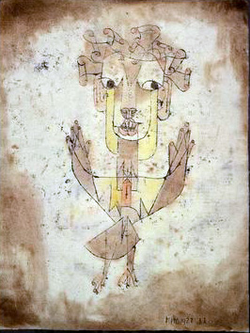
Paul Klee's 1920 painting Angelus Novus, which Benjamin bought in 1921 and compared to "the angel of history"

Paul Klee's 1920 painting Angelus Novus, which Benjamin bought in 1921 and compared to "the angel of history"

Memorial in PortbouImage by Francisco Peralta Torrejón, licensed under Creative Commons Attribution-Share Alike 4.0

Memorial in Portbou

Commemorative plaque for Walter Benjamin, Berlin-WilmersdorfImage by Wikinaut, licensed under Creative Commons Attribution-Share Alike 3.0

Commemorative plaque for Walter Benjamin, Berlin-Wilmersdorf

👶 Biography

Walter was born into a Jewish family, and he was very curious from a young age. 👶He studied at many schools, including the famous University of Frankfurt. 📚Walter was influenced by great thinkers like Karl Marx, who talked about society and economics. As an adult, he wrote many essays about culture and art. ✨Walter faced challenges during the time of the Nazis in Germany, which led him to leave his home. 😢He sadly passed away while trying to escape to safety in Spain. 🚶‍♂️
Go deeper

🖼️ Major Works

Walter Benjamin wrote many influential works! One of his most famous is "The Work of Art in the Age of Mechanical Reproduction" from 1936. 🖼️ In this essay, he discussed how things like photographs and films change how we experience art. Another popular work is "Theses on the Philosophy of History," where he shared thoughts about history and time. 📜He also wrote "One-Way Street," a book filled with tiny stories and reflections about city life. 🏙️ Each of these works makes us think different about the world around us! 🤔
Go deeper

🎨 Key Concepts

Walter Benjamin introduced key ideas like "Aura," which means that original art has a special feeling that can't be copied. 🎨He also talked about "flâneur," a person who leisurely walks through the city, observing everything. 🚶‍♀️ He believed that understanding art and culture helps us see the true nature of society. 🏛️ Another important idea was "the dialectical image," which shows how history and memories can connect in surprising ways. 🌌These concepts encourage us to look deeply into the world! 🔍
Go deeper

🖼️ Impact On Art Theory

Walter Benjamin changed the way we think about art! 🖼️ His essay, "The Work of Art in the Age of Mechanical Reproduction," showed how photographs and films affect our perception of original art. 🔍He explained that mass-produced art lacks the "aura" of something unique. This made artists and critics realize the importance of originality in art. 🎨Walter's thoughts inspired modern artists to think about technology's role in their creativity. By questioning art's meaning, he changed how we understand various art forms. 💭
Go deeper

🎉 Reception And Legacy

Walter Benjamin's work was not always recognized during his lifetime, but today he is celebrated as a great thinker! 🎉His ideas have inspired many writers, artists, and philosophers worldwide. 🌍Schools and universities teach his essays, allowing everyone to explore his thoughts. Walter's focus on culture, art, and society still influences discussions in philosophy and literature. 💬People continue to find meaning in his pioneering ideas, ensuring that his legacy will live on for years to come! 🕊️
Go deeper

🏫 The Frankfurt School

Walter Benjamin was part of the Frankfurt School, a group of thinkers in Germany! 🏫They focused on culture and society, discussing important ideas about Marxism and critical theory. 🗣️ Members like Theodor Adorno and Max Horkheimer collaborated with him to explore how culture shapes the world. 🌎The Frankfurt School aimed to understand how people can create changes in society. Through their discussions, they inspired many students and future thinkers to look at society through a critical lens. 👓
Go deeper

🏺 Historical Materialism

Historical materialism is a way of thinking about history and society that Walter Benjamin used to analyze culture! 🏺It shows how economic and social factors influence people's lives. Walter believed that understanding the past is crucial to understanding the present and future. 🕰️ He combined this idea with his thoughts on art and memory, illustrating how history shapes our experiences. 📚By linking culture to material conditions, he encouraged others to think critically about how society works! 🍃
Go deeper

🧠 Influence On Philosophy

Walter Benjamin influenced many philosophers. 🧠His connection between culture and society helped people think about how art impacts our lives! Artists and thinkers like Theodor Adorno and Herbert Marcuse were influenced by his ideas in the Frankfurt School. 📚His thoughts about time also inspired philosophers like Martin Heidegger. ⌛Walter's work encourages everyone to think critically about their surroundings and question how things are made and perceived. This helps shape new ways to see the world! 🌈
Go deeper

📖 Contributions To Literary Criticism

Benjamin's contributions to literary criticism were enormous! 📖He examined how stories and literature reveal truths about society. He analyzed popular authors like Charles Dickens and Franz Kafka, helping people understand their meanings. 🕵️ His famous concept of "the storyteller" discussed how storytelling plays a vital role in human connection. 👫Walter believed that stories could help us make sense of our experiences in life. He used his essays to teach readers how to see literature in a new light! 💡
Go deeper

🧠 Take the Quiz about Walter Benjamin

Question 1 of 10

When was Walter Benjamin born?

Question 2 of 10

What is one of his famous works?

Question 3 of 10

What does 'Aura' refer to?

Question 4 of 10

Which university did Walter attend?

Question 5 of 10

What topic did Walter write many essays about?

Question 6 of 10

What is 'flâneur'?

Question 7 of 10

Walter Benjamin faced many challenges during which period?

Question 8 of 10

When did Walter Benjamin die?

Question 9 of 10

What is the Frankfurt School?

Question 10 of 10

What kind of thinker was Walter Benjamin?

🔒

Your results

Answer all 10 questions to see how you did.

Kid-safe AI powered by AstroSafe

DIY.org

Kid-safe AI for discovery and learning. Ask anything, explore everything, learn with confidence.

Product

  • Pricing
  • App
  • All Apps

Resources

  • Blog
  • Kids Wikipedia
  • Worksheets
  • Activities for Kids
  • Build a Hacker Simulator
  • SafeTube

Company

  • About
  • Terms & Conditions
  • Privacy Policy
  • AstroSafe
TwitterInstagramYouTube

© 2026 DIY.org. All rights reserved. · Powered by AstroSafe