Titania Facts For Kids
Titania, designated Uranus III, is the largest moon of Uranus and is characterized by its icy surface and unique geological features.
Select reading age

Titania Facts For Kids
Videos & Quizzesincluded
About this topic
Titania is the largest moon of Uranus, and is also called Uranus III because it's the third moon from the planet! 🌌It was discovered by William Herschel on January 11, 1787. Titania is named after the queen of the fairies in Shakespeare's play "A Midsummer Night's Dream." 🌟 It’s a big moon, with a diameter of about 1,577 kilometers (or about 980 miles), which makes it even larger than the country of Mexico! 🌎Titania has a rocky surface covered in ice, making it a fascinating place in our solar system.
Explore with ChatDinoKey Points
Titania is known for its amazing surface features, like canyons and craters.
Titania orbits Uranus at a distance of about 436,000 kilometers, or about 271,000 miles.
Titania is one of the largest moons in our solar system.
In 1787, William Herschel was using his telescope to explore the night sky when he found Titania!
Titania is named after the fairy queen in Shakespeare’s play "A Midsummer Night's Dream."
Titania has a very thin atmosphere made mostly of oxygen, but it’s not breathable for humans!
Titania has inspired stories, games, and art!
Scientists are very curious about Titania!
Titania is the largest of Uranus's 27 known moons, but how does it stack up against other moons in our solar system?
Photos of Titania

Size comparison of Earth, the Moon, and Titania

Voyager 2's highest-resolution image of Titania shows moderately cratered plains, enormous rifts and long scarps. Near the bottom, a region of smoother plains including the crater Ursula is split by the graben Belmont Chasma.

Titania with some surface features labeled. The south pole is situated close to the unlabeled bright crater below and left of the crater Jessica.
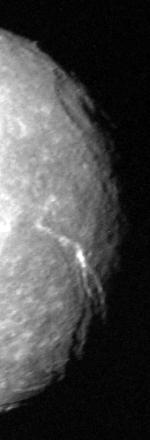
Messina Chasma—a large canyon on Titania
🌄 Surface Features
Titania is known for its amazing surface features, like canyons and craters. 🌄The largest canyon is called Verona Rupes, which is thought to be about 5 kilometers deep, making it one of the deepest in the solar system! 🌌Some places on Titania might also have bright and dark areas due to different materials. The bright spots are thought to be ice! ❄️ There are also many cracks and grooves on Titania, suggesting that it has been through some cosmic changes over time. It’s like a giant puzzle waiting to be solved! 🧩
Go deeper🌔 Orbital Mechanics
Titania orbits Uranus at a distance of about 436,000 kilometers, or about 271,000 miles. 🌔It takes about 8.7 Earth days to make one complete orbit around Uranus. Titania spins slowly on its axis, and it’s also tidally locked with Uranus – which means it always shows the same face to the planet! 🌍This is similar to how our Moon operates with Earth. It’s fascinating to know that as Titania orbits, part of it is always looking at Uranus while the other side is facing away into space! 🌌
Go deeper🪐 Physical Characteristics
Titania is one of the largest moons in our solar system. 🪐It has a unique surface that’s made up of water ice and rock. Some areas of Titania are smooth while others have lots of big craters. 🌑These craters were made when big space rocks crashed into it! Titania also has tall cliffs, some reaching about 5 kilometers high! 🏞️ That's taller than many mountains on Earth! If you could see Titania up close, it would look like a frozen, rocky world filled with secrets waiting to be explored!
Go deeper🔭 Discovery And Exploration
In 1787, William Herschel was using his telescope to explore the night sky when he found Titania! 🔭He was an amazing astronomer who also discovered Uranus itself. Later, in 1986, a spacecraft named Voyager 2 flew by Titania. This was super exciting! 🚀The Voyager 2 took lots of pictures and gathered information. It revealed that Titania has cliffs, canyons, and mysterious bright spots. Scientists learned a lot from the mission, and it helped us understand this moon better.
Go deeper👑 Mythological Significance
Titania is named after the fairy queen in Shakespeare’s play "A Midsummer Night's Dream." 👑 In this story, Titania is known for her beauty and magical powers. 🌟Myths about fairies and magic can spark our imaginations! Just like in the play, Titania is a special name that reminds us of magic in nature. 🌼When we look at Titania in the night sky, we can think about the enchanting tales of fairies and dreams connected to her name! ✨
Go deeper🌬️ Atmosphere And Composition
Titania has a very thin atmosphere made mostly of oxygen, but it’s not breathable for humans! 🌬️ Scientists believe it also has some methane, which gives it a colder feel. 🥶The temperature on Titania can drop to about -190 degrees Celsius (-310 degrees Fahrenheit) at night! 😱Because the atmosphere is so thin, it doesn’t really trap heat, making it an icy place to be. Titania’s icy surface is mostly made up of water ice, and scientists think there may even be a salty ocean underneath! 🌊
Go deeper🎨 Titania In Popular Culture
Titania has inspired stories, games, and art! 🎨You can spot her name in various books, movies, and video games that feature space adventures. 🌌Some science fiction works take inspiration from Uranus and its moons, including Titania. The name Titania often evokes images of magic and mystery! 📚Despite being a moon in our solar system, her name helps link science with stories that spark the imagination! 🧙♀️ So, keep watching the stars, and you may find Titania inspiring your own tales of adventure! ✨
Go deeper🔍 Potential For Future Research
Scientists are very curious about Titania! 🔍Future missions could explore this icy moon in more detail to find out if it might have the building blocks of life. 🌱Some scientists believe there might be liquid water beneath its icy crust, similar to what we think exists on Europa. 🧊Researching Titania could give us clues about how moons form and their potential to host life. 🚀Spacecraft like the James Webb Space Telescope might be able to study Titania even from far away, revealing more secrets about this fascinating place! 🌌
Go deeper🌒 Comparative Analysis With Other Moons
Titania is the largest of Uranus's 27 known moons, but how does it stack up against other moons in our solar system? 🌒For example, Titania is smaller than Ganymede, Jupiter's largest moon, but larger than our Moon! 🌕While some moons, like Europa, have oceans beneath icy surfaces, Titania may have a salty ocean too! 🌊Compared to some rough, volcanic moons like Io, Titania is more icy and rocky. Studying Titania helps us learn about moons in general and their unique characteristics! 🌍✨
Go deeper