All Articles

Three-phase Electric Power

Three-phase Electric Power Facts For Kids

Three-phase electric power is a common type of alternating current used globally for generating, transmitting, and distributing electricity efficiently.

🎨 Reading age for 6-8
Background blob
Three-phase Electric Power
Facts for Kids!

Do more with AI

Introduction

Three-phase electric power is super cool! ⚡It's a special way to deliver electricity that helps power our homes, schools, and factories. Instead of sending just one flow of electricity, it sends three! 🌬️ Each flow is like a different lane on a road, all working together to transport more energy at once. This makes it better for running big machines and providing smoother power for your TV or video game. Three-phase power is found all over the world, and it helps us with everyday tasks and fun activities! 🌍

Images of Three-phase Electric Power

Normalized waveforms of the instantaneous voltages in a three-phase system. The graph maps voltages over time for one whole cycle of the system. Time starts from left, and increases towards the right side. Each of the three phases starts and ends the cycle in the same value, as each cycle is (ideally) identical. The phase order is 1–2–3. This sequence repeats each cycle, and thus the rotational frequency of the generator sets the frequency of the power system. Ideally, each phase's voltage, current, and power is offset from the others' by 120°, thus having all at equidistance. This symmetry can also be recreated in converters.

Normalized waveforms of the instantaneous voltages in a three-phase system. The graph maps voltages over time for one whole cycle of the system. Time starts from left, and increases towards the right side. Each of the three phases starts and ends the cycle in the same value, as each cycle is (ideally) identical. The phase order is 1–2–3. This sequence repeats each cycle, and thus the rotational frequency of the generator sets the frequency of the power system. Ideally, each phase's voltage, current, and power is offset from the others' by 120°, thus having all at equidistance. This symmetry can also be recreated in converters.

Three-phase electric power transmission lines

Three-phase electric power transmission lines

Three-phase transformer (Békéscsaba, Hungary): On the left are the primary wires, and on the right are the secondary wires.

Three-phase transformer (Békéscsaba, Hungary): On the left are the primary wires, and on the right are the secondary wires.

Animation of three-phase current

Animation of three-phase current

Photos of Three-phase Electric Power
Wye (Y) and delta (Δ) circuits

Wye (Y) and delta (Δ) circuits

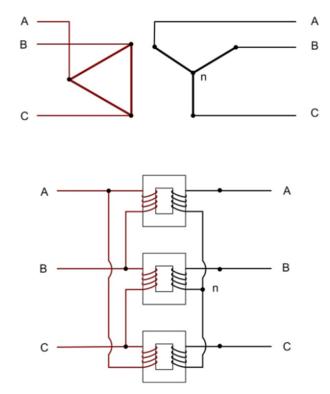
A delta-wye configuration across a transformer core (note that a practical transformer would usually have a different number of turns on each side)

A delta-wye configuration across a transformer core (note that a practical transformer would usually have a different number of turns on each side)

The first AC motor developed by Italian physicist Galileo Ferraris. This was a two-phase motor and required four wires.

The first AC motor developed by Italian physicist Galileo Ferraris. This was a two-phase motor and required four wires.

Normalized waveforms of the instantaneous voltages in a three-phase system. The graph maps voltages over time for one whole cycle of the system. Time starts from left, and increases towards the right side. Each of the three phases starts and ends the cycle in the same value, as each cycle is (ideally) identical. The phase order is 1–2–3. This sequence repeats each cycle, and thus the rotational frequency of the generator sets the frequency of the power system. Ideally, each phase's voltage, current, and power is offset from the others' by 120°, thus having all at equidistance. This symmetry can also be recreated in converters.

Normalized waveforms of the instantaneous voltages in a three-phase system. The graph maps voltages over time for one whole cycle of the system. Time starts from left, and increases towards the right side. Each of the three phases starts and ends the cycle in the same value, as each cycle is (ideally) identical. The phase order is 1–2–3. This sequence repeats each cycle, and thus the rotational frequency of the generator sets the frequency of the power system. Ideally, each phase's voltage, current, and power is offset from the others' by 120°, thus having all at equidistance. This symmetry can also be recreated in converters.

Three-phase electric power transmission linesImage by Wing-Chi Poon, licensed under Creative Commons Attribution-Share Alike 2.5

Three-phase electric power transmission lines

Three-phase transformer (Békéscsaba, Hungary): On the left are the primary wires, and on the right are the secondary wires.Image by Zátonyi Sándor, (ifj.) Fizped, licensed under Creative Commons Attribution 3.0

Three-phase transformer (Békéscsaba, Hungary): On the left are the primary wires, and on the right are the secondary wires.

Animation of three-phase currentImage by BillC at English Wikipedia, licensed under Creative Commons Attribution-Share Alike 3.0

Animation of three-phase current

Photos of Three-phase Electric Power
Wye (Y) and delta (Δ) circuits

Wye (Y) and delta (Δ) circuits

A delta-wye configuration across a transformer core (note that a practical transformer would usually have a different number of turns on each side)Image by Alexandra von Meier, licensed under Creative Commons Attribution-Share Alike 4.0

A delta-wye configuration across a transformer core (note that a practical transformer would usually have a different number of turns on each side)

Transmission Methods

Transmitting three-phase power is very important! 📡After it's generated, electricity travels through tall, strong steel towers called transmission lines. These lines are usually found high above the ground, where they can go long distances! ✈️ To maintain the power's strength, substations reduce its voltage. Then, the electricity flows through power lines to homes and businesses. 🏘️ Sometimes, underground cables are used in cities to keep things neat and tidy. 😊Using these methods helps us get power safely where we need it!

Distribution Techniques

Once electricity arrives at neighborhoods, it needs to be distributed! 🏡This happens through distribution lines that connect homes and buildings. The three phases share the power equally! ⚖️ Each house typically gets its own transformer that converts the high voltage into a lower, safer voltage that we can use for our devices and lights! 💻This means we can enjoy using our gadgets without worrying. 🧒Electricity is like a superhero, bringing energy to our everyday lives!

History Of Three-phase Power

Three-phase power was invented a long time ago, in the late 1800s! 🕰️ A smart man named Nikola Tesla played a big role in its creation. He believed that using three wires instead of one could make electricity travel faster and more efficiently. 🚀In 1887, Tesla started showing how three-phase power could work, and by 1891, the first three-phase system was used in a power plant in Germany! 🇩🇪 Today, Tesla is remembered as a great inventor, and his ideas still help us today!

Advantages Of Three-phase Power

Why do we use three-phase power instead of just one? Well, there are many advantages! 🌟First, it allows us to deliver more power, making it great for running big machines! 💪Second, three-phase power is smoother, meaning less jittery electricity for our devices! This keeps our lights bright and consistent. 💡Lastly, it operates more efficiently, saving energy and helping to protect our planet! 🌎Thanks to three-phase power, we can have fun while using fewer resources!

Generation Of Three-phase Power

Generating three-phase power starts at power plants! 🌱Most of these plants use big turbines, which are like giant fans turned by wind, water, or steam to produce energy! 💨After the turbines spin and create electricity, the power is sent to transformers, which make it suitable for transportation. 📦This electricity is then sent through three wires on power lines, traveling long distances to reach homes, schools, and businesses! 🚈It's like delivering high-fives of energy to us all!

Principles Of Three-phase Power

Three-phase power works on a neat principle! Imagine fiddling with three yo-yos and making them spin in perfect harmony. 🎨Each yo-yo represents one of the three phases. These phases are called "A," "B," and "C." When electricity flows through them, they are 120 degrees apart, which creates a smooth flow of power. 🌊This means that while one phase is "resting," the other two are working hard! This helps keep everything running smoothly and prevents flickering lights. 🔌

Applications Of Three-phase Power

Three-phase power has many exciting applications! 🛠️ It is widely used in industries to run heavy machines like cranes, lathes, and pumps. 🔧Hospitals rely on it to run essential equipment and keep everything functioning! 🏥Additionally, homes use three-phase power for heating, cooling, and cooking. 🍳Even electric trains use this power to travel fast on tracks! 🚆So whether it’s powering your favorite roller coaster or lights at a concert, three-phase power is all around us!

Challenges In Three-phase Systems

Even though three-phase power is super useful, it comes with challenges! 🚧One problem is that if one phase fails, it can cause issues with power delivery. ⚡This might make our lights flicker or cause machines to stop working. Also, three-phase systems can be complicated to set up, needing special equipment! 🤖Finally, wires can get damaged or interfere with nature if we’re not careful, so utility companies work hard to keep everything safe and organized. 🌳

Components Of A Three-phase System

A three-phase system is made up of several parts! First, we have the three wires, named after the phases: A, B, and C. These wires carry the electricity. 🔌Next, there’s a transformer, which changes the electricity's strength so it can travel long distances. Then, we have generators that create this power! ⚙️ Lastly, we cannot forget about the motors, which help turn electricity into energy that runs machines like fans, elevators, and more! 🏭All these components work together to provide power!

Future Of Three-phase Power Technologies

The future of three-phase power looks bright! 🌞Scientists and engineers are always exploring new ways to make it even better. 🌱For example, they are researching better materials for wires that are lighter and can carry more power! Also, renewable energy sources like wind and solar are being combined with three-phase systems to help the Earth! 🌬️ This means we can get energy that's better for our planet! 🌏Exciting advancements will keep us using three-phase power for many years to come! 💡

Three-phase Electric Power Quiz

Q1
Question 1 of 10

Learn more about Three-phase Electric Power

Ready to create?

Drop Files here
Make

To create a safe space for kid creators worldwide!

Create

Vibe Coding

Kids GPT

All Tools

Kibu

Resources

Worksheets

SafeTube

Blog

FAQ

Account

Pricing

Log-in

Sign-up

Data Deletion

Company

About

Community Guidelines

Privacy Policy

Terms of Service

2025, URSOR LIMITED. All rights reserved. DIY is in no way affiliated with Minecraft™, Mojang, Microsoft, Roblox™ or YouTube. LEGO® is a trademark of the LEGO® Group which does not sponsor, endorse or authorize this website or event. Made with love in San Francisco.