Thermohaline Circulation Facts For Kids
Thermohaline circulation is a global oceanic process that involves the movement of seawater driven by temperature and salinity differences, crucial for regulating the Earth's climate and ocean ecosystems.
Select reading age
Thermohaline Circulation Facts For Kids
Videos & Quizzesincluded
About this topic
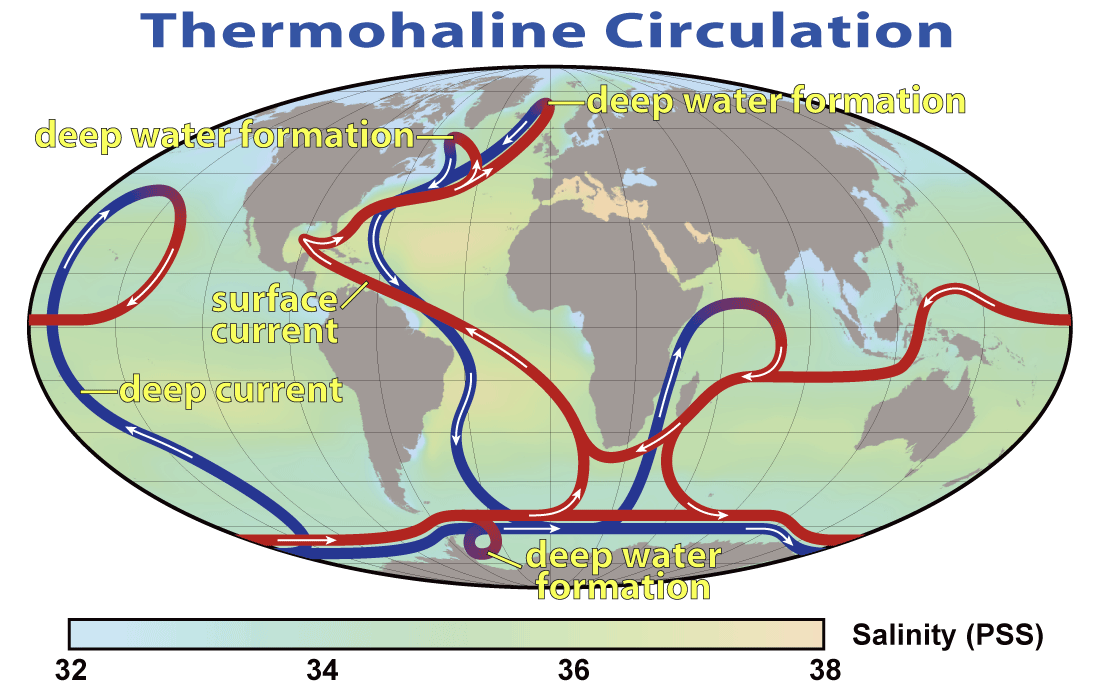
Have you ever heard of thermohaline circulation? 🌊It's like nature's own roller coaster for ocean water! This amazing system moves warm and cold water around the globe. It begins in the North Atlantic Ocean near places like Greenland, where cold and salty water sinks. The warm water from the equator travels around the ocean and helps control the Earth's climate. Without it, regions could be much colder or hotter than they are now! Scientists sometimes call this circulation the "ocean conveyor belt" because it moves water like a long train. 🚂
Explore with ChatDinoKey Points
Scientists are continually researching thermohaline circulation to learn more!
So, what makes water denser?
Thermohaline circulation affects global weather!
Thermohaline circulation has three key components: temperature, salinity, and density!
Scientists have been studying thermohaline circulation for a long time!
Thermohaline circulation is vital for marine ecosystems!
Scientists use special computer models to predict thermohaline circulation!
Climate change is a big challenge for thermohaline circulation!
Photos of Thermohaline Circulation

Effect of temperature and salinity upon sea water density maximum and sea water freezing temperature

The global conveyor belt on a continuous-ocean map (animation)

Modelled 21st century warming under the "intermediate" global warming scenario (top). The potential collapse of the subpolar gyre in this scenario (middle). The collapse of the entire Atlantic Meridional Overturning Circulation (bottom).
🔍 Future Research Directions
Scientists are continually researching thermohaline circulation to learn more! 🔍They want to discover how it will change with our warming planet. New technology like underwater robots and satellites help researchers gather data faster. 🌊By studying these changes, they can help create solutions for protecting ecosystems. Future research may include exploring how melting ice affects currents or how circulation influences storm patterns! Young scientists like you can also help by learning about the ocean and showing love for our planet. Together, we can ensure a healthy future for our oceans! 🌟
Go deeper🤔 The Science Behind Density Differences
So, what makes water denser? 🤔Well, it's all about temperature and salinity! When water is cold, it gets heavier; when it's salty, it also becomes heavier. Imagine adding sugar to your tea: the more sugar you add, the denser the tea becomes! 🌊In oceans, cold water with lots of salt sinks to the bottom, while warm and less salty water stays on top. This difference in density helps create a cycle of ocean currents that keep water moving around the world. By understanding this, researchers can learn how our planet’s climate works!
Go deeper🌏 Global Impact Of Thermohaline Circulation
Thermohaline circulation affects global weather! 🌏It helps distribute heat across the planet, making places like Western Europe warmer. If this system slows down, it could cause severe weather changes. For instance, cold regions might become even colder, while some hot places could get hotter! 🌞This circulation also influences fish migration, ocean pollution spread, and sea level rise. It’s like a giant air conditioner, helping to keep temperatures balanced. The health of our oceans depends on it, so scientists study this vital process all around the world!
Go deeper🌡️ Key Components Of Thermohaline Circulation
Thermohaline circulation has three key components: temperature, salinity, and density! 🌡️ Salinity is how salty the water is, and the temperature is how warm or cold it is. Cold and salty water sinks, while warm water rises. Together, these factors create different densities. The densest water sinks to the bottom, creating movement in the ocean. This process affects not just oceans but also nearby climates! Besides that, ocean currents like the Gulf Stream, which travels from the Gulf of Mexico up to the Atlantic, are part of this great system.
Go deeper🧑🔬 History Of Thermohaline Circulation Studies
Scientists have been studying thermohaline circulation for a long time! 🧑🔬 The first ideas about how ocean water moves came from oceanographers in the early 20th century. In 1957, a famous scientist named Henry Stommel published important papers that helped explain it all! Over the years, many research projects, like the World Ocean Circulation Experiment in the 1990s, gathered more information. They used special float trackers to follow water movement! 🌍Scientists now understand how vital it is for regulating the climate and marine life, but there's still more to learn.
Go deeper🐠 Thermohaline Circulation In Marine Ecosystems
Thermohaline circulation is vital for marine ecosystems! 🐠It helps distribute nutrients and oxygen throughout the ocean. Think of it like a big salad mixer! 🌿Different ocean creatures, like fish, plankton, and whales, depend on these currents for food and habitat. Moreover, this circulation helps support coral reefs, where many sea animals live. When currents are strong, marine life flourishes, but if they weaken, it can harm these creatures. That's why scientists study how thermohaline circulation works to keep our oceans vibrant and full of life!
Go deeper💻 Modeling And Predicting Thermohaline Circulation
Scientists use special computer models to predict thermohaline circulation! 💻These models use data about temperature and salinity from oceans all around the world. By putting this information together, they can simulate how water will move in the future. It's like building a model of a roller coaster to predict how people will ride it! 🎢This helps them understand possible changes due to climate change. The better we understand these models, the better we can prepare for climate impacts, protect marine life, and keep our oceans healthy!
Go deeper🌡️ Climate Change And Its Effects On Thermohaline Circulation
Climate change is a big challenge for thermohaline circulation! 🌡️ As the Earth warms, ice in places like Greenland is melting, adding fresh water to the oceans. This fresh water is less dense, so it can disrupt the normal sinking of cold water. If it slows down, scientists worry about extreme weather and rising sea levels. 🌊For instance, areas that are usually warm could experience colder temperatures, while storms might become more intense. It's super important that we understand these changes to protect our planet and help keep our oceans healthy!
Go deeper