Supercluster Facts For Kids
A supercluster is a large group of smaller galaxy clusters or galaxy groups, and they are among the largest known structures in the universe.
Select reading age
Supercluster Facts For Kids
Videos & Quizzesincluded
About this topic
Superclusters are HUGE! 🪐They are giant groups of many smaller clusters of galaxies. Our universe is like a big puzzle made of stars, planets, and galaxies, and superclusters are some of the biggest pieces. 🌌The Milky Way, which is our home galaxy, is part of a supercluster called the Local Supercluster. Imagine being in the biggest clubhouse ever with tons of friends! That’s what superclusters are like in space, helping scientists understand how everything fits together. Just like you have neighborhoods, superclusters have clusters of galaxies living together in a cosmic neighborhood! 🌠
Explore with ChatDinoKey Points
There are different kinds of superclusters!
Superclusters start to form when galaxies and galaxy clusters attract each other through gravity.
Scientists are always trying to learn more about superclusters!
Superclusters play an important role in cosmology, which is the study of the universe!
A supercluster is a massive collection of smaller galaxy groups or clusters!
Here are some famous superclusters!
Gravity is like a magic glue that keeps superclusters together!
Superclusters help scientists understand the universe better!
Dark matter is like a ghostly friend that you can’t see but can feel!
To study superclusters, scientists use powerful telescopes that can see deep into space!
Photos of Supercluster
![The Abell 901/902 supercluster is located a little over two billion light-years from Earth.[4]](https://upload.wikimedia.org/wikipedia/commons/thumb/f/f8/An_Intergalactic_Heavyweight.jpg/960px-An_Intergalactic_Heavyweight.jpg)
The Abell 901/902 supercluster is located a little over two billion light-years from Earth.[4]

Supercluster — photo 2
😄 Types Of Superclusters
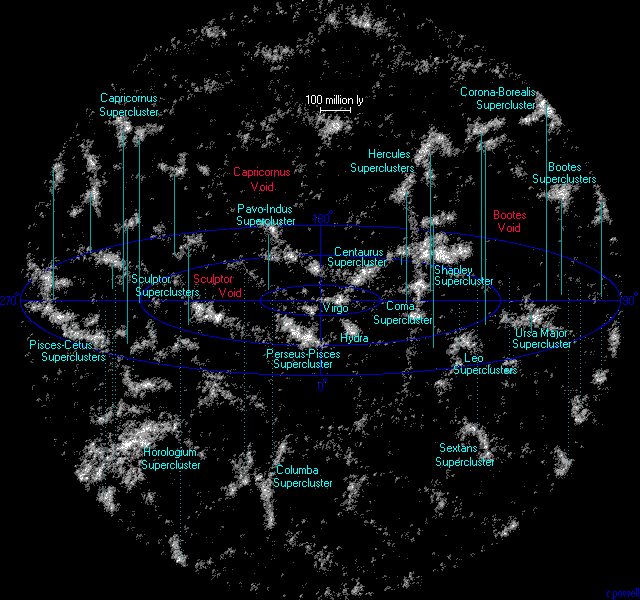
There are different kinds of superclusters! 😄They can be divided into two main types: rich and poor. Rich superclusters have many galaxies packed together closely, like a busy shopping mall! 🏬One example is the Virgo Supercluster, which contains our Local Group of galaxies! Poor superclusters have fewer galaxies and are more spread out, like a quiet park. 🌳An example is the Pisces-Cetus Supercluster, which has many less dense areas. Each type tells us something different about how galaxies like to live together in the universe!
Go deeper🌊 Formation Of Superclusters
Superclusters start to form when galaxies and galaxy clusters attract each other through gravity. 🌊Imagine a giant magnet pulling together a group of toys! Over millions of years, smaller clusters merge to become a supercluster. 🏗️ Scientists think the process begins shortly after the Big Bang, about 13.8 billion years ago! The gas in space cools down and creates stars and galaxies, which then relax into clusters and finally superclusters. This cosmic dance takes a long time, but it is how our universe gets bigger and more interesting! 🌠
Go deeper🚀 Future Research Directions
Scientists are always trying to learn more about superclusters! 🚀They build better telescopes to see deeper into space. They also want to use satellites that can measure dark matter more precisely! 📡With new technology, they hope to discover new superclusters and figure out how they change over billions of years. 🌌Studies of superclusters can even help answer great questions about the universe's birth and future! Imagine traveling to new worlds in space and unlocking the mysteries together! Every new discovery is an adventure! 🌠
Go deeper🌟 Superclusters In Cosmology
Superclusters play an important role in cosmology, which is the study of the universe! 🌟By examining superclusters, scientists learn how galaxies form and organize. They also help measure the universe's size and shape! The arrangement of superclusters can reveal secrets about dark energy, an otherworldly force pushing the universe to expand! 🚀When researchers study these gigantic cosmic structures, they gather clues on how the universe looked billions of years ago! Every new discovery helps us understand not only our cosmic neighborhood but also our incredible universe! 🌌
Go deeper🤯 Definition Of A Supercluster
A supercluster is a massive collection of smaller galaxy groups or clusters! 🤯These clusters can hold thousands of galaxies. Each galaxy can have billions of stars, like our Sun! ☀️ Superclusters are found throughout the universe. They form because galaxies and clusters of galaxies attract each other using gravity, kind of like friends coming together to play! 🤝The largest superclusters can be millions of light-years wide. This shows us how vast and amazing our universe truly is! 🌌
Go deeper🌟 Notable Examples Of Superclusters
Here are some famous superclusters! 🌟The Virgo Supercluster is near Earth and includes the Milky Way. 🌌It has over 100 galaxies! Then there is the Laniakea Supercluster! It’s even bigger, stretching about 500 million light-years! 😲Another is the Shapley Supercluster, which is one of the largest known and has galaxies that are mostly very far away. Each supercluster shows us how galaxies enjoy gathering in different ways! 🌊
Go deeper💫 Gravitational Forces In Superclusters
Gravity is like a magic glue that keeps superclusters together! 💫Just like how you can pull a wagon with a string, galaxies pull on each other with gravity! The stronger the gravity, the closer the galaxies are. 🚜In superclusters, scientists find that really big galaxies pull in more smaller galaxies. Imagine a big kid inviting little kids to join a game! 🎮This pulling force shapes the structure of superclusters and tells galaxies where to go. With gravity’s help, superclusters can be hundreds of times heavier than our Milky Way! 🌟
Go deeper🌌 Role Of Superclusters In The Universe
Superclusters help scientists understand the universe better! 🌌By studying them, we learn how galaxies form and move. Superclusters are like big highways in space! 🚀They show us where galaxies are traveling and how gravity affects them. This can also teach us about dark matter, the invisible stuff that pulls galaxies together! 🕵️♂️ Superclusters are like clues in a cosmic treasure hunt, helping unravel the mysteries of how everything works in our universe! Each discovery brings us a step closer to understanding our cosmic home!
Go deeper👻 Impacts Of Dark Matter On Superclusters
Dark matter is like a ghostly friend that you can’t see but can feel! 👻It affects how galaxies in superclusters move. Although we can’t see dark matter, it makes up most of the universe's mass! This invisible matter helps pull galaxies and superclusters together. 💪When galaxies collide or come close, dark matter’s gravity gives them an extra push to stick together. Think of it like a hidden hand at a game, guiding the other players! 🎮Understanding dark matter helps scientists learn how superclusters grow and change over time! 📈
Go deeper🔭 Observational Techniques For Studying Superclusters
To study superclusters, scientists use powerful telescopes that can see deep into space! 🔭They look for light from different galaxies and clusters, even those far, far away! Some telescopes, like the Hubble Space Telescope, spot galaxies that are billions of light-years from us. 🌌Other methods include measuring how fast galaxies are moving, which helps find their distance. By using radio waves and different types of light, astronomers can get a clearer picture of these cosmic giants. 📡Each observation helps gather knowledge piece by piece! ⌛
Go deeper