Strong Interaction Facts For Kids
The strong interaction is a fundamental force in physics that binds quarks together to form protons and neutrons, forming the basis of atomic structure.
Select reading age

Strong Interaction Facts For Kids
Videos & Quizzesincluded
About this topic
The strong interaction is an amazing force in nature! 🌌It is one of the four fundamental forces, alongside gravity, electromagnetism, and the weak force. This powerful force is responsible for holding protons and neutrons together inside the nucleus of an atom. Without it, the nucleus would fall apart! The strong interaction works at very tiny distances, like the size of an atom, making it super strong enough to keep everything together. In fact, it’s the strongest force we know! 🌟
Explore with ChatDinoQuick Facts
Key Points
The strong interaction works through a special force that acts between quarks.
Many exciting experiments have been conducted to learn about the strong interaction!
The strong interaction, or strong nuclear force, is like a super glue for small particles called quarks.
Scientists are still studying the strong interaction!
The study of strong interaction began in the early 20th century!
There are four fundamental forces in nature, and the strong interaction is the strongest of them all!
The strong interaction involves particles called quarks and gluons!
Understanding the strong interaction can be tough!
The strong interaction plays an important role in nuclear reactions!
The strong interaction isn’t just a cool science fact – it has real-world applications!
Photos of Strong Interaction
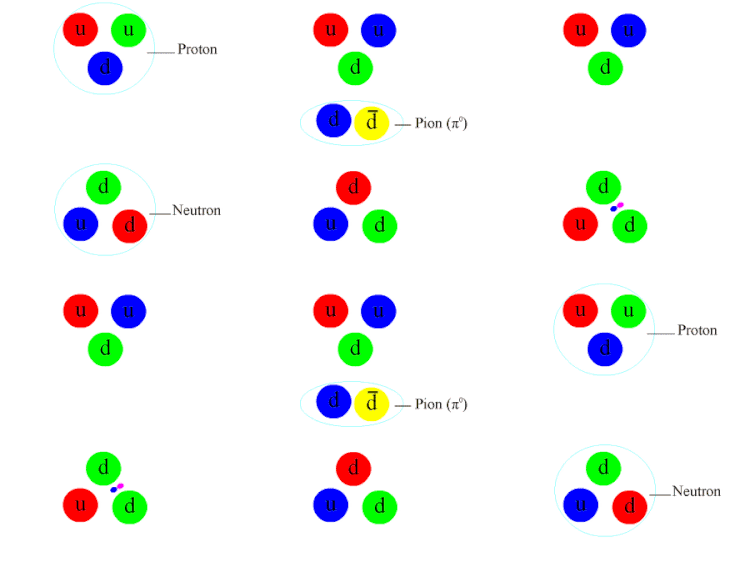
An animation of the strong interaction between a proton and a neutron, mediated by pions. The colored small double circles inside are gluons.

The fundamental couplings of the strong interaction, from left to right: (a) gluon radiation, (b) gluon splitting and (c,d) gluon self-coupling.

A Feynman diagram (shown by the animation in the lead) with the individual quark constituents shown, to illustrate how the fundamental strong interaction gives rise to the nuclear force. Straight lines are quarks, while multi-colored loops are gluons (the carriers of the fundamental force).
🎾 How Strong Interaction Works
The strong interaction works through a special force that acts between quarks. Imagine a strong rubber band holding together different colored balls! 🎾The stronger the rubber band, the harder it is to pull the balls apart. In a similar way, gluons act as "connectors" that pull quarks together tightly. This creates a stable proton or neutron. Because of this power, quarks cannot be found alone—they are always found in groups! This incredible force makes sure the tiny building blocks of atoms stay tightly bound together, creating the matter all around us! 🏗️
Go deeper⚗️ Key Experiments And Discoveries
Many exciting experiments have been conducted to learn about the strong interaction! ⚗️ One important discovery was the confirmation of quarks in the 1970s during experiments at the Stanford Linear Collider. In 2000, the discovery of the "upsilon" particle helped scientists learn more about the strong force. The LHC is also famous for discovering the Higgs boson in 2012, which is connected to the strong interaction! Through these experiments, scientists deepen our understanding of how matter works at the smallest scales. There are still many more discoveries waiting to be made! 🌌
Go deeper💪 Definition Of Strong Interaction
The strong interaction, or strong nuclear force, is like a super glue for small particles called quarks. Quarks are the building blocks of protons and neutrons. 💪The strong interaction keeps these quarks tightly bound together, which then combine to form protons and neutrons. Protons are positively charged, and neutrons are neutral, but together they form the nucleus of an atom. The strong interaction can also hold other particles called hadrons. Imagine it like a superhero power that keeps everything safe and sound! 🦸♂️
Go deeper🔬 Current Research And Developments
Scientists are still studying the strong interaction! 🔬They want to learn more about how it works and why it is so strong. One exciting project is the Large Hadron Collider (LHC) in Switzerland, where scientists smash particles together at incredible speeds! This helps them observe what happens when the strong interaction takes place. Researchers are also looking for new particles and forces related to the strong interaction. These findings can lead to exciting discoveries about the universe and the fundamental building blocks of matter! 🚀
Go deeper🗓️ History Of Strong Interaction Theory
The study of strong interaction began in the early 20th century! 🗓️ Scientists like Ernest Rutherford and Niels Bohr helped us understand atomic structure. In 1934, Indian physicist C. V. Raman proposed new ideas about interactions inside the nucleus. Later, the concept of quarks was introduced by Murray Gell-Mann and George Zweig in the 1960s. This was a big breakthrough! 🎉They showed how quarks combined with the strong interaction to create protons and neutrons. Over the years, physicists have built on their ideas to explore the mysteries of strong interaction!
Go deeper🦸♀️ Comparison With Other Fundamental Forces
There are four fundamental forces in nature, and the strong interaction is the strongest of them all! 🦸♀️ The first is gravity, which pulls objects toward each other, like when you drop a ball. The second is electromagnetism, which makes magnets stick and keeps our electronics working. The weak force is responsible for certain types of radioactive decay. While these forces are essential, the strong interaction wins the “strongest force” award! 🏆It only works within very tiny distances inside atomic nuclei, so it has a special role that is different from the others!
Go deeper🦠 Particles Involved In Strong Interaction
The strong interaction involves particles called quarks and gluons! 🦠Quarks are tiny particles that come in six different types, or "flavors," named up, down, charm, strange, top, and bottom. Protons are made of two up quarks and one down quark, while neutrons have one up quark and two down quarks. Gluons are like the messengers of the strong force, carrying the power that binds quarks together. They help quarks stick together inside protons and neutrons! It's a fantastic little world full of tiny particles working together! 🌈
Go deeper🤔 Challenges In Understanding Strong Interaction
Understanding the strong interaction can be tough! 🤔One reason is that it works at such tiny distances, making it challenging to observe directly. Scientists also face difficulty calculating the behavior of quarks and gluons because they interact in complicated ways. Moreover, they must consider how these particles behave under different conditions like high energy or extreme temperatures. Researchers continue to work hard to solve these puzzles, pushing the boundaries of physics and expanding our knowledge of the universe! 🧩
Go deeper💥 Role Of Strong Interaction In Nuclear Reactions
The strong interaction plays an important role in nuclear reactions! 💥In the sun, for example, it helps fuse hydrogen atoms into helium, releasing a tremendous amount of energy that powers our solar system. In nuclear power plants, we use fission, where heavy atomic nuclei split into smaller pieces, releasing energy. Here too, the strong interaction is crucial! This force allows us to harness the energy from these reactions, providing electricity to homes around the world! 🌍The strong interaction is like a key that opens the door to these powerful energy sources!
Go deeper🛠️ Applications Of Strong Interaction In Technology
The strong interaction isn’t just a cool science fact – it has real-world applications! 🛠️ One exciting example is in cancer treatment, where physicists are developing particle beams to target and destroy cancer cells using the strong force. In nuclear reactors, power plants harness the strong interaction to create energy for homes and businesses. Additionally, research in particle physics helps create new technologies, such as advanced sensors and imaging devices. Scientists continually explore how to use this powerful force for even more advancements in medicine and technology! 💡
Go deeper