All Articles

Sigmund Freud

Sigmund Freud Facts For Kids

Sigmund Freud was an Austrian neurologist and the founding figure of psychoanalysis, a clinical method for treating psychopathology through dialogue between a patient and a psychoanalyst.

🎨 Reading age for 6-8
Background blob
Sigmund Freud
Sigmund Freud
Facts for Kids!

Do more with AI

Introduction

Sigmund Freud was a famous doctor from Austria, born on May 6, 1856. He is best known for his work in psychology! 😃Freud created theories about how our minds work and even studied dreams. He believed that our feelings and thoughts are influenced by things we might not even know! He lived during a time when people were just starting to understand how the brain affects our behavior. Freud's ideas shaped how doctors think about mental health today! He passed away on September 23, 1939, but his thoughts still inspire researchers and doctors around the world. 🌍

Images of Sigmund Freud

Freud's birthplace, a rented room in a locksmith's house, Freiberg, Austrian Empire (Příbor, Czech Republic)Image by Michal Novak, licensed under Creative Commons Attribution 3.0

Freud's birthplace, a rented room in a locksmith's house, Freiberg, Austrian Empire (Příbor, Czech Republic)

Freud (aged 16) and his mother, Amalia, in 1872

Freud (aged 16) and his mother, Amalia, in 1872

Freud's home at Berggasse 19, ViennaImage by C.Stadler/Bwag, licensed under Creative Commons Attribution-Share Alike 4.0

Freud's home at Berggasse 19, Vienna

André Brouillet's A Clinical Lesson at the Salpêtrière (1887) depicting a Charcot demonstration. Freud had a lithograph of this painting placed over the couch in his consulting rooms.[63]

André Brouillet's A Clinical Lesson at the Salpêtrière (1887) depicting a Charcot demonstration. Freud had a lithograph of this painting placed over the couch in his consulting rooms.[63]

Approach to Freud's consulting rooms at Berggasse 19Image by Motmit at English Wikipedia ( Original text: Motmit ( talk ) ), licensed under Creative Commons Attribution-Share Alike 3.0

Approach to Freud's consulting rooms at Berggasse 19

Carl Jung in 1910

Carl Jung in 1910

At Clark University, Worcester, Massachusetts in 1909. Front row: Freud, G. Stanley Hall, Carl Jung; back row: Abraham Brill, Ernest Jones, Sándor Ferenczi
At Clark University, Worcester, Massachusetts in 1909. Front row: Freud, G. Stanley Hall, Carl Jung; back row: Abraham Brill, Ernest Jones, Sándor Ferenczi

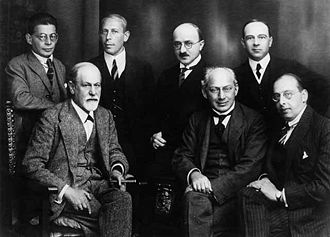
The Committee in 1922 (from left to right): Otto Rank, Sigmund Freud, Karl Abraham, Max Eitingon, Sándor Ferenczi, Ernest Jones, and Hanns Sachs

The Committee in 1922 (from left to right): Otto Rank, Sigmund Freud, Karl Abraham, Max Eitingon, Sándor Ferenczi, Ernest Jones, and Hanns Sachs

Photos of Sigmund FreudImage by ROBERT HUFFSTUTTER, licensed under Creative Commons Attribution 2.0

Biography

Freud was born in a small town called Freiburg, now part of the Czech Republic. 🎉He was a curious child who loved learning. Freud studied medicine at the University of Vienna, where he became a doctor. He became interested in helping people with emotional problems. In 1885, he traveled to Paris to learn from a famous doctor named Jean-Martin Charcot, who studied hysteria (a condition where people have lots of emotions). Freud later moved back to Vienna and started his practice. He married Martha Bernays in 1886 and had six children! 👨‍👩‍👧‍👦

Psychoanalysis

Freud invented a way to help people called *psychoanalysis*! 🛋️ This is a method where a person talks to a doctor about their feelings and thoughts. The doctor listens and helps them understand why they feel that way. Freud thought that many problems came from things hidden in our minds. By exploring these hidden thoughts, people could feel better. He used techniques like asking about childhood memories and interpreting dreams to help people understand themselves. This innovative approach laid the foundation for modern therapy! 🌈

Defense Mechanisms

To help us deal with strong feelings, Freud discovered *defense mechanisms*! 🤔These are ways our brains protect us from uncomfortable emotions. For example, *repression* is when we forget things that hurt us, like a sad memory. 😢Another mechanism is *projection*, where we think others have our feelings. 🌈These fancy terms help us understand why we sometimes act in surprising ways! Freud believed that while these defenses can be helpful, they can also make it hard for us to see what we're really feeling!

Dream Interpretation

Freud believed dreams were like windows to our hidden feelings! 💤He wrote a famous book called "The Interpretation of Dreams" in 1900. In this book, he explained that dreams often have secret meanings. For example, if you dream about flying, it might mean you want to feel free from worries! 🕊️ Freud thought dreams often reflected our deepest desires and fears. He encouraged people to think about the symbols in their dreams, believing that understanding them could help people achieve happiness and well-being! 🌟

Impact On Psychology

Freud's ideas changed psychology forever! Many doctors and researchers started to pay more attention to our feelings and thoughts, not just our bodies. 💡His work helped create fields like *psychotherapy*, where talking helps heal emotional issues. Freud's focus on childhood experiences also made people think about how they shape us as adults. Even today, many psychologists use his ideas to help people understand their feelings. Without Freud, psychology might not have developed as quickly or deeply! 🌍

Legacy And Influence

Today, Freud's ideas continue to influence psychology, literature, and even art! 🎨His theories on dreams and the unconscious mind encourage people to explore their own thoughts and feelings. Many psychologists still use some of his techniques, like talking about feelings in therapy. 🌈Books and movies often reference his ideas, showing how widely known he is! While some ideas have changed, Freud’s influence remains strong, reminding us to think deeply about our minds! 🌍

Theories Of Personality

Freud created three parts of our personality: the id, ego, and superego! 🤔
- The id is like a little kid who wants what it wants right now, such as food and fun! 🎈
- The ego is like a wise adult; it helps us make good choices.
- The superego is our conscience that thinks about right and wrong. ⚖️
These three parts work together to shape how we feel and act! Freud believed we all have conflicts between our desires and our moral feelings!

Criticism And Controversies

Although Freud had great ideas, not everyone agreed with him! 😟Some said his theories were hard to test and didn't apply to everyone. For example, he thought that most dreams were about personal desires, which others found too simple. People also criticized his views on women, believing he didn’t fully understand how they felt. 🌸These disagreements led to other psychologists creating different theories about the mind and behavior. Despite the criticism, Freud's ideas still opened up important conversations about mental health!

Sigmund Freud Quiz

Q1
Question 1 of 10

Learn more about Sigmund Freud

Ready to create?

Drop Files here
Make

To create a safe space for kid creators worldwide!

Create

Vibe Coding

ChatDino

All Tools

Kibu

Resources

Worksheets

SafeTube

Blog

FAQ

Account

Pricing

Log-in

Sign-up

Data Deletion

Company

About

Community Guidelines

Privacy Policy

Terms of Service

2025, URSOR LIMITED. All rights reserved. DIY is in no way affiliated with Minecraft™, Mojang, Microsoft, Roblox™ or YouTube. LEGO® is a trademark of the LEGO® Group which does not sponsor, endorse or authorize this website or event. Made with love in San Francisco.