Shock Wave Facts For Kids

A shock wave is a fast-moving disturbance that forms when an object exceeds the speed of sound in a medium like air or water.
Select reading age
Go deeper More articles
Shock Wave
Shock Wave Facts For Kids
Videos & Quizzesincluded

About this topic

Shock waves are super cool and fast waves that travel through different materials! ๐ŸŒŠThey can happen in air, water, and even solid things like metal. A classic example is when a jet airplane flies faster than the speed of sound. ๐Ÿ’จThis creates a loud "boom" called a sonic boom! Shock waves can also be created by explosions or even by sound spreading out from a drum when someone hits it. They are interesting because they help scientists understand how things move super quickly and how energy travels through different materials!
Explore with ChatDino

Key Points

There are different types of shock waves!
A shock wave is like a super-fast wave that travels quicker than sound!
Shock waves form when something moves faster than the speed of sound in a medium, like air.
Scientists are excited about future research on shock waves!
Scientists use math to understand shock waves better!
Engineers use shock waves to design cool stuff!
Shock waves are super important in space and astrophysics!
You can have fun with shock waves through cool experiments!
Did you know shock waves are used in medicine?
The study of shock waves goes back many years!

Photos of Shock Wave

USS Iowa firing at broadside during training exercises in Puerto Rico, 1984. Circular marks are visible where the expanding spherical atmospheric shockwaves from the gun firing meet the water surface.

USS Iowa firing at broadside during training exercises in Puerto Rico, 1984. Circular marks are visible where the expanding spherical atmospheric shockwaves from the gun firing meet the water surface.

Pressureโ€“time diagram at an external observation point for the case of a supersonic object propagating past the observer. The leading edge of the object causes a shock (left, in red) and the trailing edge of the object causes an expansion (right, in blue).

Pressureโ€“time diagram at an external observation point for the case of a supersonic object propagating past the observer. The leading edge of the object causes a shock (left, in red) and the trailing edge of the object causes an expansion (right, in blue).

Conical shockwave with its hyperbola-shaped ground contact zone in yellowImage by Cmglee, licensed under Creative Commons Attribution-Share Alike 4.0

Conical shockwave with its hyperbola-shaped ground contact zone in yellow

Shock wave propagating into a stationary medium, ahead of the fireball of an explosion. The shock is made visible by the shadow effect (Trinity explosion).

Shock wave propagating into a stationary medium, ahead of the fireball of an explosion. The shock is made visible by the shadow effect (Trinity explosion).

Schlieren photograph of the detached shock on a bullet in supersonic flight, published by Ernst Mach and Peter Salcher in 1887

Schlieren photograph of the detached shock on a bullet in supersonic flight, published by Ernst Mach and Peter Salcher in 1887

Shadowgram of shock waves from a supersonic bullet fired from a rifle. The shadowgraph optical technique reveals that the bullet is moving at about a Mach number of 1.9. Left- and right-running bow waves and tail waves stream back from the bullet and its turbulent wake is also visible. Patterns at the far right are from unburned gunpowder particles ejected by the rifle.Image by Settles1, licensed under Creative Commons Attribution-Share Alike 3.0

Shadowgram of shock waves from a supersonic bullet fired from a rifle. The shadowgraph optical technique reveals that the bullet is moving at about a Mach number of 1.9. Left- and right-running bow waves and tail waves stream back from the bullet and its turbulent wake is also visible. Patterns at the far right are from unburned gunpowder particles ejected by the rifle.

Damage caused by a meteor shock waveImage by Nikita Plekhanov, licensed under Creative Commons Attribution-Share Alike 3.0

Damage caused by a meteor shock wave

Recompression shock on a transonic-flow airfoil, at and above critical Mach number

Recompression shock on a transonic-flow airfoil, at and above critical Mach number

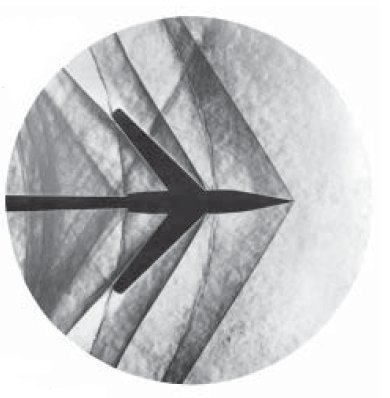
NASA took their first Schlieren photograph of shock waves interacting between two aircraft in 2019.

NASA took their first Schlieren photograph of shock waves interacting between two aircraft in 2019.

๐ŸŽ‰ Types Of Shock Waves

There are different types of shock waves! ๐ŸŽ‰One type is called "normal shock waves," which happen when sound travels through the air normally. Another type is "oblique shock waves," which are created when an object moves at an angle, like a rocket taking off! ๐Ÿš€These waves help scientists know how things behave when they go super fast. Thereโ€™s also "spherical shock waves," which spread out in all directions, like when a stone is dropped in water and creates ripples! ๐ŸŒŠEach type is unique and helps us understand speed and energy!
Go deeper

๐ŸŽ๏ธ What Is A Shock Wave?

A shock wave is like a super-fast wave that travels quicker than sound! ๐ŸŽ๏ธ Imagine you're at a concert and someone plays a loud drum. When the drum hits, the sound spreads out, but if you could move faster than that sound, you would create a shock wave! Itโ€™s like a bubble of energy that pushes through the air. These waves can make things shake and rattle. For instance, if a plane goes really fast, it can create a shock wave around it! ๐ŸŒŸSo, shock waves are all about fast movements and energy going zoom!
Go deeper

๐ŸŒฌ๏ธ Formation Of Shock Waves

Shock waves form when something moves faster than the speed of sound in a medium, like air. ๐ŸŒฌ๏ธ When an airplane flies very fast, it compresses the air in front of it. This compression creates a sharp change in pressure, which creates the shock wave! If a bomb explodes, it also sends out a shock wave through the air. ๐Ÿ’ฅThe sound you hear from far away is actually the shock wave pushing the air! That's why you might see the explosion first and hear it later. Shock waves are formed from fast movements and big energy releases!
Go deeper

๐ŸŒŸ Future Research Directions

Scientists are excited about future research on shock waves! ๐ŸŒŸThey want to learn more about how these waves can help in creating better technology, like faster planes and safer rockets. Thereโ€™s also research on using shock waves in medicine, like new treatments for different diseases! ๐Ÿš€Researchers are exploring shock waves in underwater applications, especially for cleaning and investigating ocean environments. The possibilities are endless! Future scientists will keep pushing boundaries to understand shock waves better and discover new uses, making the world an even more amazing place! ๐ŸŽ‰
Go deeper

๐Ÿ“ Mathematics Of Shock Waves

Scientists use math to understand shock waves better! ๐Ÿ“They look at things like speed and pressure. The formula that helps them calculate shock waves is called the "Rankine-Hugoniot conditions." This formula helps them figure out the differences in pressure before and after the wave passes through. ๐Ÿ“ŠLearning about shock waves uses concepts like speed (how fast something moves) and density (how much stuff is in a space). The math helps engineers and scientists design better vehicles, like planes and rockets, to travel safely through shock waves!
Go deeper

๐Ÿ—๏ธ Shock Waves In Engineering

Engineers use shock waves to design cool stuff! ๐Ÿ—๏ธ For example, when creating planes and rockets, they have to think about what happens when their vehicles travel super fast. They study how shock waves form and how they affect the shape of the aircraft. ๐Ÿ›ฉ๏ธ Engineers use computers to simulate shock waves to make designs better and safer. They also apply shock wave technology in shock absorbers for cars to keep them smooth on bumpy roads. ๐Ÿš—Shock waves help create safer and faster technologies in engineering!
Go deeper

๐ŸŒŒ Shock Waves In Astrophysics

Shock waves are super important in space and astrophysics! ๐ŸŒŒWhen stars explode in a big event called a supernova, they create powerful shock waves. These waves can send materials out into space, forming new stars and planets! ๐ŸŒ Scientists study these waves to understand how our universe works. Another example is when galaxies collide; the shock waves can help form new stars. Astronomers use telescopes to observe these events and learn what happens when stars and galaxies interact. Shock waves are part of the amazing story of our universe!
Go deeper

๐ŸŽˆ Experiments And Demonstrations

You can have fun with shock waves through cool experiments! ๐ŸŽˆOne simple way is to clap your hands really hard. People nearby will see your hands move before they hear the sound โ€“ thatโ€™s a mini shock wave! You can also try dropping a stone in a pond to see how ripples, similar to shock waves, spread out in circles! ๐ŸŒŠAnother fun demo is to pop a balloon; the popping sound creates a tiny shock wave that you can feel! Try these experiments and pay attention to how sound and movement play with shock waves!
Go deeper

๐Ÿฅ Applications Of Shock Waves In Medicine

Did you know shock waves are used in medicine? ๐ŸฅDoctors actually use them to help patients get better! One amazing use is for breaking down kidney stones. ๐Ÿ’ŽShock wave therapy directs waves towards the stones, making them smaller so they can easily pass through the body. This method is called Extracorporeal Shock Wave Lithotripsy (ESWL). Itโ€™s non-invasive, which means it doesn't involve cutting! Shock waves are also used in physical therapy to reduce pain. Isn't it great how science helps doctors heal people? ๐ŸŒŸ
Go deeper

๐ŸŽ“ Historical Discoveries Related To Shock Waves

The study of shock waves goes back many years! ๐ŸŽ“In the 17th century, the famous scientist Isaac Newton helped explain how sound travels. Later, in the 1900s, a scientist named Ernst Mach studied shock waves and is remembered for the "Mach Number," which indicates how fast something is moving compared to sound. ๐Ÿš€In World War II, the concept of shock waves was important for building faster airplanes! Today, shock waves are studied in different fields, showing how history is connected to modern science. Discovering shock waves is a mix of past and present learning! ๐Ÿ•ฐ๏ธ
Go deeper

๐Ÿง  Take the Quiz about Shock Wave

Question 1 of 10

What creates a sonic boom?

Question 2 of 10

Which type of shock wave happens when sound travels normally?

Question 3 of 10

What do scientists use to understand shock waves?

Question 4 of 10

What can shock waves help doctors with?

Question 5 of 10

What type of event creates shock waves in space?

Question 6 of 10

How can you create a small shock wave at home?

Question 7 of 10

What is one use of shock waves in cars?

Question 8 of 10

Who studied shock waves in the 1900s?

Question 9 of 10

What happens when a bomb explodes in relation to shock waves?

Question 10 of 10

What is Extracorporeal Shock Wave Lithotripsy (ESWL)?

๐Ÿ”’

Your results

Answer all 10 questions to see how you did.

Kid-safe AI powered by AstroSafe

DIY.org

Kid-safe AI for discovery and learning. Ask anything, explore everything, learn with confidence.

Product

  • Pricing
  • App
  • All Apps

Resources

  • Blog
  • Kids Wikipedia
  • Worksheets
  • Activities for Kids
  • Build a Hacker Simulator
  • SafeTube

Company

  • About
  • Terms & Conditions
  • Privacy Policy
  • AstroSafe
TwitterInstagramYouTube

ยฉ 2026 DIY.org. All rights reserved. ยท Powered by AstroSafe