Seven Bridges Of Königsberg Facts For Kids
The Seven Bridges of Königsberg is a historical mathematical problem that explores whether one can cross seven bridges in the city of Königsberg exactly once without retracing any steps.
Select reading age

Seven Bridges Of Königsberg Facts For Kids
Videos & Quizzesincluded
About this topic
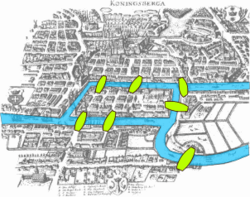
The Seven Bridges of Königsberg is a famous math puzzle! 🌉It comes from the old city of Königsberg, which is now called Kaliningrad in Russia. The city had seven bridges that connected four different land areas. The challenge was to walk through the city in a way that you crossed each bridge only once and returned home. Many tried, but nobody could solve it! This puzzle led to the invention of "graph theory," a special part of math that helps us understand how to connect points in the best way. 📊
Explore with ChatDinoKey Points
The Seven Bridges of Königsberg has inspired many stories and artworks!
When Euler studied the Seven Bridges of Königsberg, he discovered a smart way to explain why crossing the bridges was so tricky!
Today, mathematicians and scientists use graph theory in different fields!
The problem was studied by a smart mathematician named Leonhard Euler in 1736!
The Seven Bridges of Königsberg puzzle doesn’t just stay in history; it affects us today!
The city of Königsberg had four main areas: Kneiphof, Lomse, the mainland, and the other side of the Pregel River.
Euler's work gave birth to graph theory!
If you want to learn more about the Seven Bridges of Königsberg, there are many fun books and websites!
Several fun concepts link to the Seven Bridges of Königsberg!
Photos of Seven Bridges Of Königsberg
Seven Bridges Of Königsberg — photo 1

Modern map of Kaliningrad. Locations of the remaining bridges are highlighted in green, while those destroyed are highlighted in red.

In this picture of the Königsberg Cathedral, the bridge on the right is one of the two surviving bridges from Euler's time.

Comparison of the graphs of the Seven bridges of Konigsberg (top) and Five room puzzle (bottom). The numbers denote the number of edges connected to each node. Nodes with an odd number of edges are shaded orange.
🎨 Cultural Impact
The Seven Bridges of Königsberg has inspired many stories and artworks! 🎨It's made people curious about math and puzzles. 🧩Movies, books, and games have played with the idea of finding pathways and solving complex problems. It encourages creativity and critical thinking! Some places even hold contests revolving around the puzzle, to challenge people's problem-solving skills. Even pop culture references the puzzle! The story of the Seven Bridges helps teach kids that math can be playful and exciting! 🌈
Go deeper🧩 Euler's Solution
When Euler studied the Seven Bridges of Königsberg, he discovered a smart way to explain why crossing the bridges was so tricky! 🧩He found that it all depended on how many bridges connected to each land area. If an area had an odd number of bridges, it was like having a door that only opened in one direction! 🔄Euler showed that if you want to return to the same spot after crossing each bridge only once, each place must have an even number of bridges. This is part of his super clever solution! 🌟
Go deeper🧪 Modern Applications
Today, mathematicians and scientists use graph theory in different fields! 🧪In cities, planners use it to create safe road networks. In computers, it's vital for understanding how data moves around the internet. 🌐Even in biology, it helps track how diseases spread. The ideas from the Seven Bridges of Königsberg come in handy for creating maps, understanding social connections, and solving puzzles! 🗺️💡 The legacy of this old problem continues to inspire all kinds of new discoveries!
Go deeper🧠 Historical Background
The problem was studied by a smart mathematician named Leonhard Euler in 1736! 🧠He was born in Switzerland and became one of the most important figures in math. Euler loved puzzles and worked on many cool problems. When he looked at the Seven Bridges of Königsberg, he realized that it wasn't possible to cross all seven bridges without repeating. His ideas changed how people understand connections! Because of him, we now have tools to solve many fun puzzles and problems in math. 🗺️
Go deeper🚦 Practical Implications
The Seven Bridges of Königsberg puzzle doesn’t just stay in history; it affects us today! 🚦Graph theory helps us solve problems like how to plan the best delivery routes, build efficient road systems, and even manage computer networks! 💻Engineers and scientists use these ideas to make our world better. Additionally, this problem teaches us about trial and error. Sometimes, we need to try different things before we find a solution. So, even if a puzzle seems impossible, never stop trying! 💪
Go deeper🌊 The Layout Of The Bridges
The city of Königsberg had four main areas: Kneiphof, Lomse, the mainland, and the other side of the Pregel River. 🌊The seven bridges were built to connect these areas, making it easy for people to walk around. Imagine four islands connected by seven paths! People would try to start at one side, cross each bridge once, and come back. However, to do this properly, it just wasn't possible. If you tried it, you'd find yourself stuck or crossing a bridge twice! 🚶♂️🚶♀️
Go deeper📉 Graph Theory And The Problem
Euler's work gave birth to graph theory! 📉This is a part of mathematics where we can use lines and dots to show how things are connected. Imagine drawing circles for each area in Königsberg and using lines for each bridge. That's a graph! 🖍️ His findings help understand many real-world problems, like maps, networks, and even social media connections! 📱So, thanks to Euler, this math puzzle led to a whole new way of thinking about connections in everyday life.
Go deeper📚 Further Reading And Resources
If you want to learn more about the Seven Bridges of Königsberg, there are many fun books and websites! 📚Look for math books aimed at kids that explore puzzles. Websites like National Geographic Kids or even math activity sites have interesting stories and games. You can also watch videos explaining Euler and his discoveries. Get ready for a journey through math and fun challenges! 🔍Dive deeper and see how this old puzzle is still relevant today! 🥳
Go deeper🧐 Related Mathematical Concepts
Several fun concepts link to the Seven Bridges of Königsberg! 🧐One is "Eulerian paths," which are paths through a graph that visit each edge (or bridge) exactly once. 🎢Another is "Hamiltonian paths," which visit each vertex (or area) once without worrying about the edges. These ideas help solve problems in routes and travel logistics! Also, concepts like nodes (points) and edges (lines connecting them) are important in graph theory. So you see, there’s a lot of fun math connecting us all! 🎈
Go deeper