Saints Cyril And Methodius Facts For Kids

Saints Cyril and Methodius were 9th-century brothers who spread Christianity and created a written form of Slavonic language, making significant contributions to education and culture in Eastern Europe.
Select reading age
Go deeper More articles
Saints Cyril And Methodius
Saints Cyril And Methodius Facts For Kids
Videos & Quizzesincluded

About this topic

Saints Cyril and Methodius were two special brothers born in the 9th century in Greece. 🏛️ They became famous for spreading Christianity and teaching people about God. Cyril was born in 827 and Methodius in 815. These brothers loved learning and wanted to help others. They created a new way for Slavic people to read and write. 📚Their work is celebrated in many countries, especially in parts of Eastern Europe where they made a real difference! Today, their contributions are remembered for teaching people how to understand their faith in their own words. 🙏
Explore with ChatDino

Key Points

During the 9th century, many Slavic people in Europe didn't have their own written language.
Cyril, whose birth name was Constantine, was a very bright boy.
Cyril and Methodius didn't just spread religion; they also helped create a rich culture.
Cyril and Methodius were canonized as saints because of their amazing contributions to Christianity and education.
Saint Methodius, the older brother of Cyril, was born in 815.
The work of Cyril and Methodius had a lasting effect on Slavic languages.
Saints Cyril and Methodius Day is celebrated on July 5th in many countries!
In 863, Cyril and Methodius were sent to a place called Great Moravia, which is now part of the Czech Republic and Slovakia.
Cyril and Methodius recognized that people needed a way to write in their own language.

Photos of Saints Cyril And Methodius

Saints Cyril And Methodius — photo 1

Saints Cyril And Methodius — photo 1

Cyril and Methodius, painting by Jan Matejko, 1885Image by Hardy PL, licensed under Creative Commons Attribution 4.0

Cyril and Methodius, painting by Jan Matejko, 1885

Saints Cyril and Methodius in Rome. Fresco in San Clemente

Saints Cyril and Methodius in Rome. Fresco in San Clemente

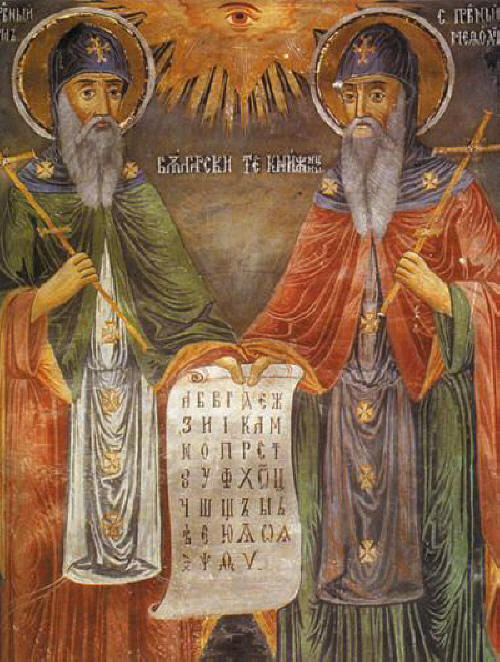
Saint Cyril and Methodius by Stanislav Dospevski, Bulgarian painter

Saint Cyril and Methodius by Stanislav Dospevski, Bulgarian painter

The Baška tablet is an early example of the Glagolitic from Croatia

The Baška tablet is an early example of the Glagolitic from Croatia

A cartoon about Saints Cyril and Methodius from Bulgaria in 1938. The caption reads : Brother Cyril, go tell those who are inside to learn the alphabet so they know freedom (Bulgarian: свобода) and anarchy (Bulgarian: слободия) are not the same.

A cartoon about Saints Cyril and Methodius from Bulgaria in 1938. The caption reads : Brother Cyril, go tell those who are inside to learn the alphabet so they know freedom (Bulgarian: свобода) and anarchy (Bulgarian: слободия) are not the same.

Saints Cyril and Methodius processionImage by Testus, licensed under Creative Commons Attribution-Share Alike 3.0

Saints Cyril and Methodius procession

The Basilica of Assumption of Mary and St. Cyrillus and Methodius in Velehrad

The Basilica of Assumption of Mary and St. Cyrillus and Methodius in Velehrad

Saints Cyril And Methodius — photo 9

Saints Cyril And Methodius — photo 9

🏰 Historical Context

During the 9th century, many Slavic people in Europe didn't have their own written language. Instead, they used Greek and Latin, which made it hard for them to learn about Christianity. 🏰The Byzantine Empire, where Cyril and Methodius lived, wanted to spread Christianity widely. This was a time when nations were forming, and languages were developing. The brothers decided to help Slavic people connect with their faith in ways they could understand using their own language. This was a big step in spreading knowledge and faith during a very important time in history! 🌍
Go deeper

📖 Life Of Saint Cyril

Cyril, whose birth name was Constantine, was a very bright boy. He loved reading and studying from a young age! 📖He later became a monk and took the name Cyril. Cyril was very curious about languages and learned many of them. He was passionate about helping others understand God’s teachings. One notable thing he did was travel with his brother Methodius to help spread Christianity in new lands. Cyril's love for education and helping others made him a beloved figure among the Slavic people! 🌟
Go deeper

🎶 Cultural Contributions

Cyril and Methodius didn't just spread religion; they also helped create a rich culture. 🎶They introduced music, art, and stories that expressed Christian faith in Slavic traditions. Their teachings inspired people to write, sing, and create beautiful things that reflected their beliefs. This helped shape the culture of Slavic nations! People started using their own language more, leading to the growth of literature and arts. Cyril and Methodius not only changed how people worshiped but how they expressed themselves creatively! 🎨
Go deeper

🌈 Legacy And Canonization

Cyril and Methodius were canonized as saints because of their amazing contributions to Christianity and education. 🌈The Catholic Church recognized them for their hard work, making them important figures in church history. People from different cultures continue to honor their memory for bringing good to the world. Their legacy lives on in many languages and cultures today! Schools, streets, and churches still carry their names, reminding everyone of their dedication to spreading knowledge and love for learning! 📜They are true heroes of faith and culture! 🌟
Go deeper

🌊 Life Of Saint Methodius

Saint Methodius, the older brother of Cyril, was born in 815. He had a wonderful spirit for exploration! 🌊Before becoming a missionary, he worked as a military officer and later became a monk. When he joined Cyril on their mission to help the Slavic people, Methodius brought his knowledge and leadership skills. He was wise and often took charge. His guidance helped many communities understand Christianity better. Methodius became known as a protector of the Slavic people and played a huge role in spreading their religious beliefs! 🙌
Go deeper

🌍 Impact On Slavic Languages

The work of Cyril and Methodius had a lasting effect on Slavic languages. 🌍Their Glagolitic Alphabet and teachings allowed people to express faith, stories, and ideas in their own tongues. 📚Thanks to their efforts, Slavic languages were finally written down, preserving them for future generations. Today, many Slavic languages, such as Polish, Czech, and Serbian, trace their roots back to the brothers’ work! This means that because of Cyril and Methodius, people can still read and write in their native languages! 🌟
Go deeper

🎉 Saints Cyril And Methodius Day

Saints Cyril and Methodius Day is celebrated on July 5th in many countries! 🎉This day honors the incredible work the brothers did for the Slavic people. Schools, churches, and communities often hold special events to celebrate their contributions. People remember their love for learning, helping others, and spreading faith. 🎈It's a fun day filled with activities like singing, storytelling, and sometimes even parades! Families come together to celebrate the languages and cultures created through their teachings, keeping their legacy alive! 🙌
Go deeper

🗺️ Missionary Work In Great Moravia

In 863, Cyril and Methodius were sent to a place called Great Moravia, which is now part of the Czech Republic and Slovakia. 🗺️ The leaders of Great Moravia wanted to learn about Christianity and needed help. Cyril and Methodius taught the people about God, introduced them to the Bible, and helped them understand prayers. They were very kind and spoke to the people in their own language. This made it easier for the Slavic people to accept Christianity because they could understand everything they were learning! 💖
Go deeper

✍️ Creation Of The Glagolitic Alphabet

Cyril and Methodius recognized that people needed a way to write in their own language. So, Cyril created the Glagolitic Alphabet around 863! ✍️ This alphabet had unique letters that represented sounds in the Slavic language, making it easier for people to read and write. The Glagolitic Alphabet was the first Slavic written alphabet. Over time, it evolved into the Cyrillic alphabet, which is still used today in languages like Russian and Bulgarian. 📜The brothers’ invention was a huge leap for education and communication in Slavic countries!
Go deeper

🧠 Take the Quiz about Saints Cyril And Methodius

Question 1 of 10

What did Cyril and Methodius create for the Slavic people?

Question 2 of 10

What year were Cyril and Methodius sent to Great Moravia?

Question 3 of 10

Which sibling was known as the older brother?

Question 4 of 10

What type of spirit did Methodius have?

Question 5 of 10

What is celebrated on Saints Cyril and Methodius Day?

Question 6 of 10

What is the name of the alphabet invented by Cyril?

Question 7 of 10

When was Cyril born?

Question 8 of 10

What did Cyril and Methodius introduce to the Slavic nations?

Question 9 of 10

Who was known for his curiosity about languages?

Question 10 of 10

Which country celebrates Saints Cyril and Methodius Day?

🔒

Your results

Answer all 10 questions to see how you did.

Kid-safe AI powered by AstroSafe

DIY.org

Kid-safe AI for discovery and learning. Ask anything, explore everything, learn with confidence.

Product

  • Pricing
  • App
  • All Apps

Resources

  • Blog
  • Kids Wikipedia
  • Worksheets
  • Activities for Kids
  • Build a Hacker Simulator
  • SafeTube

Company

  • About
  • Terms & Conditions
  • Privacy Policy
  • AstroSafe
TwitterInstagramYouTube

© 2026 DIY.org. All rights reserved. · Powered by AstroSafe