All Articles

Russian Revolution Of 1905

Russian Revolution Of 1905 Facts For Kids

The Russian Revolution of 1905 was a significant uprising against the czar's rule, beginning with peaceful protests and leading to reforms that laid the groundwork for future revolutions.
🎨 Reading age for 6-8
Background blob
Russian Revolution Of 1905
Facts for Kids!

Do more with AI

Introduction

The Russian Revolution of 1905 was an important event in history! 🌍It started on January 22, 1905, when many people protested against the government. They were unhappy with how things were run in the Russian Empire, which was a huge country in Europe and Asia. The revolution involved a lot of people, from workers to soldiers, wanting a better life. In 1906, this movement helped create a constitutional monarchy, which means a king shares power with the people. Although the revolution did not fully change everything, it was a significant step toward more freedoms in Russia! 🎉

Images of Russian Revolution Of 1905

Subdivisions of the Russian Empire in 1897 (uyezd level)Image by Altes (derived from File:Subdivisions of the Russian Empire in 1914.svg ), licensed under Creative Commons Attribution-Share Alike 4.0

Subdivisions of the Russian Empire in 1897 (uyezd level)

French ethnic map of European Russia from 1898. In accordance with official "All-Russian" ideology of the time, the group labelled "Russians" includes not only what are considered Russians today (here called "Great Russians"), but also Belarusians ("White Russians") and Ukrainians ("Little Russians").

French ethnic map of European Russia from 1898. In accordance with official "All-Russian" ideology of the time, the group labelled "Russians" includes not only what are considered Russians today (here called "Great Russians"), but also Belarusians ("White Russians") and Ukrainians ("Little Russians").

January 9, 1905. Cavalrymen at the Pevchesky Bridge block the march of the protesters to the Winter PalaceImage by Unknown Unknown, licensed under Creative Commons Attribution-Share Alike 3.0 de

January 9, 1905. Cavalrymen at the Pevchesky Bridge block the march of the protesters to the Winter Palace

Artistic impression of Bloody Sunday in St. Petersburg

Artistic impression of Bloody Sunday in St. Petersburg

Artistic impression of the mutiny by the crew of the battleship Potemkin against the ship's officers on 14 June 1905

Artistic impression of the mutiny by the crew of the battleship Potemkin against the ship's officers on 14 June 1905

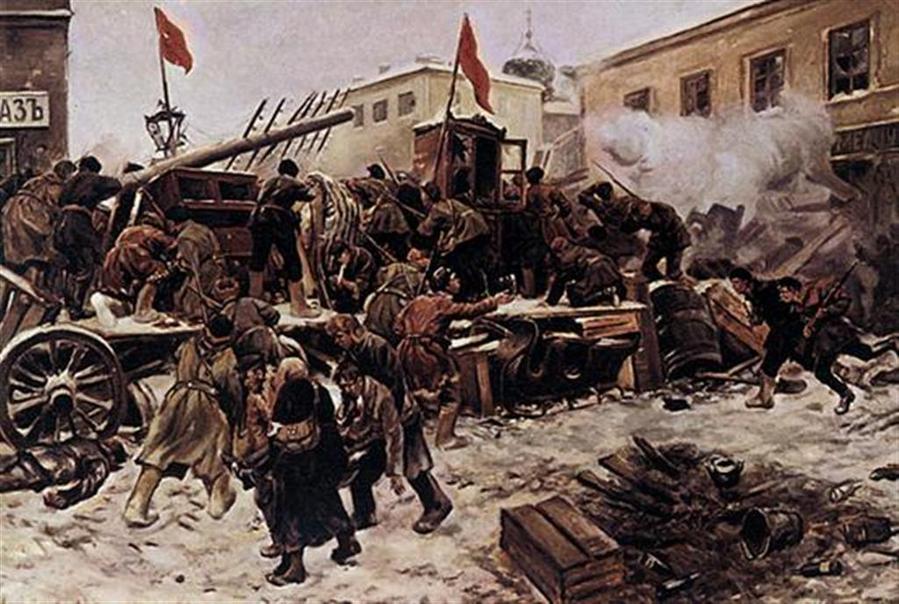
A barricade erected by revolutionaries in Moscow during Moscow uprising of 1905

A barricade erected by revolutionaries in Moscow during Moscow uprising of 1905

The Soviet of Workers' Deputies of St. Petersburg in 1905, Trotsky in the center. The soviets were an early example of a workers council.

The Soviet of Workers' Deputies of St. Petersburg in 1905, Trotsky in the center. The soviets were an early example of a workers council.

Barricades in Nizhny Novgorod, during the December uprising of 1905

Barricades in Nizhny Novgorod, during the December uprising of 1905

A locomotive overturned by striking workers at the main railway depot in Tiflis in 1905

A locomotive overturned by striking workers at the main railway depot in Tiflis in 1905

Subdivisions of the Russian Empire in 1897 (uyezd level)Image by Altes (derived from File:Subdivisions of the Russian Empire in 1914.svg ), licensed under Creative Commons Attribution-Share Alike 4.0

Subdivisions of the Russian Empire in 1897 (uyezd level)

French ethnic map of European Russia from 1898. In accordance with official "All-Russian" ideology of the time, the group labelled "Russians" includes not only what are considered Russians today (here called "Great Russians"), but also Belarusians ("White Russians") and Ukrainians ("Little Russians").

French ethnic map of European Russia from 1898. In accordance with official "All-Russian" ideology of the time, the group labelled "Russians" includes not only what are considered Russians today (here called "Great Russians"), but also Belarusians ("White Russians") and Ukrainians ("Little Russians").

January 9, 1905. Cavalrymen at the Pevchesky Bridge block the march of the protesters to the Winter PalaceImage by Unknown Unknown, licensed under Creative Commons Attribution-Share Alike 3.0 de

January 9, 1905. Cavalrymen at the Pevchesky Bridge block the march of the protesters to the Winter Palace

Artistic impression of Bloody Sunday in St. Petersburg

Artistic impression of Bloody Sunday in St. Petersburg

Artistic impression of the mutiny by the crew of the battleship Potemkin against the ship's officers on 14 June 1905

Artistic impression of the mutiny by the crew of the battleship Potemkin against the ship's officers on 14 June 1905

A barricade erected by revolutionaries in Moscow during Moscow uprising of 1905

A barricade erected by revolutionaries in Moscow during Moscow uprising of 1905

The Soviet of Workers' Deputies of St. Petersburg in 1905, Trotsky in the center. The soviets were an early example of a workers council.Image by Unknown author Unknown author, licensed under Creative Commons Attribution-Share Alike 4.0

The Soviet of Workers' Deputies of St. Petersburg in 1905, Trotsky in the center. The soviets were an early example of a workers council.

Barricades in Nizhny Novgorod, during the December uprising of 1905

Barricades in Nizhny Novgorod, during the December uprising of 1905

A locomotive overturned by striking workers at the main railway depot in Tiflis in 1905

A locomotive overturned by striking workers at the main railway depot in Tiflis in 1905

Key Events And Milestones

The 1905 Revolution had several key events! One significant moment happened on January 22, known as "Bloody Sunday." 😢 On this day, peaceful protesters went to the Winter Palace in St. Petersburg to ask Tsar Nicholas II for help. Instead of listening, soldiers fired on the crowd, which led to many injuries and deaths. This event outraged the people! Other important milestones included the general strike in October 1905, where workers stopped working to show their anger. These events were crucial, leading to changes like the creation of the Duma, a government assembly for the people! 🏛️

Major Figures And Leaders

Many important people played a role in the Russian Revolution of 1905! Tsar Nicholas II was the ruler at that time. 👑He faced a lot of criticism for not listening to the people's needs. Another key figure was Father Gapon, a priest who organized the march on Bloody Sunday to express the workers' grievances. Additionally, the Bolsheviks, led by figures like Leon Trotsky, were emerging as important leaders advocating for change. 💪They wanted to support the working class! These major figures shaped the revolution and how people viewed the government that year!

Impact On Society And Culture

The 1905 Revolution had a big impact on Russian society and culture! 🖌️ It made many people realize they could stand up for their rights. After the revolution, more people became involved in politics and demanded things like better working conditions and freedom of speech. 📣Writers, artists, and musicians also began to express their ideas about change through their work. The revolution inspired new discussions about democracy and social justice, encouraging the Russian people to imagine a different kind of future! 🌈It showed how they could come together to fight for their beliefs.

Legacy Of The 1905 Revolution

The legacy of the 1905 Revolution continues to be remembered today! 📚It was one of the first times that people in Russia stood up against their government to demand change. The ideas and actions from this revolution inspired future movements, including the 1917 Russian Revolution. 🎈People learned the importance of unity and fighting for their rights. The revolution was a key turning point, making many understand the need for reforms and the role of citizens in shaping a country's future. ❤️ Its spirit lives on in the hearts of those who still strive for justice and equality worldwide!

Consequences For The Russian Empire

After the 1905 Revolution, the Russian Empire changed in some important ways! 🏰Although Tsar Nicholas II promised reforms, many people were still unhappy. The Duma was created, but it wasn't strong enough to bring real change. This made the citizens feel frustrated, leading to further protests in the following years. ⚔️ Some reforms did happen, like better working conditions for factory workers, but many people felt the changes were too small. The 1905 Revolution showed that the people wanted more power, setting the stage for even bigger changes later on. ⏳

International Reactions And Responses

The 1905 Revolution caught the attention of the world! 🌍Other countries watched closely as they were interested in what was happening in Russia. Many were curious about how a large empire could face such enormous challenges. Some international leaders expressed support for the Russian people, while others feared the spread of revolution to their own countries. 🌏People believed that changes in Russia could inspire revolts elsewhere! The revolution showed that people everywhere wanted fairness and justice, causing fears of unrest in other nations and leading to discussions about reforms worldwide! ⚖️

Role Of The Revolution In World History

The 1905 Revolution played a crucial role in world history! 🌐It inspired people in other countries to fight for their rights and freedoms. Many revolutions around the world, like those in Mexico and China, were influenced by the ideas and actions of the Russian people. The revolution showed that ordinary people could stand up against their government. ✊This idea spread and helped create discussions about democracy and social changes around the world. The events of 1905 also foreshadowed more revolutions, as people everywhere started to realize the power they held when they united! 🔥

Causes Of The Russian Revolution Of 1905

There were several reasons why the 1905 revolution happened! One main cause was poverty. 🏚️ Many workers in cities like St. Petersburg struggled to earn enough money for food and shelter. In addition, Russians were unhappy with the government led by Tsar Nicholas II. They wanted more rights and a say in how the country was run. ✊People also got angry after a defeat in the Russo-Japanese War (1904-1905), where Russia lost to Japan. This made the citizens feel that their leaders were weak and not taking care of them! 😠

Influence On The 1917 Russian Revolution

The 1905 Revolution directly influenced the 1917 Russian Revolution, where even more significant changes happened! 📅Many of the leaders and ideas that emerged in 1905 were important in 1917. Citizens were still upset with the Tsar and continued to demand more rights. ⏩Events like the World War I and continuing strikes further fueled the desire for change. The 1917 Revolution eventually led to the overthrow of Tsar Nicholas II, establishing a new government. 💥The lessons learned from the difficulties in 1905 prepared the people for an even bigger fight for their rights just 12 years later!

Comparative Analysis With Other Revolutions

The 1905 Revolution can be compared to other famous revolutions, like the American Revolution and the French Revolution! 🇺🇸🇫🇷 In each case, people were unhappy with their governments and wanted more rights. The American Revolution aimed for independence from British rule, while the French Revolution sought to end a monarchy. 🏰Similarly, the Russian Revolution aimed to limit the power of the Tsar and establish a government that represented the people. All these revolutions showed that when people unite, they can bring about change! 🌈They shared similar challenges and dreams, inspiring future generations everywhere!

Russian Revolution Of 1905 Quiz

Q1
Question 1 of 10

Learn more about Russian Revolution Of 1905

Ready to create?

Drop Files here
Make

To create a safe space for kid creators worldwide!

Create

Vibe Coding

Kids GPT

All Tools

Kibu

Resources

Worksheets

SafeTube

Blog

FAQ

Account

Pricing

Log-in

Sign-up

Data Deletion

Company

About

Community Guidelines

Privacy Policy

Terms of Service

2025, URSOR LIMITED. All rights reserved. DIY is in no way affiliated with Minecraft™, Mojang, Microsoft, Roblox™ or YouTube. LEGO® is a trademark of the LEGO® Group which does not sponsor, endorse or authorize this website or event. Made with love in San Francisco.