Pioneer 10 Facts For Kids
Pioneer 10 was a NASA spacecraft that made history as the first to travel through the asteroid belt and conduct a flyby of Jupiter, providing invaluable data about the outer planets.
Select reading age

Pioneer 10 Facts For Kids
Videos & Quizzesincluded
About this topic
Pioneer 10 was a special spacecraft launched by NASA on March 2, 1972. 🚀It was the very first spacecraft to travel through the asteroid belt and reach Jupiter! 🌌Pioneer 10 took important pictures and gathered valuable data about the giant planet. By the time it stopped sending signals in 2003, it was about 12 billion kilometers away from Earth! 🌎Do you know it took 21 months for it to reach Jupiter? That's like going on an exciting road trip but to space!
Explore with ChatDinoKey Points
Pioneer 10 wasn't just a fast traveler; it inspired future spacecraft!
Though Pioneer 10 is no longer sending signals, its legacy lives on!
Pioneer 10 was launched from Cape Canaveral, Florida.
The main goal of Pioneer 10 was to study Jupiter's atmosphere, magnetic field, and its many moons.
Pioneer 10 made some shocking discoveries!
Pioneer 10 had amazing tools to study Jupiter!
Pioneer 10 faced many challenges on its journey.
Pioneer 10 sent signals back to Earth to share all its amazing findings!
Photos of Pioneer 10

Pioneer 10 — photo 1
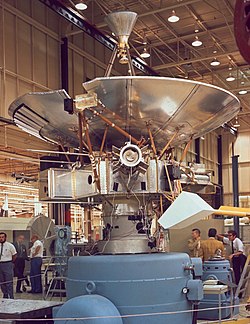
Pioneer 10 — photo 2

Pioneer 10 — photo 3

Pioneer 10 — photo 4

Pioneer 10 — photo 5

SNAP-19 RTGs mounted on an extension boom of Pioneer 10 replica

Pioneer 10 — photo 7

Pioneer 10 — photo 8

Pioneer 10 — photo 9
🚀 Legacy And Impact
Pioneer 10 wasn't just a fast traveler; it inspired future spacecraft! 🚀After its journey, scientists learned how to send missions to other planets, like Voyager and New Horizons. 🌌The spacecraft helped prove that it is possible to explore faraway worlds! Pioneer 10 showed us that humans could reach the stars! 🌟It became a symbol of curiosity and exploration, encouraging kids like you to dream big and become space explorers one day! 🌠
Go deeper🌌 Future Exploration
Though Pioneer 10 is no longer sending signals, its legacy lives on! 🌌It opened the door for future missions to explore deeper into space. Scientists today are planning more missions to not just study our solar system but also search for planets around other stars. 🌠Who knows what exciting discoveries await? Maybe one day we’ll find life beyond Earth! 👽Remember, every time we look at the stars, there’s more to discover, just like Pioneer 10 taught us! 🚀
Go deeper🗺️ Launch And Journey
Pioneer 10 was launched from Cape Canaveral, Florida. 🗺️ It went up high into the sky on a mighty rocket called Atlas-Centaur. The spacecraft traveled on a straight path past the asteroid belt, which is filled with rocky bits! 🪐After about 11 months, it zipped past Jupiter on December 3, 1973. The journey from Earth to Jupiter taught scientists a lot about space travel and how rockets work. 🚀It was like a superhero flying through the stars on an important mission!
Go deeper🌕 Mission Objectives
The main goal of Pioneer 10 was to study Jupiter's atmosphere, magnetic field, and its many moons. 🌕It also aimed to test new technologies for future space missions. The spacecraft was equipped with different instruments to collect information, like sensors and cameras. 🎥Pioneer 10 had a special golden plaque with drawings of humans and information about Earth! This was to tell any aliens who might find it about us! 👽The hope was to learn more about planets far away.
Go deeper🌟 Notable Discoveries
Pioneer 10 made some shocking discoveries! 🌟It found that Jupiter is made mostly of hydrogen and helium, just like a giant gasball! 🎈The spacecraft also revealed that Jupiter has a strong magnetic field and many moons, including the largest one called Ganymede! 🌕It was also the first to observe Jupiter’s Great Red Spot, a huge storm that’s been raging for hundreds of years! 🌪️ The data from Pioneer 10 taught scientists so much more about the mysteries of our solar system!
Go deeper🌌 Scientific Instruments
Pioneer 10 had amazing tools to study Jupiter! 🌌It carried a camera to take pictures, spectrometers to look at light from the planet, and radiation detectors to measure energy. ⚡It even had a magnetometer to study magnetic fields! All this information helped scientists understand what Jupiter is made of! 🎈The spacecraft was like a science lab flying in space! Each tool played a special role in collecting data that made our knowledge of Jupiter better!
Go deeper⚡ Challenges And Solutions
Pioneer 10 faced many challenges on its journey. One problem was the intense radiation near Jupiter! ⚡To keep safe, engineers designed it with special materials, like aluminum, to protect its instruments. 🌈Also, the spacecraft had to deal with the cold of space, so they equipped it with heaters. 🥵The team worked hard to solve problems, proving that teamwork and creativity can help overcome obstacles, just like in your school projects! 🙌
Go deeper📡 Communication With Earth
Pioneer 10 sent signals back to Earth to share all its amazing findings! 📡The spacecraft used a special antenna to communicate over long distances. Because it was so far away, the signals took about 14 hours to reach Earth! 🌍That’s like a day at school, just waiting for a message! Scientists received the data on big computers and studied everything Pioneer 10 had sent. It was like a long-distance friendship, connecting the spacecraft with Earth!
Go deeper