Perpetual Motion Facts For Kids

Perpetual motion is the motion of bodies that continues forever in an unperturbed system, but it is impossible according to the laws of physics.

Select reading age
Go deeper More articles
Perpetual Motion
Perpetual Motion Facts For Kids
Videos & Quizzesincluded

About this topic

Perpetual motion is a super cool idea! 🤖It’s when something moves forever without stopping, like a magical machine that never needs more energy. Imagine a toy car that could zoom around without running out of battery! The idea of perpetual motion has fascinated people for centuries, urging them to invent machines that run endlessly. 🌍But in real life, we can't make these machines work forever. Scientists say that it goes against the rules of energy! Let's dive into the fun world of perpetual motion and discover its secrets together! 🎢
Explore with ChatDino

Key Points

The laws of thermodynamics are like magic rules for how energy behaves!
Some famous designs tried to achieve perpetual motion!
Even though we can't create perpetual motion machines, scientists still explore energy!
There are three types of machines people have dreamed about!
Perpetual motion pops up in movies and books!
Scientists study everything carefully, and they've figured out why perpetual motion doesn't work!
People have dreamed of perpetual motion for a long time!
While perpetual motion machines are fictional, they help us learn about energy!
Perpetual motion raises interesting questions!

Photos of Perpetual Motion

October 1920 issue of Popular Science magazine, on perpetual motion. Although scientists have established them to be impossible under the laws of physics, perpetual motion continues to capture the imagination of inventors.[note 2]
October 1920 issue of Popular Science magazine, on perpetual motion. Although scientists have established them to be impossible under the laws of physics, perpetual motion continues to capture the imagination of inventors.[note 2]

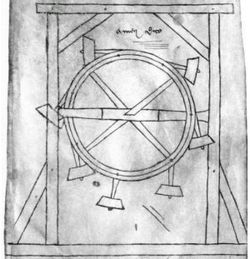
Perpetuum mobile of Villard de Honnecourt (about 1230).

Perpetuum mobile of Villard de Honnecourt (about 1230).

The "Overbalanced Wheel", annotated with distances of the weights from the centreline showing that the torques on both sides even out on averageImage by Cmglee, licensed under Creative Commons Attribution-Share Alike 4.0

The "Overbalanced Wheel", annotated with distances of the weights from the centreline showing that the torques on both sides even out on average

Perpetual motion wheels from a drawing by Leonardo da VinciImage by This illustration was made by Citron You must credit this : Citron / CC-BY-SA-3.0, licensed under Creative Commons Attribution-Share Alike 3.0

Perpetual motion wheels from a drawing by Leonardo da Vinci

The "Float Belt". The yellow blocks indicate floaters. It was thought that the floaters would rise through the liquid and turn the belt. However, pushing the floaters into the water at the bottom takes as much energy as the floating generates, and some energy is dissipated.

The "Float Belt". The yellow blocks indicate floaters. It was thought that the floaters would rise through the liquid and turn the belt. However, pushing the floaters into the water at the bottom takes as much energy as the floating generates, and some energy is dissipated.

The "capillary bowl"

The "capillary bowl"

Ellipsoid paradox surface and rays emitted by body A in the direction of body B. (a) When bodies A and B are point like, all rays from A must be incident on B. (b) When bodies A and B are extended, some rays from A will not be incident on B and may eventually return to A.Image by Greg503, licensed under Creative Commons Attribution-Share Alike 4.0

Ellipsoid paradox surface and rays emitted by body A in the direction of body B. (a) When bodies A and B are point like, all rays from A must be incident on B. (b) When bodies A and B are extended, some rays from A will not be incident on B and may eventually return to A.

✨ The Laws Of Thermodynamics

The laws of thermodynamics are like magic rules for how energy behaves! ✨The First Law says energy can't be created or destroyed; it just changes forms. The Second Law tells us that energy always spreads out, like when ice melts into water! 🧊This means we can't make a machine that moves forever without using energy. ❤️ These rules show us why perpetual motion is impossible. They are important because they help scientists understand everything, from engines to the weather! 🌦️
Go deeper

🏆 Famous Perpetual Motion Designs

Some famous designs tried to achieve perpetual motion! 🏆One was Bessler's Wheel, which he claimed could spin endlessly. Another popular example is a device called the "Magical Pendulum," which looked like a swinging pendulum but never lost energy! ⚖️ However, as amazing as these designs are, they always fall short in real life. When scientists tried to test them, they found that the machines couldn't run forever. Still, these designs are a fun part of inventing and help inspire kids like you to keep exploring! 🚀
Go deeper

🔭 Modern Research And Innovations

Even though we can't create perpetual motion machines, scientists still explore energy! 🔭They work hard to understand new energy sources, like fusion energy, which tries to copy the sun's power. There’s also research in making robots and machines more efficient so they can use less energy to perform their tasks! 🤖Even though we may never reach true perpetual motion, scientists are inventing awesome solutions to make the world a better place! With every step, we learn more about energy, movement, and the universe! 🌌
Go deeper

💡 Types Of Perpetual Motion Machines

There are three types of machines people have dreamed about! 💡The first type (Type 1) would create energy forever without any input. The second type (Type 2) moves constantly but needs some energy refills. Lastly, we have Type 3, which makes use of energy but doesn’t waste any. 🚀Sadly, all these types can’t exist because of the universal laws of physics. Just like how you can't drink soda forever from a single can! 🥤Even so, they teach us about energy and help invent fun new gadgets!
Go deeper

🎬 Perpetual Motion In Popular Culture

Perpetual motion pops up in movies and books! 🎬In the animated film "The Iron Giant", there’s a big robot that functions like a perpetual motion machine. There’s also a popular book called “The Invention of Hugo Cabret” that has characters dreaming of endless energy! 📚These stories spark our imaginations and encourage us to think about how we interact with energy and machines! Isn't it exciting to see how ideas of perpetual motion show up in our favorite stories? 🌟Keep dreaming big and exploring cool ideas!
Go deeper

🔍 Scientific Explanations And Debunking

Scientists study everything carefully, and they've figured out why perpetual motion doesn't work! 🔍The laws of physics, like energy conservation and entropy, explain why machines stop. For instance, friction is like tiny bumps that slow things down—think of riding a bike and how the wheels can get sticky! 🚲Even though the machines seem like they could work, scientists have proven that they are impossible. It's like building a sandcastle when the tide is coming in; it just won't stay up! 🌊
Go deeper

🌌 Historical Attempts At Perpetual Motion

People have dreamed of perpetual motion for a long time! 🌌In the 12th century, a genius named Bhaskara II from India designed a water wheel that could keep spinning forever. Another cool attempt came in 1602 from a German man named Johann Bessler, who created a wheel that seemed to turn without stopping! 🚴‍♂️ But, sad news! Each time someone tried to make one of these machines, they found out it stopped working eventually. Even with all their hard work, nobody has succeeded in creating a perpetual motion machine so far! 🛠️
Go deeper

🌈 Practical Implications Of Perpetual Motion

While perpetual motion machines are fictional, they help us learn about energy! 🌈Scientists study these ideas to create better energy systems. ⚡For example, wind turbines and solar panels use energy from nature. The dreams of perpetual motion teach us to be inventive and think outside the box about renewable energy. 🌱Even though you can't have a machine that runs forever, understanding energy helps us make a cleaner and brighter world! With patience and creativity, the world can discover new energy sources!
Go deeper

🤔 Philosophical Questions Around Energy And Motion

Perpetual motion raises interesting questions! 🤔What is energy? Can something move forever? People have been thinking about these questions for ages! Ancient Greeks like Aristotle pondered motion and energy. The idea of perpetual motion makes us consider the universe's limits and the nature of time. ⏳Keeping your mind curious and asking deep questions is important, just like scientists do! Exploring these thoughts helps us wish for a better future and fuels our desire to create! 💭
Go deeper

🧠 Take the Quiz about Perpetual Motion

Question 1 of 10

What is perpetual motion?

Question 2 of 10

Who designed a water wheel in the 12th century?

Question 3 of 10

What is the First Law of Thermodynamics?

Question 4 of 10

Which machine seemed to turn without stopping?

Question 5 of 10

What do scientists say about perpetual motion machines?

Question 6 of 10

Why can't we create perpetual motion machines?

Question 7 of 10

What is one type of perpetual motion machine?

Question 8 of 10

What should we learn from perpetual motion?

Question 9 of 10

Which fairy tale mentions a perpetual motion machine?

Question 10 of 10

What do scientists study to help create better energy systems?

🔒

Your results

Answer all 10 questions to see how you did.

Kid-safe AI powered by AstroSafe

DIY.org

Kid-safe AI for discovery and learning. Ask anything, explore everything, learn with confidence.

Product

  • Pricing
  • App
  • All Apps

Resources

  • Blog
  • Kids Wikipedia
  • Worksheets
  • Activities for Kids
  • Build a Hacker Simulator
  • SafeTube

Company

  • About
  • Terms & Conditions
  • Privacy Policy
  • AstroSafe
TwitterInstagramYouTube

© 2026 DIY.org. All rights reserved. · Powered by AstroSafe