Norbert Wiener Facts For Kids
Norbert Wiener was a pioneering American mathematician and philosopher known for founding the field of cybernetics and making significant contributions to mathematics and computer science.
Select reading age

Norbert Wiener Facts For Kids
Videos & Quizzesincluded
About this topic
Norbert Wiener was a very smart mathematician born on November 26, 1894, in Columbia, Ohio. 🎓He loved using math to solve problems and create new ideas! One of his most famous works is about cybernetics, which is the study of how machines and living things communicate and control each other. Norbert passed away on March 18, 1964, in Stockholm, Sweden. He made huge contributions to science and technology, which help us today, especially in computer science and robotics! 🤖
Explore with ChatDinoKey Points
Norbert Wiener received many awards for his great contributions to science!
Norbert Wiener's work changed the world in many ways!
When Norbert was young, he was a super bright student!
Norbert Wiener made important discoveries in mathematics, especially in the field of probability and statistics.
Norbert Wiener wrote many important books and articles during his life.
Norbert Wiener thought deeply about how technology and humanity interact.
Norbert Wiener is known as the "father of cybernetics."
Wiener’s work greatly influenced how we use technology today.
Photos of Norbert Wiener
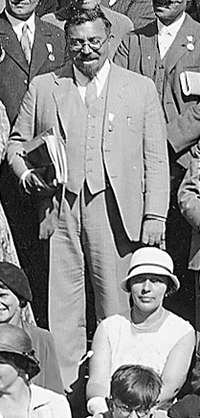
Norbert (standing) and Margaret Wiener (sitting) at the International Congress of Mathematicians, Zurich 1932

In the mathematical field of probability, the "Wiener sausage" is a neighborhood of the trace of a Brownian motion up to a time t, given by taking all points within a fixed distance of Brownian motion. It can be visualized as a cylinder of fixed radius the centerline of which is Brownian motion.

Norbert Wiener in MIT, 1963
🏆 Awards And Honors
Norbert Wiener received many awards for his great contributions to science! 🏆In 1956, he was elected to the National Academy of Sciences, recognizing his work in mathematics and cybernetics. He received the prestigious Medal of Science from the U.S. government, showing how much his studies mattered. His ideas are still celebrated today, and he is considered one of the top scientists of the 20th century!
Go deeper🌟 Legacy And Impact
Norbert Wiener's work changed the world in many ways! 🌟His ideas about cybernetics are still used in modern technology, from smart computers to advanced robotics. Because of his influence, we think carefully about how technology fits into our lives today. Many schools teach about his discoveries, encouraging future generations to think about how they use math and technology responsibly! Norbert’s legacy lives on, inspiring young minds everywhere! 🧠
Go deeper🌟 Early Life And Education
When Norbert was young, he was a super bright student! 🌟By age 11, he entered college at Tufts University. He was a great reader and loved physics and mathematics! He earned his bachelor's degree in 1913. Later, he studied in Europe at famous universities like the University of Göttingen, where he learned from other amazing mathematicians. He finished his Ph.D. in 1916, making him a very young expert in math! 📚
Go deeper📊 Mathematical Achievements
Norbert Wiener made important discoveries in mathematics, especially in the field of probability and statistics. 📊He helped advance mathematical tools that scientists and engineers use today. He introduced concepts like stochastic processes, which study random events over time. This helped other mathematicians understand randomness in things like weather patterns and games of chance. His work laid the groundwork for many theories that are still taught in schools! 🎲
Go deeper📖 Writings And Publications
Norbert Wiener wrote many important books and articles during his life. 📖His most famous book is "Cybernetics," published in 1948. He also wrote "The Human Use of Human Beings" in 1950, discussing how machines affect society. In total, he authored around 200 publications! His writings helped explain complex ideas in simple terms, making it easier for everyone to understand technology and its role in our world. ✍️
Go deeper🤔 Philosophical Perspectives
Norbert Wiener thought deeply about how technology and humanity interact. 🤔He believed that advancements in machines should be used to benefit people, not harm them. He worried about robots taking over jobs and encouraged ethical thinking in science. His ideas inspired many discussions about how to create technology responsibly. Wiener felt it was essential to think about the impact of machines on our lives and society as a whole. 🌍
Go deeper🤖 Contributions To Cybernetics
Norbert Wiener is known as the "father of cybernetics." 🤖 Cybernetics is the study of communication and control in living beings and machines, like robots! In 1948, he published a book called "Cybernetics: Or Control and Communication in the Animal and the Machine." This book explained how animals, humans, and machines can process information and control their actions. His work has helped improve many technologies including computers and robots, making them much smarter! 💡
Go deeper💻 Influence On Technology And Society
Wiener’s work greatly influenced how we use technology today. 💻His ideas about communication, feedback, and information flow are now used in fields like artificial intelligence and robotics. His insights also impacted areas like economics and biology, helping scientists understand how systems work. Today, we rely on the principles he introduced to build smarter computers, learn new things, and improve our daily lives using technology! 🚀
Go deeper