Messier 87 Facts For Kids
Messier 87 (M87) is a supergiant elliptical galaxy in the Virgo constellation containing several trillion stars.

About this topic
Key Points
Photos of Messier 87

In Hubble's galaxy classification scheme, M87 is an E0 galaxy.

Area in constellation Virgo around M87
![Stellar velocity map of the central region of M87, showing the motion of stars relative to Earth: .mw-parser-output .legend{page-break-inside:avoid;break-inside:avoid-column}.mw-parser-output .legend-color{display:inline-block;min-width:1.25em;height:1.25em;line-height:1.25;margin:1px 0;text-align:center;border:1px solid black;background-color:transparent;color:black}.mw-parser-output .legend-text{} away towards The image shows a slight rotation in the vertical plane (the lower right moving toward earth, the upper left moving away), showing that M87 is rotating slowly.[53][54]](https://upload.wikimedia.org/wikipedia/commons/thumb/d/d2/Galactic_Chromodynamics.jpg/960px-Galactic_Chromodynamics.jpg)
Stellar velocity map of the central region of M87, showing the motion of stars relative to Earth: .mw-parser-output .legend{page-break-inside:avoid;break-inside:avoid-column}.mw-parser-output .legend-color{display:inline-block;min-width:1.25em;height:1.25em;line-height:1.25;margin:1px 0;text-align:center;border:1px solid black;background-color:transparent;color:black}.mw-parser-output .legend-text{} away towards The image shows a slight rotation in the vertical plane (the lower right moving toward earth, the upper left moving away), showing that M87 is rotating slowly.[53][54]

Messier 87 — photo 4
Messier 87 — photo 5

Messier 87 — photo 6
![Composite image showing how the M87 system looked, across the entire electromagnetic spectrum, during the Event Horizon Telescope's April 2017 campaign to take the first image of a black hole. Requiring 19 different facilities on the Earth and in space, this image reveals the enormous scales spanned by the black hole and its forward-pointing jet. It shows the image of the larger-scale jet taken by ALMA (upper left), on the same scale as the visible image by the Hubble Space Telescope (center) and the X-ray image by Chandra (upper right).[91]](https://upload.wikimedia.org/wikipedia/commons/thumb/9/9d/Telescopes_Unite_in_Unprecedented_Observations_of_Famous_Black_Hole_M87.jpg/960px-Telescopes_Unite_in_Unprecedented_Observations_of_Famous_Black_Hole_M87.jpg)
Composite image showing how the M87 system looked, across the entire electromagnetic spectrum, during the Event Horizon Telescope's April 2017 campaign to take the first image of a black hole. Requiring 19 different facilities on the Earth and in space, this image reveals the enormous scales spanned by the black hole and its forward-pointing jet. It shows the image of the larger-scale jet taken by ALMA (upper left), on the same scale as the visible image by the Hubble Space Telescope (center) and the X-ray image by Chandra (upper right).[91]

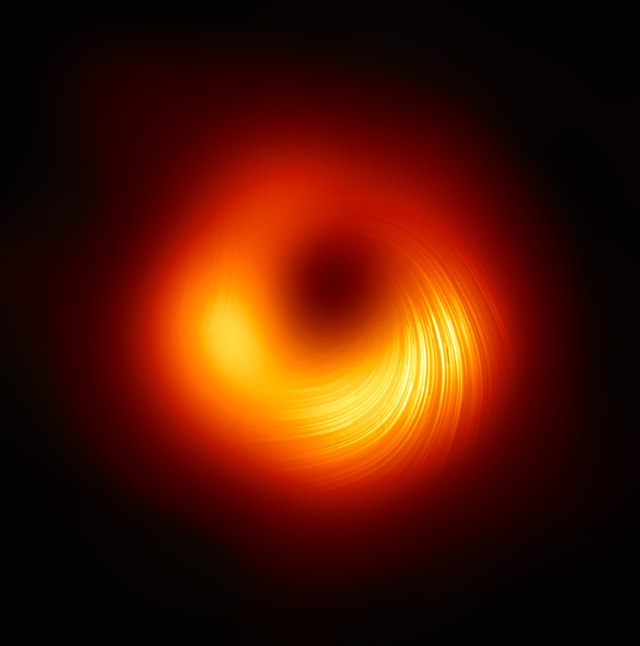
Sharpening of the original EHT imaging of the M87 black hole, using the PRIMO technique for interferometric modeling. The rightmost image adds back in some fuzzing to account for the limited resolving power of the underlying observations.

Messier 87 — photo 9