All Articles

Mars Pathfinder

Mars Pathfinder Facts For Kids

Mars Pathfinder was a groundbreaking spacecraft that delivered the Sojourner rover to the Martian surface in 1997, marking a significant milestone in the exploration of Mars.
๐ŸŽจ Reading age for 6-8
Background blob
Mars Pathfinder
Facts for Kids!

Do more with AI

Introduction

Mars Pathfinder was a special spacecraft that landed on Mars on July 4, 1997. ๐Ÿš€It brought along a little robot called Sojourner, which was the first rover to explore Mars! This mission helped scientists learn a lot about the red planet. The landing site was Ares Vallis, a valley filled with rocks and boulders. Mars is about 140 million miles away from Earth! The Mars Pathfinder mission lasted about three months, but it sent back lots of pictures and information about Martian weather and rocks.

Images of Mars Pathfinder

Sojourner rover on Mars on sol 22

Sojourner rover on Mars on sol 22

Photos of Mars Pathfinder
Wheel size comparison: Sojourner, Mars Exploration Rover, Mars Science Laboratory

Wheel size comparison: Sojourner, Mars Exploration Rover, Mars Science Laboratory

Mars Pathfinder IMP camera closeup

Mars Pathfinder IMP camera closeup

Diagram of Mars Pathfinder IMP camera

Diagram of Mars Pathfinder IMP camera

Mars Pathfinder lander scheme. ASI/MET pole is visible extending towards the top.

Mars Pathfinder lander scheme. ASI/MET pole is visible extending towards the top.

This is a more recent "geometrically improved, color enhanced" version of the 360-degree "Gallery Pan", the first contiguous, uniform panorama taken by the Imager for Mars (IMP) over the course of Sols 8, 9, and 10. Different regions were imaged at different times over the three Martian days to acquire consistent lighting and shadow conditions for all areas of the panorama. In this version of the panorama, much of the discontinuity that was due to parallax has been corrected, particularly along the lower tiers of the mosaic containing the Lander features. Distortion due to a 2.5 degree tilt in the IMP camera mast has been removed. The IMP is a stereo imaging system that, in its fully deployed configuration, stands 1.8 meters above the Martian surface, and has a resolution of two millimeters at a range of two meters. The IMP has color capability provided by 24 selectable filters -- twelve filters per "eye". Its red, green, and blue filters were used to take this panorama. The three color images were first digitally balanced according to the transmittance capabilities of a specific high-definition TV device at JPL, and then enhanced via changes to saturation and intensity while retaining the hue. A threshold was applied to avoid changes to the sky. An MTF filter was applied to sharpen feature edges. At left is a Lander petal and a metallic mast which is a portion of the low-gain antenna. On the horizon the double "Twin Peaks" are visible, about 1-2 kilometers away. The rock "Couch" is the dark, curved rock at right of Twin Peaks. Another Lander petal is at left-center, showing the fully deployed forward ramp at far left, and rear ramp at right, which rover Sojourner used to descend to the surface of Mars on July 5. Immediately to the left of the rear ramp is the rock "Barnacle Bill", which scientists found be andesitic, possibly indicating that it is a volcanic rock (a true andesite) or a physical mixture of particles. Just beyond Barnacle Bill, rover tracks lead to Sojourner, shown using its Alpha Proton X-Ray Spectrometer (APXS) instrument to study the large rock "Yogi". Yogi, low in quartz content, appears to be more primitive than Barnacle Bill, and appears more like the common basalts found on Earth. The tracks and circular pattern in the soil leading up to Yogi were part of Sojourner's soil mechanics experiments, in which varying amounts of pressure were applied to the wheels in order to determine physical properties of the soil. During its traverse to Yogi the rover stirred the soil and exposed material from several centimeters in depth. During one of the turns to deploy Sojourner's Alpha Proton X-Ray Spectrometer, the wheels dug particularly deeply and exposed white material. Spectra of this white material show it is virtually identical to the rock "Scooby Doo", and such white material may underlie much of the site. Deflated airbags are visible at the perimeter of all three Lander petals. Mars Pathfinder is the second in NASA's Discovery program of low-cost spacecraft with highly focused science goals. The Jet Propulsion Laboratory, Pasadena, CA, developed and manages the Mars Pathfinder mission for NASA's Office of Space Science, Washington, D.C. JPL is an operating division of the California Institute of Technology (Caltech). The IMP was developed by the University of Arizona Lunar and Planetary Laboratory under contract to JPL. Peter Smith is the Principal Investigator.

This is a more recent "geometrically improved, color enhanced" version of the 360-degree "Gallery Pan", the first contiguous, uniform panorama taken by the Imager for Mars (IMP) over the course of Sols 8, 9, and 10. Different regions were imaged at different times over the three Martian days to acquire consistent lighting and shadow conditions for all areas of the panorama. In this version of the panorama, much of the discontinuity that was due to parallax has been corrected, particularly along the lower tiers of the mosaic containing the Lander features. Distortion due to a 2.5 degree tilt in the IMP camera mast has been removed. The IMP is a stereo imaging system that, in its fully deployed configuration, stands 1.8 meters above the Martian surface, and has a resolution of two millimeters at a range of two meters. The IMP has color capability provided by 24 selectable filters -- twelve filters per "eye". Its red, green, and blue filters were used to take this panorama. The three color images were first digitally balanced according to the transmittance capabilities of a specific high-definition TV device at JPL, and then enhanced via changes to saturation and intensity while retaining the hue. A threshold was applied to avoid changes to the sky. An MTF filter was applied to sharpen feature edges. At left is a Lander petal and a metallic mast which is a portion of the low-gain antenna. On the horizon the double "Twin Peaks" are visible, about 1-2 kilometers away. The rock "Couch" is the dark, curved rock at right of Twin Peaks. Another Lander petal is at left-center, showing the fully deployed forward ramp at far left, and rear ramp at right, which rover Sojourner used to descend to the surface of Mars on July 5. Immediately to the left of the rear ramp is the rock "Barnacle Bill", which scientists found be andesitic, possibly indicating that it is a volcanic rock (a true andesite) or a physical mixture of particles. Just beyond Barnacle Bill, rover tracks lead to Sojourner, shown using its Alpha Proton X-Ray Spectrometer (APXS) instrument to study the large rock "Yogi". Yogi, low in quartz content, appears to be more primitive than Barnacle Bill, and appears more like the common basalts found on Earth. The tracks and circular pattern in the soil leading up to Yogi were part of Sojourner's soil mechanics experiments, in which varying amounts of pressure were applied to the wheels in order to determine physical properties of the soil. During its traverse to Yogi the rover stirred the soil and exposed material from several centimeters in depth. During one of the turns to deploy Sojourner's Alpha Proton X-Ray Spectrometer, the wheels dug particularly deeply and exposed white material. Spectra of this white material show it is virtually identical to the rock "Scooby Doo", and such white material may underlie much of the site. Deflated airbags are visible at the perimeter of all three Lander petals. Mars Pathfinder is the second in NASA's Discovery program of low-cost spacecraft with highly focused science goals. The Jet Propulsion Laboratory, Pasadena, CA, developed and manages the Mars Pathfinder mission for NASA's Office of Space Science, Washington, D.C. JPL is an operating division of the California Institute of Technology (Caltech). The IMP was developed by the University of Arizona Lunar and Planetary Laboratory under contract to JPL. Peter Smith is the Principal Investigator.

Landing sequence

Landing sequence

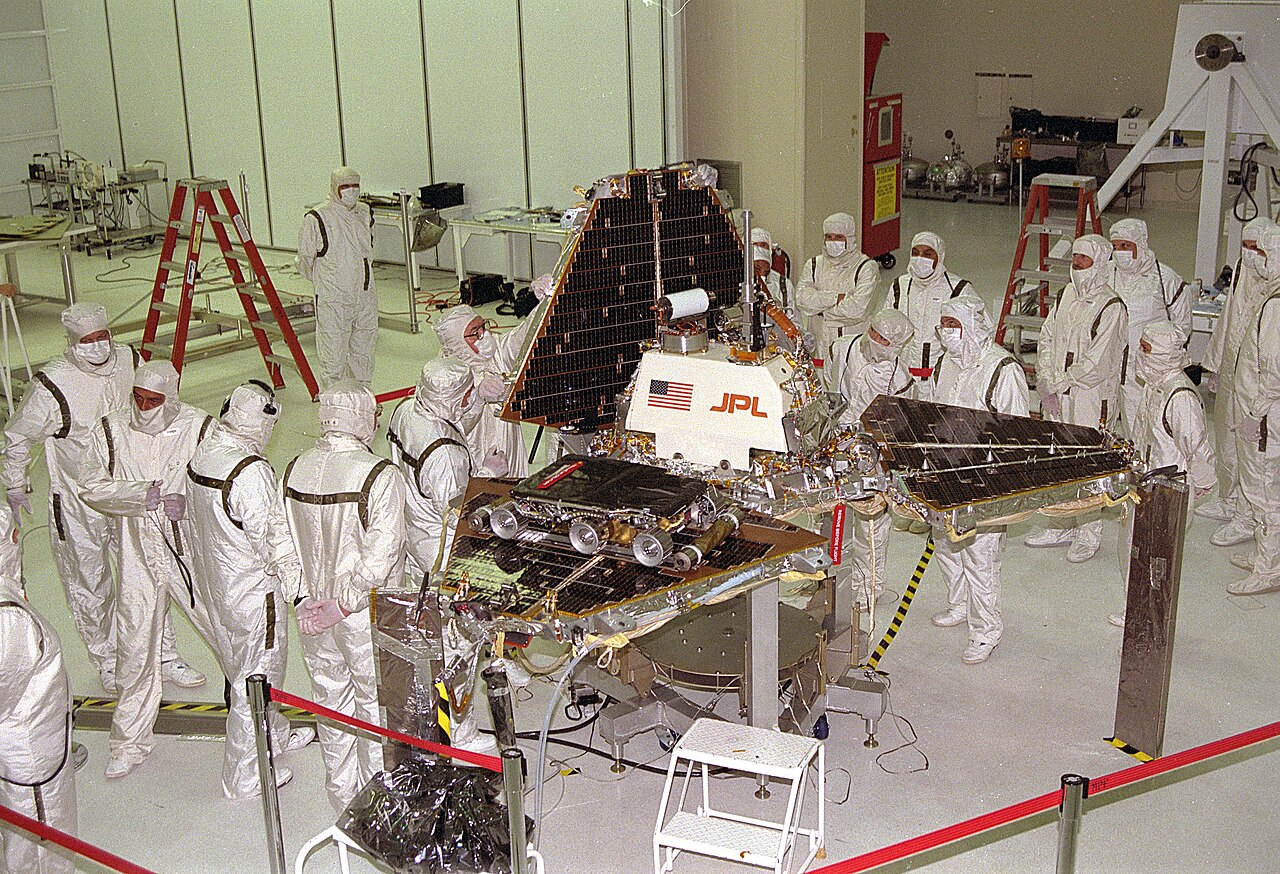
Mars Pathfinder during final assembly showing the aeroshell, cruise ring and solid rocket motor

Mars Pathfinder during final assembly showing the aeroshell, cruise ring and solid rocket motor

Sojourner rover on Mars on sol 22

Sojourner rover on Mars on sol 22

Photos of Mars Pathfinder
Wheel size comparison: Sojourner, Mars Exploration Rover, Mars Science Laboratory

Wheel size comparison: Sojourner, Mars Exploration Rover, Mars Science Laboratory

Mars Pathfinder IMP camera closeup

Mars Pathfinder IMP camera closeup

Diagram of Mars Pathfinder IMP camera

Diagram of Mars Pathfinder IMP camera

Mars Pathfinder lander scheme. ASI/MET pole is visible extending towards the top.

Mars Pathfinder lander scheme. ASI/MET pole is visible extending towards the top.

This is a more recent "geometrically improved, color enhanced" version of the 360-degree "Gallery Pan", the first contiguous, uniform panorama taken by the Imager for Mars (IMP) over the course of Sols 8, 9, and 10. Different regions were imaged at different times over the three Martian days to acquire consistent lighting and shadow conditions for all areas of the panorama. In this version of the panorama, much of the discontinuity that was due to parallax has been corrected, particularly along the lower tiers of the mosaic containing the Lander features. Distortion due to a 2.5 degree tilt in the IMP camera mast has been removed. The IMP is a stereo imaging system that, in its fully deployed configuration, stands 1.8 meters above the Martian surface, and has a resolution of two millimeters at a range of two meters. The IMP has color capability provided by 24 selectable filters -- twelve filters per "eye". Its red, green, and blue filters were used to take this panorama. The three color images were first digitally balanced according to the transmittance capabilities of a specific high-definition TV device at JPL, and then enhanced via changes to saturation and intensity while retaining the hue. A threshold was applied to avoid changes to the sky. An MTF filter was applied to sharpen feature edges. At left is a Lander petal and a metallic mast which is a portion of the low-gain antenna. On the horizon the double "Twin Peaks" are visible, about 1-2 kilometers away. The rock "Couch" is the dark, curved rock at right of Twin Peaks. Another Lander petal is at left-center, showing the fully deployed forward ramp at far left, and rear ramp at right, which rover Sojourner used to descend to the surface of Mars on July 5. Immediately to the left of the rear ramp is the rock "Barnacle Bill", which scientists found be andesitic, possibly indicating that it is a volcanic rock (a true andesite) or a physical mixture of particles. Just beyond Barnacle Bill, rover tracks lead to Sojourner, shown using its Alpha Proton X-Ray Spectrometer (APXS) instrument to study the large rock "Yogi". Yogi, low in quartz content, appears to be more primitive than Barnacle Bill, and appears more like the common basalts found on Earth. The tracks and circular pattern in the soil leading up to Yogi were part of Sojourner's soil mechanics experiments, in which varying amounts of pressure were applied to the wheels in order to determine physical properties of the soil. During its traverse to Yogi the rover stirred the soil and exposed material from several centimeters in depth. During one of the turns to deploy Sojourner's Alpha Proton X-Ray Spectrometer, the wheels dug particularly deeply and exposed white material. Spectra of this white material show it is virtually identical to the rock "Scooby Doo", and such white material may underlie much of the site. Deflated airbags are visible at the perimeter of all three Lander petals. Mars Pathfinder is the second in NASA's Discovery program of low-cost spacecraft with highly focused science goals. The Jet Propulsion Laboratory, Pasadena, CA, developed and manages the Mars Pathfinder mission for NASA's Office of Space Science, Washington, D.C. JPL is an operating division of the California Institute of Technology (Caltech). The IMP was developed by the University of Arizona Lunar and Planetary Laboratory under contract to JPL. Peter Smith is the Principal Investigator.

This is a more recent "geometrically improved, color enhanced" version of the 360-degree "Gallery Pan", the first contiguous, uniform panorama taken by the Imager for Mars (IMP) over the course of Sols 8, 9, and 10. Different regions were imaged at different times over the three Martian days to acquire consistent lighting and shadow conditions for all areas of the panorama. In this version of the panorama, much of the discontinuity that was due to parallax has been corrected, particularly along the lower tiers of the mosaic containing the Lander features. Distortion due to a 2.5 degree tilt in the IMP camera mast has been removed. The IMP is a stereo imaging system that, in its fully deployed configuration, stands 1.8 meters above the Martian surface, and has a resolution of two millimeters at a range of two meters. The IMP has color capability provided by 24 selectable filters -- twelve filters per "eye". Its red, green, and blue filters were used to take this panorama. The three color images were first digitally balanced according to the transmittance capabilities of a specific high-definition TV device at JPL, and then enhanced via changes to saturation and intensity while retaining the hue. A threshold was applied to avoid changes to the sky. An MTF filter was applied to sharpen feature edges. At left is a Lander petal and a metallic mast which is a portion of the low-gain antenna. On the horizon the double "Twin Peaks" are visible, about 1-2 kilometers away. The rock "Couch" is the dark, curved rock at right of Twin Peaks. Another Lander petal is at left-center, showing the fully deployed forward ramp at far left, and rear ramp at right, which rover Sojourner used to descend to the surface of Mars on July 5. Immediately to the left of the rear ramp is the rock "Barnacle Bill", which scientists found be andesitic, possibly indicating that it is a volcanic rock (a true andesite) or a physical mixture of particles. Just beyond Barnacle Bill, rover tracks lead to Sojourner, shown using its Alpha Proton X-Ray Spectrometer (APXS) instrument to study the large rock "Yogi". Yogi, low in quartz content, appears to be more primitive than Barnacle Bill, and appears more like the common basalts found on Earth. The tracks and circular pattern in the soil leading up to Yogi were part of Sojourner's soil mechanics experiments, in which varying amounts of pressure were applied to the wheels in order to determine physical properties of the soil. During its traverse to Yogi the rover stirred the soil and exposed material from several centimeters in depth. During one of the turns to deploy Sojourner's Alpha Proton X-Ray Spectrometer, the wheels dug particularly deeply and exposed white material. Spectra of this white material show it is virtually identical to the rock "Scooby Doo", and such white material may underlie much of the site. Deflated airbags are visible at the perimeter of all three Lander petals. Mars Pathfinder is the second in NASA's Discovery program of low-cost spacecraft with highly focused science goals. The Jet Propulsion Laboratory, Pasadena, CA, developed and manages the Mars Pathfinder mission for NASA's Office of Space Science, Washington, D.C. JPL is an operating division of the California Institute of Technology (Caltech). The IMP was developed by the University of Arizona Lunar and Planetary Laboratory under contract to JPL. Peter Smith is the Principal Investigator.

Landing sequence

Landing sequence

Mars Pathfinder during final assembly showing the aeroshell, cruise ring and solid rocket motor

Mars Pathfinder during final assembly showing the aeroshell, cruise ring and solid rocket motor

Sojourner rover on Mars on sol 22

Sojourner rover on Mars on sol 22

Photos of Mars Pathfinder
Wheel size comparison: Sojourner, Mars Exploration Rover, Mars Science Laboratory

Wheel size comparison: Sojourner, Mars Exploration Rover, Mars Science Laboratory

Mars Pathfinder IMP camera closeup

Mars Pathfinder IMP camera closeup

Diagram of Mars Pathfinder IMP camera

Diagram of Mars Pathfinder IMP camera

Mars Pathfinder lander scheme. ASI/MET pole is visible extending towards the top.

Mars Pathfinder lander scheme. ASI/MET pole is visible extending towards the top.

This is a more recent "geometrically improved, color enhanced" version of the 360-degree "Gallery Pan", the first contiguous, uniform panorama taken by the Imager for Mars (IMP) over the course of Sols 8, 9, and 10. Different regions were imaged at different times over the three Martian days to acquire consistent lighting and shadow conditions for all areas of the panorama. In this version of the panorama, much of the discontinuity that was due to parallax has been corrected, particularly along the lower tiers of the mosaic containing the Lander features. Distortion due to a 2.5 degree tilt in the IMP camera mast has been removed. The IMP is a stereo imaging system that, in its fully deployed configuration, stands 1.8 meters above the Martian surface, and has a resolution of two millimeters at a range of two meters. The IMP has color capability provided by 24 selectable filters -- twelve filters per "eye". Its red, green, and blue filters were used to take this panorama. The three color images were first digitally balanced according to the transmittance capabilities of a specific high-definition TV device at JPL, and then enhanced via changes to saturation and intensity while retaining the hue. A threshold was applied to avoid changes to the sky. An MTF filter was applied to sharpen feature edges. At left is a Lander petal and a metallic mast which is a portion of the low-gain antenna. On the horizon the double "Twin Peaks" are visible, about 1-2 kilometers away. The rock "Couch" is the dark, curved rock at right of Twin Peaks. Another Lander petal is at left-center, showing the fully deployed forward ramp at far left, and rear ramp at right, which rover Sojourner used to descend to the surface of Mars on July 5. Immediately to the left of the rear ramp is the rock "Barnacle Bill", which scientists found be andesitic, possibly indicating that it is a volcanic rock (a true andesite) or a physical mixture of particles. Just beyond Barnacle Bill, rover tracks lead to Sojourner, shown using its Alpha Proton X-Ray Spectrometer (APXS) instrument to study the large rock "Yogi". Yogi, low in quartz content, appears to be more primitive than Barnacle Bill, and appears more like the common basalts found on Earth. The tracks and circular pattern in the soil leading up to Yogi were part of Sojourner's soil mechanics experiments, in which varying amounts of pressure were applied to the wheels in order to determine physical properties of the soil. During its traverse to Yogi the rover stirred the soil and exposed material from several centimeters in depth. During one of the turns to deploy Sojourner's Alpha Proton X-Ray Spectrometer, the wheels dug particularly deeply and exposed white material. Spectra of this white material show it is virtually identical to the rock "Scooby Doo", and such white material may underlie much of the site. Deflated airbags are visible at the perimeter of all three Lander petals. Mars Pathfinder is the second in NASA's Discovery program of low-cost spacecraft with highly focused science goals. The Jet Propulsion Laboratory, Pasadena, CA, developed and manages the Mars Pathfinder mission for NASA's Office of Space Science, Washington, D.C. JPL is an operating division of the California Institute of Technology (Caltech). The IMP was developed by the University of Arizona Lunar and Planetary Laboratory under contract to JPL. Peter Smith is the Principal Investigator.

This is a more recent "geometrically improved, color enhanced" version of the 360-degree "Gallery Pan", the first contiguous, uniform panorama taken by the Imager for Mars (IMP) over the course of Sols 8, 9, and 10. Different regions were imaged at different times over the three Martian days to acquire consistent lighting and shadow conditions for all areas of the panorama. In this version of the panorama, much of the discontinuity that was due to parallax has been corrected, particularly along the lower tiers of the mosaic containing the Lander features. Distortion due to a 2.5 degree tilt in the IMP camera mast has been removed. The IMP is a stereo imaging system that, in its fully deployed configuration, stands 1.8 meters above the Martian surface, and has a resolution of two millimeters at a range of two meters. The IMP has color capability provided by 24 selectable filters -- twelve filters per "eye". Its red, green, and blue filters were used to take this panorama. The three color images were first digitally balanced according to the transmittance capabilities of a specific high-definition TV device at JPL, and then enhanced via changes to saturation and intensity while retaining the hue. A threshold was applied to avoid changes to the sky. An MTF filter was applied to sharpen feature edges. At left is a Lander petal and a metallic mast which is a portion of the low-gain antenna. On the horizon the double "Twin Peaks" are visible, about 1-2 kilometers away. The rock "Couch" is the dark, curved rock at right of Twin Peaks. Another Lander petal is at left-center, showing the fully deployed forward ramp at far left, and rear ramp at right, which rover Sojourner used to descend to the surface of Mars on July 5. Immediately to the left of the rear ramp is the rock "Barnacle Bill", which scientists found be andesitic, possibly indicating that it is a volcanic rock (a true andesite) or a physical mixture of particles. Just beyond Barnacle Bill, rover tracks lead to Sojourner, shown using its Alpha Proton X-Ray Spectrometer (APXS) instrument to study the large rock "Yogi". Yogi, low in quartz content, appears to be more primitive than Barnacle Bill, and appears more like the common basalts found on Earth. The tracks and circular pattern in the soil leading up to Yogi were part of Sojourner's soil mechanics experiments, in which varying amounts of pressure were applied to the wheels in order to determine physical properties of the soil. During its traverse to Yogi the rover stirred the soil and exposed material from several centimeters in depth. During one of the turns to deploy Sojourner's Alpha Proton X-Ray Spectrometer, the wheels dug particularly deeply and exposed white material. Spectra of this white material show it is virtually identical to the rock "Scooby Doo", and such white material may underlie much of the site. Deflated airbags are visible at the perimeter of all three Lander petals. Mars Pathfinder is the second in NASA's Discovery program of low-cost spacecraft with highly focused science goals. The Jet Propulsion Laboratory, Pasadena, CA, developed and manages the Mars Pathfinder mission for NASA's Office of Space Science, Washington, D.C. JPL is an operating division of the California Institute of Technology (Caltech). The IMP was developed by the University of Arizona Lunar and Planetary Laboratory under contract to JPL. Peter Smith is the Principal Investigator.

Landing sequence

Landing sequence

Mars Pathfinder during final assembly showing the aeroshell, cruise ring and solid rocket motor

Mars Pathfinder during final assembly showing the aeroshell, cruise ring and solid rocket motor

Photos of Mars Pathfinder
Sojourner rover on Mars on sol 22

Sojourner rover on Mars on sol 22

Wheel size comparison: Sojourner, Mars Exploration Rover, Mars Science Laboratory

Wheel size comparison: Sojourner, Mars Exploration Rover, Mars Science Laboratory

Mars Pathfinder IMP camera closeup

Mars Pathfinder IMP camera closeup

Diagram of Mars Pathfinder IMP camera

Diagram of Mars Pathfinder IMP camera

Mars Pathfinder lander scheme. ASI/MET pole is visible extending towards the top.

Mars Pathfinder lander scheme. ASI/MET pole is visible extending towards the top.

This is a more recent "geometrically improved, color enhanced" version of the 360-degree "Gallery Pan", the first contiguous, uniform panorama taken by the Imager for Mars (IMP) over the course of Sols 8, 9, and 10. Different regions were imaged at different times over the three Martian days to acquire consistent lighting and shadow conditions for all areas of the panorama. In this version of the panorama, much of the discontinuity that was due to parallax has been corrected, particularly along the lower tiers of the mosaic containing the Lander features. Distortion due to a 2.5 degree tilt in the IMP camera mast has been removed. The IMP is a stereo imaging system that, in its fully deployed configuration, stands 1.8 meters above the Martian surface, and has a resolution of two millimeters at a range of two meters. The IMP has color capability provided by 24 selectable filters -- twelve filters per "eye". Its red, green, and blue filters were used to take this panorama. The three color images were first digitally balanced according to the transmittance capabilities of a specific high-definition TV device at JPL, and then enhanced via changes to saturation and intensity while retaining the hue. A threshold was applied to avoid changes to the sky. An MTF filter was applied to sharpen feature edges. At left is a Lander petal and a metallic mast which is a portion of the low-gain antenna. On the horizon the double "Twin Peaks" are visible, about 1-2 kilometers away. The rock "Couch" is the dark, curved rock at right of Twin Peaks. Another Lander petal is at left-center, showing the fully deployed forward ramp at far left, and rear ramp at right, which rover Sojourner used to descend to the surface of Mars on July 5. Immediately to the left of the rear ramp is the rock "Barnacle Bill", which scientists found be andesitic, possibly indicating that it is a volcanic rock (a true andesite) or a physical mixture of particles. Just beyond Barnacle Bill, rover tracks lead to Sojourner, shown using its Alpha Proton X-Ray Spectrometer (APXS) instrument to study the large rock "Yogi". Yogi, low in quartz content, appears to be more primitive than Barnacle Bill, and appears more like the common basalts found on Earth. The tracks and circular pattern in the soil leading up to Yogi were part of Sojourner's soil mechanics experiments, in which varying amounts of pressure were applied to the wheels in order to determine physical properties of the soil. During its traverse to Yogi the rover stirred the soil and exposed material from several centimeters in depth. During one of the turns to deploy Sojourner's Alpha Proton X-Ray Spectrometer, the wheels dug particularly deeply and exposed white material. Spectra of this white material show it is virtually identical to the rock "Scooby Doo", and such white material may underlie much of the site. Deflated airbags are visible at the perimeter of all three Lander petals. Mars Pathfinder is the second in NASA's Discovery program of low-cost spacecraft with highly focused science goals. The Jet Propulsion Laboratory, Pasadena, CA, developed and manages the Mars Pathfinder mission for NASA's Office of Space Science, Washington, D.C. JPL is an operating division of the California Institute of Technology (Caltech). The IMP was developed by the University of Arizona Lunar and Planetary Laboratory under contract to JPL. Peter Smith is the Principal Investigator.

This is a more recent "geometrically improved, color enhanced" version of the 360-degree "Gallery Pan", the first contiguous, uniform panorama taken by the Imager for Mars (IMP) over the course of Sols 8, 9, and 10. Different regions were imaged at different times over the three Martian days to acquire consistent lighting and shadow conditions for all areas of the panorama. In this version of the panorama, much of the discontinuity that was due to parallax has been corrected, particularly along the lower tiers of the mosaic containing the Lander features. Distortion due to a 2.5 degree tilt in the IMP camera mast has been removed. The IMP is a stereo imaging system that, in its fully deployed configuration, stands 1.8 meters above the Martian surface, and has a resolution of two millimeters at a range of two meters. The IMP has color capability provided by 24 selectable filters -- twelve filters per "eye". Its red, green, and blue filters were used to take this panorama. The three color images were first digitally balanced according to the transmittance capabilities of a specific high-definition TV device at JPL, and then enhanced via changes to saturation and intensity while retaining the hue. A threshold was applied to avoid changes to the sky. An MTF filter was applied to sharpen feature edges. At left is a Lander petal and a metallic mast which is a portion of the low-gain antenna. On the horizon the double "Twin Peaks" are visible, about 1-2 kilometers away. The rock "Couch" is the dark, curved rock at right of Twin Peaks. Another Lander petal is at left-center, showing the fully deployed forward ramp at far left, and rear ramp at right, which rover Sojourner used to descend to the surface of Mars on July 5. Immediately to the left of the rear ramp is the rock "Barnacle Bill", which scientists found be andesitic, possibly indicating that it is a volcanic rock (a true andesite) or a physical mixture of particles. Just beyond Barnacle Bill, rover tracks lead to Sojourner, shown using its Alpha Proton X-Ray Spectrometer (APXS) instrument to study the large rock "Yogi". Yogi, low in quartz content, appears to be more primitive than Barnacle Bill, and appears more like the common basalts found on Earth. The tracks and circular pattern in the soil leading up to Yogi were part of Sojourner's soil mechanics experiments, in which varying amounts of pressure were applied to the wheels in order to determine physical properties of the soil. During its traverse to Yogi the rover stirred the soil and exposed material from several centimeters in depth. During one of the turns to deploy Sojourner's Alpha Proton X-Ray Spectrometer, the wheels dug particularly deeply and exposed white material. Spectra of this white material show it is virtually identical to the rock "Scooby Doo", and such white material may underlie much of the site. Deflated airbags are visible at the perimeter of all three Lander petals. Mars Pathfinder is the second in NASA's Discovery program of low-cost spacecraft with highly focused science goals. The Jet Propulsion Laboratory, Pasadena, CA, developed and manages the Mars Pathfinder mission for NASA's Office of Space Science, Washington, D.C. JPL is an operating division of the California Institute of Technology (Caltech). The IMP was developed by the University of Arizona Lunar and Planetary Laboratory under contract to JPL. Peter Smith is the Principal Investigator.

Landing sequence

Landing sequence

Mars Pathfinder during final assembly showing the aeroshell, cruise ring and solid rocket motor

Mars Pathfinder during final assembly showing the aeroshell, cruise ring and solid rocket motor

Launch And Journey

Mars Pathfinder was launched from Cape Canaveral in Florida on December 4, 1996. ๐Ÿ—บ๏ธ The spacecraft traveled through space for about six and a half months before landing on Mars. It took a parachute to slow down and then fired rockets to land gently. The entire journey was filled with excitement! It covered a distance of 466 million kilometers (290 million miles) to get to Mars. When it finally touched down, scientists celebrated it like a big holiday! ๐ŸŽ‰

Mission Objectives

The main goal of Mars Pathfinder was to explore the surface of Mars and study its rocks and soil. ๐Ÿ”Scientists wanted to learn about the planetโ€™s history and whether it ever had water! Water is important because it might mean that life could exist there. Mars Pathfinder also aimed to test new technology for future missions. By sending images and data back to Earth, it helped scientists understand how to better explore Mars in the future.

Rover Capabilities

Sojourner, the rover, was about the size of a microwave! ๐Ÿ“It could move around, take pictures, and analyze rocks. Sojourner had special tools like a camera, an alpha proton x-ray spectrometer, and even a weather sensor to learn about the Martian atmosphere. ๐ŸŒค๏ธ Sojourner could travel about 100 meters (328 feet) from the lander, sending back cool images and information. The rover helped scientists see Mars up close, giving them a better understanding of its surface and geology.

Scientific Discoveries

Mars Pathfinder made amazing discoveries! ๐ŸŒŒThe rover Sojourner studied rocks that looked like they had been shaped by water long ago. Scientists found signs of minerals that typically form in watery environments. This was exciting because it supported the idea that Mars might have once had water! The mission sent back more than 16,000 images and collected data about dust, temperature, and weather patterns. Every detail helped scientists piece together the history of the planet.

Technological Innovations

Mars Pathfinder used new technology that was very clever! ๐Ÿ’กIt had a lander and a rover that communicated with each other and sent information back to Earth. Innovative software helped the rover to travel on its own, making decisions about where to go based on its surroundings. The mission also tested airbag landing techniques to protect the vehicle during touchdown. This technology laid the foundation for future missions and made exploring Mars safer and more efficient!

Legacy And Future Missions

Mars Pathfinder was important because it opened the door for future explorations of Mars! ๐ŸšชScientists learned a lot from this mission, and it made way for even bigger missions like Mars Exploration Rover (Spirit and Opportunity) and Curiosity. These missions built on Pathfinder's successes, allowing us to learn more about whether life could exist on Mars. Research continues today, and new missions like Mars 2020 and the Perseverance rover are eager to discover even more secrets of the red planet! ๐ŸŒ

Landing Site And Conditions

Mars Pathfinder landed in Ares Vallis, a rocky area that looked like a giant riverbed. ๐ŸšงMars is very cold, with temperatures often below -80 degrees Fahrenheit (-62 degrees Celsius)! The planet has dust storms that can last for months, and it doesn't have any water on the surface like Earth. But, Pathfindder explored the terrain, discovering gravel and rocks that had been shaped by ancient water flow. The sky looks red or orange, and the ground is rocky, making it different from Earth!

Public Engagement And Media

Mars Pathfinder captured the hearts of many people! ๐ŸŽˆIt was a big event, and schools and families watched the landing live on TV. NASA created fun websites and educational materials, allowing kids to learn more. Many students even sent messages and questions about Mars! โœ‰๏ธ The media shared amazing pictures of the Martian surface, sparking interest in space exploration. Children everywhere were excited about becoming scientists and explorers, inspired by the journey to Mars!

Did you know?

๐Ÿš€ Mars Pathfinder was launched on December 4, 1996.

๐Ÿช It successfully landed on Mars on July 4, 1997.

๐Ÿ” The mission included a lander named Sojourner that was the first successful robotic rover on Mars.

๐Ÿ“ก Mars Pathfinder transmitted over 2.3 billion bits of data back to Earth.

๐Ÿ› ๏ธ It demonstrated new technologies for future Mars missions, including roving capabilities.

๐ŸŒŒ The mission lasted 83 days, far exceeding its planned lifespan of 7 days.

๐ŸŒ Mars Pathfinder was part of NASA's Mars exploration program in the 1990s.

๐Ÿ“ท The lander captured over 550 images of the Martian surface.

โš™๏ธ Sojourner was about the size of a microwave oven and weighed just 11.5 kilograms.

๐ŸŒž The mission contributed significantly to our understanding of Martian geology and climate.

Mars Pathfinder Quiz

Q1
Question 1 of 10

Learn more about Mars Pathfinder

Ready to create?

Make

To create a safe space for kid creators worldwide!

Create

Vibe Coding

Kids GPT

All Tools

Kibu

Learn

Worksheets

Courses

Skills

Resources

SafeTube

Blog

FAQ

Pricing

Account

Log-in

Sign-up

Data Deletion

Company

About

Community Guidelines

Privacy Policy

Terms of Service

2025, URSOR LIMITED. All rights reserved. DIY is in no way affiliated with Minecraftโ„ข, Mojang, Microsoft, Robloxโ„ข or YouTube. LEGOยฎ is a trademark of the LEGOยฎ Group which does not sponsor, endorse or authorize this website or event. Made with love in San Francisco.