Luna 9 Facts For Kids
Luna 9 was a Soviet robotic spacecraft that became the first to achieve a soft landing on the Moon and send back images of its surface in February 1966.
Select reading age

Luna 9 Facts For Kids
Videos & Quizzesincluded
About this topic
Luna 9 was a very special spacecraft launched by the Soviet Union 🚀 on January 31, 1966. It was the first spacecraft ever to land softly on the Moon and send back pictures! 🌕It took about 30 minutes for the spacecraft's messages to travel 🌌 over 238,855 miles (384,400 km) back to Earth. That’s like going from New York City to Los Angeles about 40 times! Luna 9 showed us that we could safely land on other celestial bodies, making it an important step for future space missions!
Explore with ChatDinoKey Points
Luna 9 touched down on the Moon in an area called Oceanus Procellarum, also known as the "Ocean of Storms" 🌊.
Luna 9 was able to send back some awesome data!
Even though Luna 9 was a success, the mission faced some challenges.
Luna 9 launched from the Baikonur Cosmodrome in Kazakhstan 🇰🇿 on January 31, 1966.
Luna 9 left a lasting legacy in the world of space exploration.
The main goal of Luna 9 was to land safely on the Moon and take pictures of its surface.
To achieve its mission, Luna 9 was equipped with several scientific instruments.
Luna 9 was a game-changer for space missions!
Photos of Luna 9

Luna 9 — photo 1

Luna 9 lander model

The first photo ever taken from the surface of another celestial body.

Luna 9 — photo 4

Luna 9 — photo 5


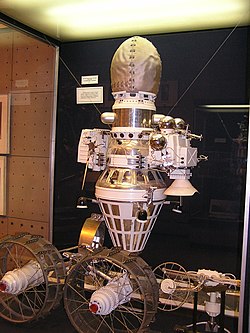
🌊 Lunar Landing
Luna 9 touched down on the Moon in an area called Oceanus Procellarum, also known as the "Ocean of Storms" 🌊. The Moon's surface was covered with fine dust and some rocky areas. 🌑When Luna 9 landed, it sent a signal back to Earth, which made scientists jump for joy! 🎊After landing, it opened its petals like a flower 🌸, revealing its camera to take amazing pictures of the Moon's landscape. With this successful landing, Luna 9 became a star in space history! 🌠
Go deeper📦 Data Collected
Luna 9 was able to send back some awesome data! 📦It transmitted the first-ever pictures of the Moon's surface, which showed craters, rocks, and the fine dust on the ground. Scientists received 12 pictures in total, with incredible details! 🌌The spacecraft also collected information about the Moon's temperature and what materials the surface was made of. This data helped scientists better understand what the Moon is like and prepared them for future missions to explore other planets! 🌟
Go deeper🤔 Challenges Faced
Even though Luna 9 was a success, the mission faced some challenges. 🤔The spacecraft had to go through harsh conditions, like extreme temperatures and radiation in space. Once it landed, it needed to ensure that its systems worked perfectly to send back images. Luna 9 also had to deal with the Moon's strange atmosphere, called a "vacuum," which doesn’t have air. Despite these challenges, it performed beautifully! 🎉It showed how hard work and creativity can solve problems in space! 🌌
Go deeper🌓 Launch And Flight
Luna 9 launched from the Baikonur Cosmodrome in Kazakhstan 🇰🇿 on January 31, 1966. It used a special rocket called the Luna 8K78, which was designed for space missions. After traveling through space for about 4 days, Luna 9 entered the Moon's orbit! 🌓It then had to slow down and carefully descend to the surface. It used special engines to control its speed and landed softly on February 3, 1966, showing the world that a soft landing was possible! 🎉
Go deeper🌠 Legacy And Impact
Luna 9 left a lasting legacy in the world of space exploration. 🌠Its successful landing inspired more missions to the Moon and beyond! Since then, scientists have developed new technology that builds on Luna 9’s achievements. Lunar landers and rovers have been sent to the Moon to learn even more. 🌕Luna 9 reminds us of the excitement of exploring space and encourages young explorers to dream big and reach for the stars! 🌟Who knows what we might discover next?
Go deeper📸 Mission Objectives
The main goal of Luna 9 was to land safely on the Moon and take pictures of its surface. 📸The mission wanted to learn about the Moon’s landscape 🌑 and gather data about its environment. The scientists also wanted to understand how the Moon’s surface was made up and see whether it was a rocky or dusty place! By doing this, Luna 9 aimed to help us better understand our closest neighbor in space. 🌌It was a big step in planning future missions, like sending people to the Moon! 🌙
Go deeper🎛️ Scientific Instruments
To achieve its mission, Luna 9 was equipped with several scientific instruments. 🎛️ It had a camera that could take pictures of the Moon's surface. The camera was special because it sent images back in radio waves! 📡Luna 9 also had tools to measure temperature and check the amount of sunlight 🌞 hitting the Moon. This data helped scientists learn more about the Moon’s environment and surface conditions. These amazing instruments paved the way for more complex missions and explorations! 🌌
Go deeper🌍 Significance In Space Exploration
Luna 9 was a game-changer for space missions! 🌍It proved that soft landings on the Moon were possible and that spacecraft could send important information back to Earth. After Luna 9, many other missions followed to explore the Moon and eventually led to humans landing on the Moon with Apollo 11 in 1969! 🚀🌕 Luna 9’s success inspired a new age of space exploration, encouraging even bolder missions to different planets and moons in our solar system!
Go deeper