Liquid crystals are unique materials that possess properties of both liquids and solids, commonly used in various display technologies due to their ability to manipulate light.
Set reading age
View for Kids
Easy to read and understand
View for Students
Clear, detailed explanations
View for Scholars
Deep dives and big ideas
Liquid crystals are fascinating materials that have properties of both liquids and solids! They can flow like liquids but also have organized structures like crystals. 🤩You can find liquid crystals in many everyday items, like smartphones and TVs! They respond to temperature and light, making them super cool for technology. Scientists study liquid crystals to understand how they work and create new gadgets. You might even find them in some toys! Liquid crystals are not just one thing, but many types exist, each with unique properties. Let’s dive deeper into this amazing world! 🌈
Liquid crystals are special because they can change their shape when exposed to electricity or temperature changes! ⚡When an electrical current is applied, the molecules of liquid crystals realign themselves to control light passing through. This property allows screens to show different colors and images! 📷For example, in an LCD screen, millions of tiny liquid crystal cells open and close to create vibrant pictures. ✨When heated, some types of liquid crystals change from one type to another, like from nematic to smectic! This ability to control light and change states makes them super useful in technology!
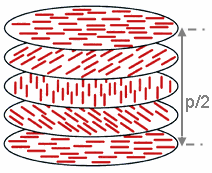
There are several types of liquid crystals, and each behaves in its own special way! The main types are nematic, smectic, and cholesteric. 🤔Nematic liquid crystals have molecules that are lined up in the same direction but can flow freely, like an organized line of ants. 🐜Smectic liquid crystals have layers, where the molecules can slide on top of each other, like a stack of pancakes! 🥞Cholesteric liquid crystals have a twisty structure, which helps create colorful effects. 🌈Each type is useful for different tech applications, and scientists keep discovering new types every day!
The story of liquid crystals began in 1888 when a scientist named Friedrich Reinitzer discovered them while studying a plant chemical called cholesteryl benzoate. 🍃He noticed that it could act like liquid and solid forms at different temperatures. Later, in the 1920s, other scientists, like Otto Lehmann, explored these materials further. They called them "liquid crystals" because they had crystal-like structure while flowing like liquids! 💧Over the years, more discoveries have been made, leading to advances in technology. By the 1970s and 1980s, liquid crystals became very popular in making screens, changing how we use technology forever! 📺
Liquid crystals have some amazing properties that make them special! 🤩They can change shape and color depending on temperature and the amount of light they receive. One cool property is called "birefringence," which means they can bend light differently based on their structure. 🌈This creates beautiful colors when light passes through! Liquid crystals also have the ability to respond to magnetic and electric fields. This means they can be controlled! ⚙️ Their combination of fluidity and order makes them perfect for technology. Scientists continue researching these properties to invent even more incredible gadgets! 🛠️
Liquid Crystal Displays, or LCDs, are everywhere! 🖥️ They are used in TV screens, computers, tablets, and even calculators! LCDs work by using liquid crystals between two glass panels. When electricity passes through, the crystals change position to block or let light through. 🌟This creates the images we see on screens! Incredible, right? LCD technology consumes less energy than older screen types, making devices last longer on a single battery charge. 📅They also produce sharp images and vibrant colors! With so many uses, liquid crystals have changed how we see and interact with the world! 🌍
Liquid crystals aren't just cool to learn about; they're used in many everyday devices! 🤖One of the most popular uses is in Liquid Crystal Displays (LCDs), found in TVs, computers, and smartphones. 📱They help create bright pictures and videos by controlling light. Liquid crystals also help in watches, where they show the time digitally! ⌚Additionally, scientists use liquid crystals in medicine, to create sensors that can detect changes in temperature or pH levels. Medical teams can use these sensors to monitor patients more effectively. Liquid crystals are also in some toys, like color-changing slime! 🎨
Did you know that liquid crystals can be found in some living organisms? 🦋Butterflies and peacocks use liquid crystal structures to create beautiful colors in their wings! They can even change colors depending on the angle. 🌈Liquid crystals also play a role in some toys, like color-changing stress balls! When the temperature changes, the colors transform! So cool! 😄Scientists even use liquid crystals in research for studying diseases, helping them discover new medicines! Plus, liquid crystal technology is used in 90% of smartphones! 📱How amazing is that? Liquid crystals truly make our world more colorful and fun! 🎉
The future of liquid crystals is bright and exciting! 🌟Scientists and engineers are working on new applications for these materials. For example, researchers are developing flexible displays using liquid crystals, so screens could bend and fold! 🤸♂️ New types of liquid crystals may also allow for faster computing and better energy efficiency. 🌱They might even help in smart fabrics that change colors or patterns! Imagine wearing a shirt that displays your favorite video game! 🎮Innovations in liquid crystal technology will open doors to even more surprising inventions in the coming years! Get ready for a fun future! 🚀