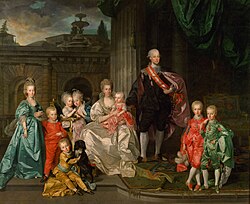
Leopold II was the penultimate Holy Roman Emperor and a significant figure in European history, known for promoting peace and the welfare of his diverse subjects during his short reign from 1790 until 1792.

Set reading age
View for Kids
Easy to read and understand
View for Students
Clear, detailed explanations
View for Scholars
Deep dives and big ideas
Leopold II was a very important person in history! 👑He lived a long time ago, from 1747 to 1792, and was the Holy Roman Emperor, which means he ruled over many countries in Europe. His job included being King of Hungary, Croatia, and Bohemia, as well as Archduke of Austria. He was also the Grand Duke of Tuscany! 🌍Leopold II's reign lasted from 1790 to 1792. People remember him for his attempts to reform his territories and improve the lives of his subjects. He was a thoughtful ruler who wanted to make changes that helped everyone!
Leopold II died on March 1, 1792, in Vienna, Austria. 😢His unexpected death shocked many people! After he passed away, his eldest son, Francis II, became the next Holy Roman Emperor. 🏰Francis II continued his father's work but faced many challenges of his own, including the growing influence of France. Leopold's short reign left a mark on history, and his policies and ideas influenced the future. People looked back and remembered him as a caring and thoughtful ruler! His legacy lasted even beyond his life! 📖
Leopold II was born on May 5, 1747, in Vienna, Austria. 🎉He came from the Habsburg family, a powerful royal house in Europe. As a young boy, he received an excellent education! 📚He studied many subjects like history, geography, and languages. By the time he was a teenager, he could speak German, Italian, and French! His parents wanted him to be a wise ruler one day. Leopold spent a lot of time learning about government and diplomacy, which helped prepare him for his future as an emperor. He was curious, smart, and kind-hearted! 🌟
Leopold II became the Holy Roman Emperor in 1790 after the death of his brother, Joseph II. 👑He ruled for just two years but made many changes in that short time. He cared about his people and wanted to make their lives better. Leopold focused on reforming laws, improving trade, and expanding education. 📖He believed everyone should have rights and worked hard to support the common folk. Sadly, he passed away in 1792 before he could finish all his plans, but people remembered him for his efforts to improve the empire! 🇦🇹
Leopold II's legacy is one of kindness and reform. 🌟Even though he ruled for a short time, he made a positive impact on his empire. People remember him for trying to improve social conditions and support education. His efforts inspired future leaders to consider changing outdated laws and promoting citizen's rights. In the long term, his reforms helped pave the way for a more modern society! People admire his intentions, and history remembers him as a ruler who cared for his people's well-being. 📜
Leopold II came from the Habsburg family, known for their many marriages to strengthen political ties. 💑He married Maria Luisa of Spain in 1765. Together, they had several children, which helped create alliances with other ruling families! Their offspring would go on to take important roles in European history. Family connections were essential for maintaining power and influence across nations. Leopold’s family ties continued to play a role in shaping politics even after his reign. When rulers worked together, it often led to peace and stability! 🕊️
Leopold II's reign was marked by military conflicts. ⚔️ He wanted to keep his empire safe and strong. After the French Revolution, neighboring countries feared revolutionary ideas spreading, so Leopold joined forces with other monarchs to fight against France. This led to struggles known as the War of the First Coalition (1792-1797). Although many battles were fought, the outcome was unclear. Leopold sought peace but faced many challenges! His military strategies aimed to maintain stability, but it was a difficult task. Leo's decisions shaped European politics during his time! 🌍
Historians study Leopold II's life and reign to understand better the events of his time. 📚Different interpretations exist about his policies and their effects! Some historians think he was too cautious in dealing with revolutionary ideas, while others believe he worked hard for necessary reforms. They look at official records, letters, and personal accounts to gather information. 🎓Discussions about his impact continue today, helping us learn how leaders affect societies and the lessons that can be drawn from history. Leopold II remains an interesting figure in European history! ✨
During Leopold II's reign, he faced many challenges. 🛑One big issue was dealing with the aftermath of the French Revolution. People in France were rebelling against their king, and Leopold worried it might spread to his country! He created policies to keep peace in his lands and protect his subjects. 🕊️ He listened to the ideas of his advisors and wanted to create a fair government. Leopold also tried to balance power among different groups in the empire. Even when things got tough, he remained committed to making positive changes! 🌈
Leopold II was influenced by the Enlightenment, a time when people began to think differently about government and society. 💡Enlightenment thinkers believed in ideas like liberty, equality, and justice. Leopold admired these ideas! He aimed to modernize his empire by implementing reforms that encouraged education and science. 🧪He supported institutions, museums, and libraries to spread knowledge. This made people excited about learning! Though he had traditional values, he believed in bettering society and considered the Enlightenment ideas important for a brighter future! 🌻
Leopold II loved the arts and culture! 🎨He supported artists, musicians, and writers during his time. Leopold's interest in culture led to the growth of theaters, music, and festivals in his empire. He enjoyed music, and his court became a popular gathering place for musicians to perform. 🎶Leopold also encouraged educational reforms, which helped create schools and universities! His love of learning and culture inspired many people, and his contributions were important for the arts. Even today, they remind us of the vibrant culture of his era! 🌈


DIY is a creative community where kids draw, build, explore ideas, and share.
No credit card required